

Recent reports that Qatar has gifted former U.S. President Donald Trump a $500 million luxury aircraft – dubbed the “Palace in the Sky” – ahead of his expected tour of the Gulf states may seem, on the surface, like another glittering spectacle in the theatre of modern diplomacy. But beneath the gleam of gold-plated fittings lies a deeply unsettling question: Is global leadership being sold off to the highest bidder?
This is not simply a matter of opulence. It is a reflection of a dangerous evolution in the nature of power. Once upon a time, global leaders were chosen for their ideas, convictions, and capacity for self-sacrifice. Today, the criteria seem disturbingly transactional: charisma, capital, and convenience.
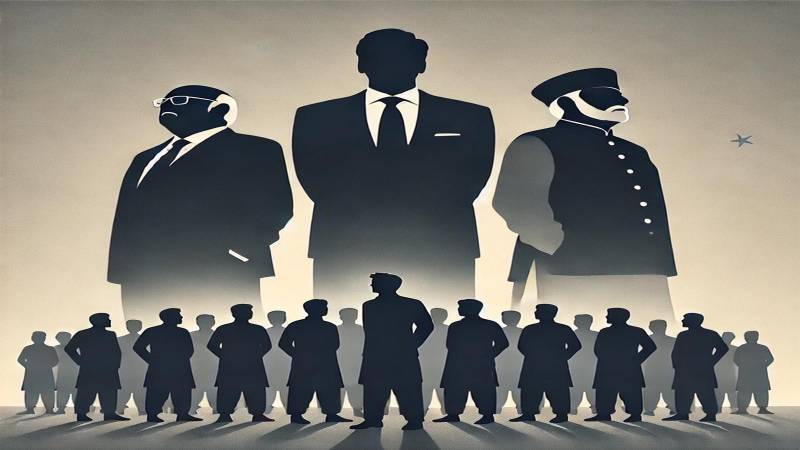
We must ask: where are the giants who once walked the world stage? The Founder of Pakistan Jinnah resisted empires with truth; Nelson Mandela forgave those who imprisoned him; Martin Luther King dreamed of a moral arc bending toward justice. Where are the Abraham Lincolns who chose union over division, the Konrad Adenauer who rebuilt broken nations, or the Muhammad Alis who sacrificed fortune for faith?
In contrast, the leaders of our age increasingly resemble merchants—bartering influence, exchanging favors, and auctioning policy to serve narrow, short-term interests. Multilateralism has given way to transactionalism. The grand vision of collective human progress has been replaced by a marketplace of power, where value is measured not in virtue, but in leverage.
Leadership, if it is to be meaningful, must return to first principles: justice over opportunism, humility over hubris, service over self-interest
Leadership as Amanah (Trust) --In the Islamic tradition, leadership is not a privilege but an amanah – a sacred trust. The Prophet Muhammad (peace be upon him) warned that leadership would be a source of regret on the Day of Judgment unless it was exercised with justice, humility, and a deep sense of accountability. Caliph Umar ibn al-Khattab, whose life epitomised simplicity and justice, once said, “If a dog were to go hungry on the banks of the Euphrates, I would be held accountable for it.”
This is not mere rhetoric—it is a moral compass. It reminds us that leadership is not about acquiring palaces in the sky, but about safeguarding the dignity of those on the ground. It is about ensuring that the weak are protected, the hungry are fed, and justice is upheld—even when inconvenient.
A Crisis of Conscience, Not Just Competence -- Our crisis is not only institutional but moral. The corrosion of principle in political discourse is now matched by the commodification of leadership itself. We are electing brand managers, not visionaries, image building vs institution strengthening. The global public is fed celebrity over substance, soundbites over policy, and spectacle over sincerity.
In the post-World War II era, statesmen like Franklin D. Roosevelt, Winston Churchill, Konrad Adenauers, and Charles de Gaulle guided the world through devastation with a sense of duty and gravitas. While far from perfect, they were defined by the gravity of their times and their efforts to rebuild rather than merely reward.
Contrast that with today’s stage-managed summits and performative diplomacy. Lavish gifts and social media followers cannot substitute for legacy, empathy, and statesmanship.
The Disappearing Moral North -- We live in an age where soft power has been diluted by soft principles, where diplomacy has become an extension of business development, where alliances are made not for peace, but for pipelines and profit margins.
This trend is not only unsustainable; it is dangerous. As we forsake shared institutions and cooperative platforms, the world risks becoming more fragmented, more divided, and more vulnerable to populist manipulation.
Leadership, if it is to be meaningful, must return to first principles: justice over opportunism, humility over hubris, service over self-interest.
A call to reawaken our collective conscience -- Let us not be so dazzled by palaces in the sky that we become blind to the cracks forming in our democracies, our economies, and our souls.
The legacy of our great supreme leaders – Jinnah, Mandela, and Lincoln was not built on palaces, watches, gold, or perks, it was built on service sacrifice and principle. From the prophetic model of governance in Medina to the legacy of world-transforming reformers and revolutionaries, the lesson is clear: Real leadership is not for sale.
It is earned through sacrifice. It is remembered through service. And it is upheld by the moral force of truth. Let us reject leadership that sells our soul for gold – and reclaim leadership that uplifts the nation with truth, humility, and justice.
We must demand more from our leaders—not just incompetence, but in character. We must measure them not by the deals they close, but by the doors they open for others. We must remember that history honours those who give, not those who take.