

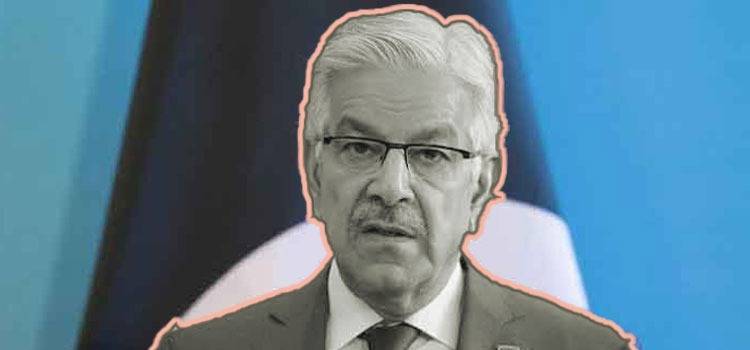
Defence Minister Khawaja Asif is a very happy man. He is happy with the situation Pakistan has been put into in the wake of the four-day war with India. The hybrid system back home is working perfectly; our Chief of Army Staff has been invited to the White House for a luncheon; at the SCO Defence Ministers’ conference, Pakistan’s position has been endorsed while India’s position has been shunted out; Pakistani Armed Forces are being welcomed everywhere in the immediate region as well as in the wider world; and, last but not least, Pakistan’s military-industrial complex is getting contracts from the armed forces of friendly countries. All those things which make a Defence Minister happy are happening in and around Pakistan. Since Khawaja Asif is considered the chief troubleshooter for the ruling party, it is good that the military and civilian leadership see eye to eye on all issues of national importance.
It seems Khawaja Asif’s happiness has had a trickle-down effect. The other day I was stopped by a very dear friend while I was on my daily evening walk in the residential colony I live in. I was passing in front of the colony’s central mosque, and my friend was stepping out after offering his Isha prayers. “Dear, is India really finished?” he asked me. I was totally flabbergasted. I asked him how India was finished. “I mean, nobody is listening to it,” he said. I had no answer, as I was myself deeply confused. Can the jingoism of media and political classes have such a profound impact on public opinion that they could ignore basic facts—facts which are available to anyone using a handset or with access to a television screen?
“India is a big and powerful country, and what they are facing is the cost of their strategic mistake. I think they will soon come out of it,” I heard myself telling my friend. But my thoughts were elsewhere: I thought to myself that Pakistan’s self-claimed military victory in the four-day war will strengthen its dependence on the sole source of national power it has developed over the past seven decades. This will, in turn, reinforce the unvirtuous cycle Pakistani society has been stuck in since its independence.
A virtuous cycle, in Western economic studies, is described as a chain of positive events where each event reinforces the others, leading to continuous improvement or economic growth. Unvirtuous cycles, in the context of Pakistan's political system, are a chain of events and developments which reinforce each other, leading to continuous degradation of national power, as well as causing political, economic and social instability.
The Pakistani foreign policy establishment would be miscalculating its own clout with the Western world if it underestimates the depth of India’s relations with Western liberal democracies
What is an unvirtuous cycle in the Pakistani context? A military victory or any achievement by Pakistan’s military is followed by more allocations for defence in the national budget; enhanced status for the military in policymaking and decision-making processes; government bypassing of other areas of national priority such as economic development or social progress; national security becoming a national obsession; political institutions and norms being relegated to second or third priority. All this makes the military the dominant player in national life, pushing everything else into irrelevance. Political leaders become merely the cheerleaders of military top brass.
Only a socially cohesive society can project strong military power, and only a strong economy can sustain an expanding military budget. Unfortunately, Pakistan has neither. Our society is in the grip of myriad social, political, religious, ethnic and sectarian conflicts. Our economy is in shambles, and we are dependent on foreign donors for our continued financial viability. In such a situation, projection of military power on a sustained and long-term basis is beyond our capacity.
Instead of post-war euphoria and jingoism, we should focus on introspection and attempt to put the events of the four-day war in proper perspective. Irrespective of whether we won or India lost the war, we should realise that had the war lasted for a few more days, it would have devastated us economically. Our media was not reporting it, but the fact is that the two insurgencies in the Northwest and Southwest were getting out of hand. We should not be too happy about India’s isolation—India is paying for its own mistake.
What was India’s mistake? It had two parts: first, it overestimated its diplomatic clout with the Western world on the issue of counter-terrorism. Second, it thought that the demonised Pakistan would not be able to withstand pressure from the Western world. Collectively, what India failed to realise was that the Western world hated an India-Pakistan major conflict more than it hated terrorism—or what India calls terrorism.
The Pakistani foreign policy establishment would be miscalculating its own clout with the Western world if it underestimates the depth of India’s relations with Western liberal democracies. Socially liberal Indian elites present a contrast with the conservative ethos of Pakistani society for most Western diplomats serving in Pakistan and the Muslim world more broadly. During the Cold War, Pakistan was closer to the West and the United States than India. However, Pakistan and the Muslim world’s conservative ethos proved too suffocating for Western diplomats and leaders, both socially and politically.
India’s history as a sustained democracy and its recently acquired socially liberal ethos, especially among its media and political elite, are far more attractive for the West. Indians have invested heavily in diplomacy to secure their position on the right side of Western liberal democracies and the United States. But perhaps they tried to cash in on their efforts too early.
This unvirtuous cycle of Pakistani politics is not only damaging to the country’s economy, politics and social fabric—it is damaging to Pakistan’s strategic and military interests
The Pakistani ruling elite would be making a mistake if it gets carried away in this moment of euphoria. A foreign policy success derived from an act of external validation—like endorsement from the White House or the US President—could prove to be a house of bubbles. Pakistan’s military elite has repeatedly made this mistake in history. Consider General Musharraf’s fate: he was befriended by former US President George W. Bush—a classic case of enhanced international profile through external validation. Within a few years, the Americans withdrew that validation and accused Musharraf’s intelligence of playing a double game in Afghanistan. This was followed by internal political crisis, Musharraf lost his grip on power, the economy took a nosedive, and foreign policy successes turned into fiascos. Similar things happened to the military governments of Zia and Ayub Khan.
The story of Indian leadership is a total contrast to the situation in which Pakistani leaders find themselves. Perhaps Prime Minister Modi is the first Indian Prime Minister to base foreign policy success on acts of external validation from the White House, US Presidents, and other Western liberal democracies—and he has suffered for it. India’s first Prime Minister, Jawaharlal Nehru, was a ferociously independent foreign policy operator. He laid the foundation of India’s so-called non-alignment during the Cold War. India’s early foreign policy was based on the axiom that foreign relations are not the foundational acts of any society. Rather, the foundational acts are its efforts for economic, political, and social self-preservation. Foreign relations are merely an offshoot of that self-preservation.
The way the Pakistani state, its leaders, and their media managers handle foreign policy makes it seem as if foreign relations are the foundation of the state’s survival. These same leaders then get into trouble the moment external validation is withdrawn.
The unvirtuous cycle of Pakistani politics continues unabated—whether we are passing through a period of external validation or criticism from foreign mentors of our state’s leadership. This unvirtuous cycle is sapping Pakistan’s societal energies needed to build its political institutions and social and economic strength.
It seems our political class, intellectuals and media men are wearing iron caps—or have been made to wear them. All they can discuss in national discourse is whether the Chief Minister or Deputy Commissioner should be sacked for failing to save 18 tourists on the bank of the Swat River. Nobody debates the fact that the unvirtuous cycle of our politics has drained our resources and energies needed to build strong institutions and functional administrative structures.
If Washington is angry with us, we are in foreign policy isolation. If Washington validates us, we succeed in ending that diplomatic isolation. This is all our media can debate on a national scale. It is this naïve and state-directed project of foreign policy debate in our national media that gives rise to the thought that “India is finished”.
Let’s give the devil its due: India has many things to offer to the world—its software exports and its soft power like feature films. After correcting its mistakes, it can always bounce back.
What do we have to offer to the world? Our military power. And our military power projection is again part of our unvirtuous cycle. From 2002 to 2019, Pakistan offered the West its military and intelligence resources to fight the global war on terror. But this kind of power has a short expiry date. Pakistan was again on the receiving end when Washington’s military and intelligence dependence on us declined substantially. Pakistan’s unvirtuous cycle lacked external validation for only three to four years. The Indian attack on May 7 gave this cycle a new rationale for validation.
Pakistan’s political class is intellectually barren. Or perhaps they have resigned themselves to this unhappy situation, only clamouring for change when they happen to be on the wrong side of the military. This unvirtuous cycle of Pakistani politics is not only damaging to the country’s economy, politics and social fabric—it is damaging to Pakistan’s strategic and military interests. Only a strong economy and a socially cohesive society can project potent military power.
At the moment, there are clear signs that Pakistan’s military is at the heart of many political and ethnic conflicts in society. Our financial viability is dependent on borrowed funds, yet we are buying expensive weapons systems. And still, the unvirtuous cycle continues unabated.
We lack the intellectual capacity to understand and conceptualise where we are going wrong. The problem is, Pakistan’s external threats cannot be wished away—they are very real. Still, if Khawaja Asif wants to feel happy, that is his choice.