

For a couple of months now, I have been trying to get an accurate list of the temples in Hyderabad city, but so far, I have failed. Still, I have put together a first draft of a list based on some books and articles. While I was doing this, I found many mistakes in my basic sources. Some of these were wrong names, or incorrect religious identities (it sure it either a mandir, or tikano, or gurudwara). I thought about many ways to make a perfect list, and decided that the only reliable way was to visit each religious place in person, meet with the people who look after them, and fix any errors. In fact, I felt reasonably sure that this was the way, and after that, I made a list of helpful people in each area who could assist me in setting up the visits.
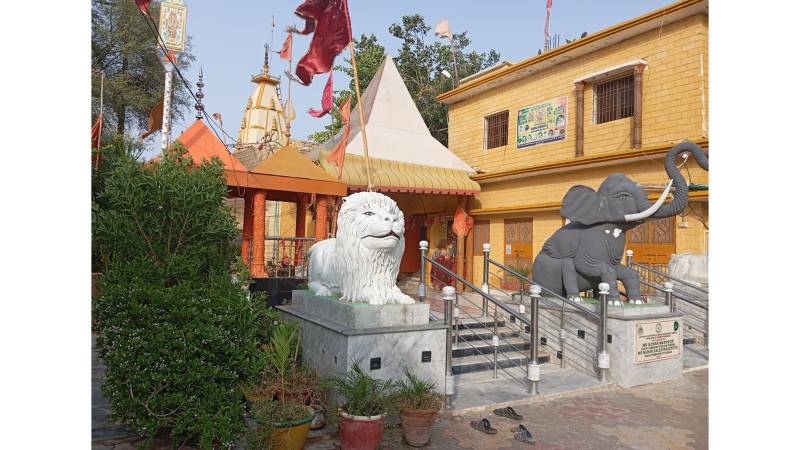
I must admit that, for ease, I chose to visit Parchin Durga Shiv Mandir near Circuit House in Hyderabad first. It was close to where I lived, unlike other temples of the city. I got in touch with Tariq Imam Junejo to help me arrange the visit. He is a senior revenue officer, and his office is in the Shahbaz Building, so the temple was not far. He coordinated the visit, and also joined me for the temple visit. As we got there, I saw four scenes (if your face points towards the east): on the right side (south) was a cow shed, and on the left side (north) were some hung items – showing what some devotees wished for. In front of the temple were huge casted figures of animals – two lions and one elephant. The lions’ colour was plastered white, and the elephant was a dark, ash colour. There were also some messy signboards with names of Sindh Government officials and politicians from the Pakistan Peoples’ Party and Pakistan Muslim League (Nawaz). These boards also showed what the government officials and people’s representatives had given. These boards mentioned– casted lions and elephant, CCTV cameras, a water cooler, and repairs and upkeep (unspecified). A striking feature was that all these marble signboards had English text, and each showed a different name for the temple; one read “Durga Shiva Temple” and others “Mata Sheranwali Durga Shiva Mandir.” However, an older iron sheet board with a green background simply said “Teerath Dham Shiv Mandir.”
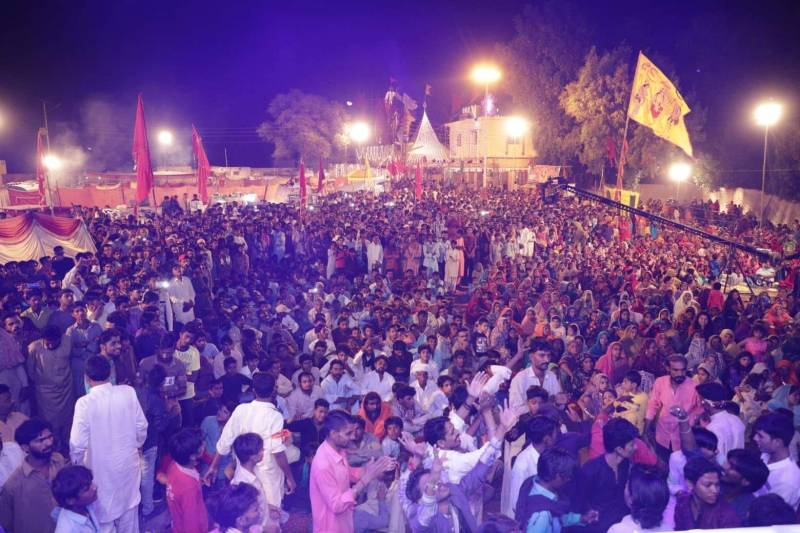
As we stood before the caster lions and elephant, a young man came up to us. He said his name was Mukhi Mahesh, he is the patron chief of Hyderabad Hindu Council and the he asked with a hint of a hurry: “Which government are you from?” We told him who we were and why we had come. I remember that it is a common question that was asked, whenever I visited temples and gurudwaras. I have inquired with mahants, mukhis, bavas, and sardars about the background of that question. All the temple caretakers, with some added detail, explained that whenever they see a visitor who is not a regular worshipper, they assume the person might be a government official, and there might be a complaint against them.
Now, as we were just stepping into the temple courtyard, he asked us to take off our shoes. We did as he asked. Before going in, I asked him about Bhagat Karamchand, but Mukhi Mahesh told me he was not there, having gone to Jamshoro to offer condolences. He added that if I could visit the coming Friday, Bhagat would surely be there and would have many tales to tell about the mandir.
Once inside the temple, Mukhi Mahesh, like a trained guide, told us that this was a Durga Mandir. He added that durga is seen as the supreme goddess known for her warrior spirit Durga Mata is deeply honoured with durga puja and navaratri. Mukhi Mahesh was a natural explainer. However, in our short talk, I saw that he had unconsciously picked up a trait of interpretation. He would ask a simple question, and whatever answer he got, he would rephrase and retell it, with more details. He was at his best when there was a pause in talk or silence from devotees or visitors.
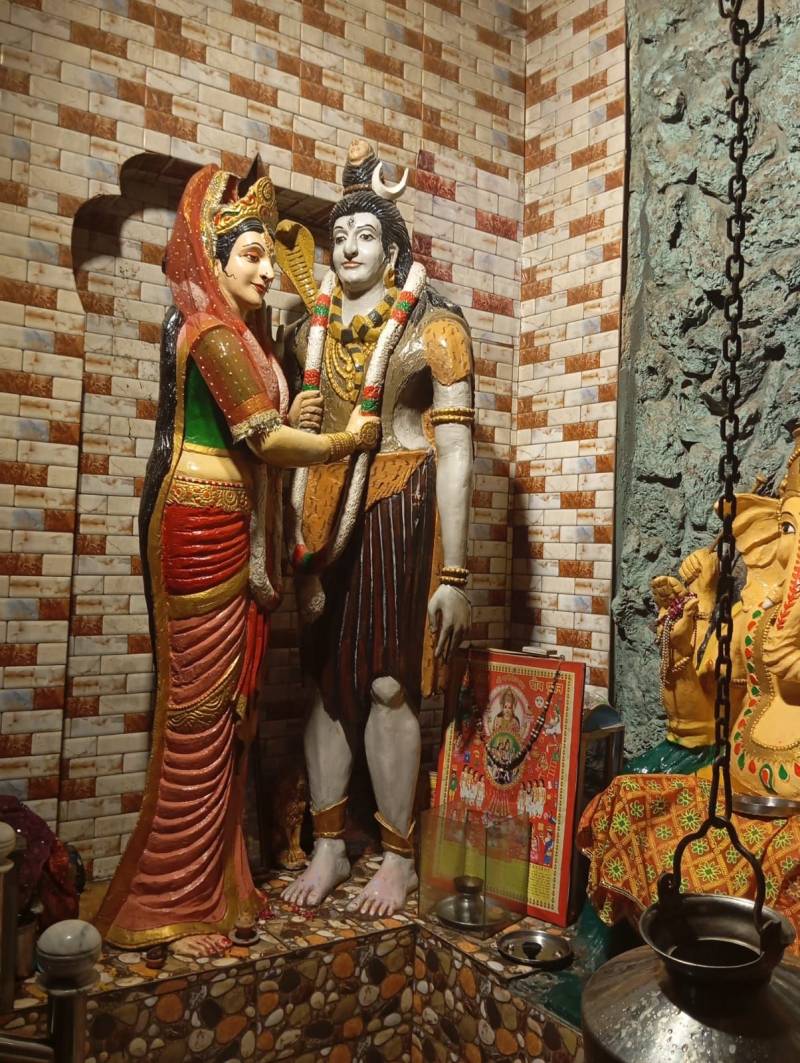
I clearly recall when we stood before the statue of Shankar Bholenath. He asked us what the name Shankar Bholenath meant. He did not wait for our reply. He answered his own question. He said, “Shankar means ‘giver of joy’ and Bholenath means ‘Innocent Lord.’ He added that followers believe he is easy to worship and quickly grants wishes. His explaining nature made me ask him about some signs of Shankar Bholenath. He named the trident, drum, third eye, blue throat, moon (crescent), sacred ash, matted hair, clothes of tiger skin, beads (from Rudraksha trees), the dhand (bull), and the black cobra snake.
The coiled cobra snake brought back memories of Jawaid Bhutto’s talk about Shankar Bholenath and the cobra snake at Asif Baladi’s flat in Karachi. I still recall his fluent talk, filled with deep thoughts and the clever, artful use of his hands. I can’t forget the way he showed us with his fingers, as if he was authority, saying: “Firstly, the cobra means Shankar Bholenath’s full mastery over time and the world. It shows he is beyond the cycle of birth, death, and rebirth. Secondly, it is a sign of his win over ego, wants, and all urges. Thirdly, the cobra stands for the awakened kundalini shakti." He explained that in Tantric and Yogic ideas, kundalini is the first cosmic energy, often seen as a coiled cobra sleeping at the base of the spine in every person. He added that when this shakti wakes up through spiritual work, this energy climbs up through the main energy path, ending in spiritual wisdom and joining with divine mind in the crown chakra. He ended his spellbinding talk in the early morning hours, saying: “Shankar Bholenath is the divine mind.”
Alas! I had no idea that it was our last meeting with Jawaid Bhutto. He was humble teacher of philosophy, and for a considerable time taught at the Department of Philosophy, University of Sindh, Jamshoro. He was then brutally killed in the US.
Before I left, I asked the custodian what his immediate demand from the Sindh Government was. He replied in one word: “Security”
Mukhi Mahesh’s words brought me back to the present. I heard him telling us something about Ganesh. I told him that I knew about Ganesh. In fact, long ago, while I was issuing children’s book series through Phoenix Books publications, Hyderabad, I had found an Amar Chitra Katha comic book from Bombay. The editor of the series was Anant Pai, and the writer of this particular book (Ganesh) was Kamala Chandrakant, with CM Vitankar having made each dialogue of the story come alive with detailed illustrations. I still recall the story of Ganesh, and its most fun part was how he got the head of an elephant.
Here is the story of Ganesh, as told in that comic book:
One day, the goddess Parvati (wife of Shankar Bholenath/Lord Shiva) was all alone. She wanted someone loyal to guard her while she bathed. So, she used some special paste and dirt from her own body, and with her divine power, she brought it to life, creating a handsome boy! She told him, “No one, absolutely no one, is allowed in without my permission!” The boy, named Ganesh, promised to obey.
Later, Shankar Bholenath returned home from his long meditation. But as he tried to enter, Ganesh bravely stood in his way, refusing him entry. Shankar Bholenath didn’t know this was his son, as Ganesh was created solely by Parvati. Surprised and a little annoyed, he tried to move him, but Ganesh was incredibly strong and wouldn’t budge! A huge fight broke out! Shiva, along with his many attendants, fought Ganesh, but all were defeated. In a moment of divine anger, and still not knowing this was his own child, Shankar Bholenath used his powerful three-pronged spear and, sadly, cut off Ganesh’s head. When Parvati came out and saw her son’s lifeless body, she was heartbroken and furious. Her anger was so immense it shook the entire universe! “That was our son!” she cried to Shankar Bholenath, demanding that he bring Ganesh back to life immediately.
Shiva, filled with deep regret, knew he had to fix his mistake. He quickly sent his attendants on an urgent mission: “Go and bring me the head of the first living creature you find sleeping with its head facing north!” The attendants rushed out. After searching, they found a majestic elephant sleeping peacefully, its head facing the correct direction. They gently took its head and brought it back to Shankar Bholenath. He carefully placed the elephant’s head onto Ganesh’s body. With his immense divine power, he brought the boy back to life! Ganesh was now whole again, with his new, wise elephant head. To make sure Ganesh was honoured; Shankar Bholenath declared that from that day forward, Ganesh would be worshipped first before any other god or any new task.
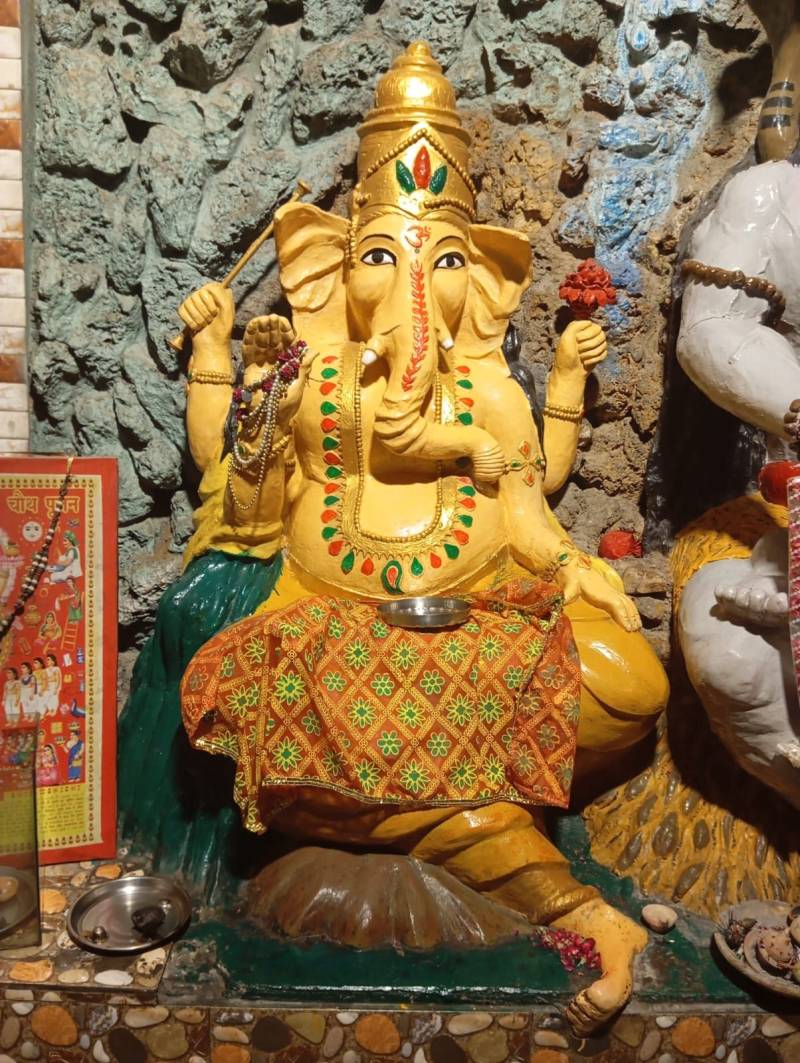
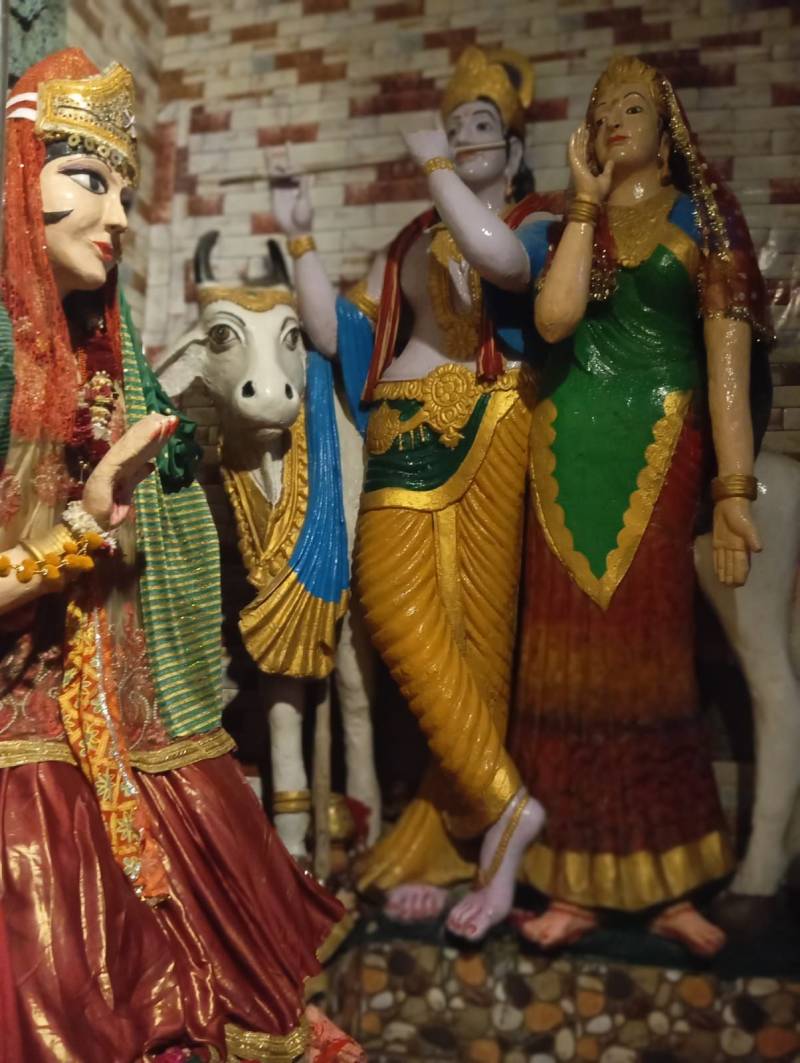
I closed my mental notes when I heard Maharaj say that Ganesh means “Lord of the Ganas,” adding that he is in charge of all kinds of obstacles. Now, we were standing before the statue of Ganga Mata, and Mukhi told us that Ganga Mata is the holy Ganges River, worshipped as a goddess. He added that her waters are pure and can wash away sins, helping people find peace. I sensed hurry in Mukhi’s voice. I guessed right; he told us that puja time was coming close. But then and there, he pointed to the statue of Bhagwan Krishna, who began his life in a prison, secretly taken to Vrindavan to escape his evil uncle Kamsa, where he grew up as a playful cowherd boy, enchanting everyone with his butter-stealing and flute-playing, while also bravely defeating many demons. As a young man, he returned to Mathura to bravely defeat Kamsa, later building the grand city of Dwarka. His most famous role came as a wise guide and charioteer to Arjuna in the great Mahabharata war, where he shared the spiritual teachings found in the Bhagavad Gita. After witnessing the end of his own clan, Bhagwan Krishna left his earthly body, having fulfilled his mission to restore righteousness and guide humanity.
I noticed some abruptness in Mukhi Mahesh’s tone. I guessed right again; he told us that puja would soon begin. We agreed, and then he quickly summarized that Saraswati is the goddess of learning, music, and art, usually shown in white clothes, sitting on a lotus or riding a swan, holding a musical instrument called a veena and a book. He added that she is worshipped by students, artists, and anyone seeking wisdom and creativity. He pointed to another statue and told us it was Devi Lakshmi. She is the goddess of wealth, fortune, plenty, and beauty. She is worshipped for good luck and abundance in all parts of life, not just money. She is worshipped especially during the festival of diyari, where people light lamps to welcome her into their homes. Hurriedly, he told us that other statues were of Kali Mata and Sheenh Mata, or Sherawali Mata. Kali Mata stands for time, change, and the smashing of evil. She has a fierce look, often shown with dark skin, a necklace of skulls, and a sword. She destroys evil forces and helps people overcome ignorance. Likewise, Sheenh Mata is also called durga. She rides on a lion or tiger. She is worshipped as a protector of good and a destroyer of evil demons. Now, devotees were pouring in, so we took our leave. However, I told him that I would visit again, probably on Friday (the 1st of August 2025).
On Friday, I called at Bhagat Karamchand’s cell number, but instead, Maharaj Himesh Chand picked up the phone. I introduced myself, telling him I had visited the temple on Wednesday (28 July, 2025). He introduced himself as Bhagat Karamchand’s son. We agreed to meet around 1:00 p.m. I went there, and we had a detailed conversation, though today our talk was about different matters. He told me this temple was built in 1768, its spot chosen because it was near the Indus River.
I asked him as to what problems the custodians had faced. He told me they live in constant fear, and any event around the world creates a possible threat for them. He added that their places of worship first faced challenges in August 1947, then came the incidents of Salman Rushdie and Babri Masjid – he added that a simple hateful word anywhere in the world worries them. He told me that even the Seema Haider case (a Pakistani woman, illegally entered India with her four children to live with an Indian man she met through an online video game), which was in no way related to Hindus or temples, put them at risk, and their temples were attacked.
His words brought to mind the threats from Sindh’s notorious dacoit, Umar Shar, active in Sindh’s kacha area, who said that if the Seema Haider issue was not settled, he would attack temples in Kashmore and Bakhshapur. I recalled an earlier threat from Rano Shar, another known dacoit in the Ghotki area, who warned Hindus to stop worshipping or visiting temples. I remember one video shared on social media, where a group of dacoits had vowed to bring back Seema Haider by attacking temples and threatening Hindus in various parts of Sindh.
I asked him to tell me about some specific events that had posed serious threats to this Durga Mandir. He sadly told me each day brings a new threat. I saw anger and sadness in his face. He paused, perhaps to pick softer words. He told me to forget old times, and said that not long ago, in 2014 or 2015, a man named Latif Lashari came as a worshipper and entered the main part of the temple.
“We were all in the courtyard when suddenly we heard the thunder of a hammer. We saw him smashing the heads of the idols/devis with a heavy hammer. We caught him, handed him to the police, but soon after, he was released with the excuse of mental illness. Again, in 2016 or 2017, a person unexpectedly appeared and erected an Alam Pak on the temple grounds. Immediately, he brought some people and tried to start construction, but it was the timely intervention of Saleem Rajput (a senior officer from the district management) who visited the scene and stated that it was a trick to grab the land, and so the Alam Pak was removed.”
He remembered another trick where a cow was slaughtered and its entrails were thrown into the courtyard.
However, the most threatening and insulting charge was a false rape charge against Bhagat Karamchand. The supposed victim, named Sakina Chandio, lodged an FIR (No. 26/23, under Section 376 – punishment for rape – of the Pakistan Penal Code). The FIR stated that on 22 April 2023, she had come to visit Rani Bagh with her mother and brother’s wife on the first day of Eid and then decided to visit the Shiv Temple. She said she met Bhagat Karamchand, who told her he could solve her life problems and asked her to visit him alone on Monday, 24 April 2023. She further stated that she went to the temple, where the suspect raped her in a room after throwing “some powder” on her face that made her drowsy. He told me the case dragged on for a long time, ruining their lives and credibility, and even putting the entire Hindu community at risk. In the end, the DNA report proved it was not Bhagat, but her husband’s semen that matched what was found on her clothes. He smiled and thanked science and technology for saving their lives. He noticed he had slightly shifted allegiance, so he quickly corrected himself, adding that it was Mataji’s grace!
Before I left, I asked him as to what his immediate demand from the Sindh Government was. He replied in one word: “Security.” I reminded him that minutes from a Sindh Assembly session (Questions-Answers, 24 January 2025) clearly stated that all temples in Hyderabad are secured by local police. He then asked me a question: “This is your second visit; have you seen a single sepoy ask for your identity?”
I replied, "No, no one has stopped me from entering the even the compound.”
I wonder: the temple is within a boundary wall, the Circuit House is nearby, and the DIG’s office is close by, and the temple is visited by judges, politicians, and government officers.
Yet, a sense of insecurity hangs in the air. Perhaps some unseen forces are united against them, with one aim: to grab the temple’s land.