

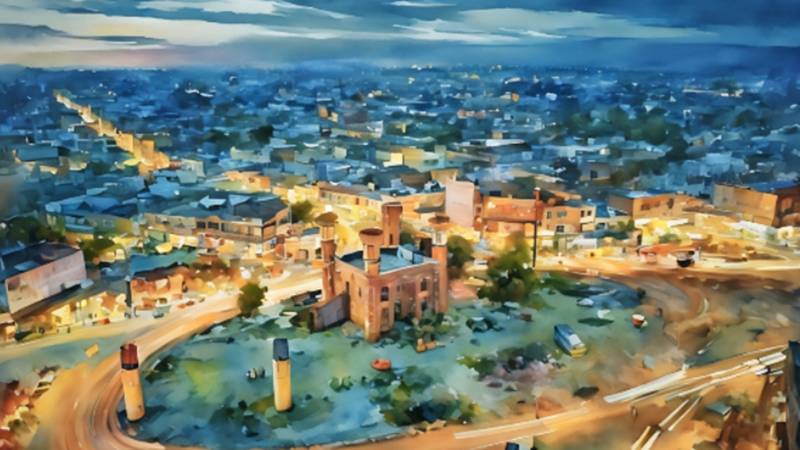
It was a holiday in Lahore, and I found myself wandering down Ferozepur Road towards Ichhra. Somewhere along that stretch once stood the grand Pancholi Art Studio, once Lahore’s cinematic heartbeat. The building later became Evernew Studios, then a passport office. But all that is gone now. The structure has vanished, and the name Pancholi Art Studio is a fading echo.
Walking that road, I thought: time moves like a silent river, dissolving even monuments into memory—memories golden, brittle, and slipping away.
Dalsukh Pancholi was born in 1906 in Karachi, but it was Lahore that witnessed his meteoric rise. His father, a prominent importer of American films, had already laid the groundwork for cinema. Young Pancholi travelled to New York to formally study screenwriting, and upon his return, he dedicated himself to creating Pancholi Art Studio—Lahore’s largest and most ambitious film studio.
His debut film, Sohni Mahinwal (1939), based on the timeless Punjabi romance, was an instant hit. He quickly followed it with Gul Bakawli, which featured a teenage Baby Noor Jehan and music by the talented Master Ghulam Haider. A young Suraiya also appeared in the film. The studio was now a force. In 1940, Yamla Jatt hit the screens—another box-office triumph starring Noor Jehan and a newcomer named Pran, with Haider again composing the score. This was followed by Chaudhry (1941), featuring Noor Jehan in her first lead role. Her voice, her presence, and Ghulam Haider’s melodies gave Pancholi his third consecutive Punjabi success.
Cities disappear, studios fade, and empires collapse. All that endures are flickers of memory—golden and weightless, slipping through our fingers
Then Pancholi made a daring leap into Urdu cinema. Khazanchi (1941) was a milestone. With Shamshad Begum’s distinctive debut voice and Ghulam Haider’s innovative music, the film transformed cinematic soundscapes. It broke records and established legends: Pancholi, Haider, Shamshad, Noor Jehan. Their names were now firmly embedded in the foundation of Indian cinema.
The momentum persisted. Zamindar and Khandan (1942) followed. Zamindar, based on an English novel, again featured Shamshad’s vocals. Khandan, directed by Shaukat Hussain Rizvi and written by Imtiaz Ali Taj, starred Pran and Noor Jehan. Its release elevated Rizvi’s reputation as a director. Then came Poonji (1943), Dasi (1944), and Shirin Farhad (1945). Pancholi was not just making films; he was building an industry, acquiring cinemas and helping Lahore become a film hub. The future seemed unstoppable.
Then came 1947. Partition drastically changed Lahore—Pancholi’s city, his sanctuary, which was suddenly thrown into chaos. The violence grew overwhelming. He left Lahore, thinking it would be temporary, entrusted the studio to a manager, and moved to Bombay. Films like Ghalat Fehmi still appeared under his name. But Lahore was gone. He never returned to his beloved city.
In Bombay, he started afresh. Pancholi Productions was established. In 1950, he released Meena Bazaar, starring Nargis and Shyam. Then came Nagina (1951), a suspenseful crowd favourite. In 1952, he introduced composer O. P. Nayyar and singer C. H. Atma in his film Aasman. Their earlier non-film track, “Preetam Aan Milo”, had already gained attention. In Aasman, C. H. Atma sang three highly praised songs—another milestone for Pancholi.
His final film, Farishta (1958), starred Sohrab Modi and Meena Kumari. With it, Pancholi’s cinematic journey quietly concluded. This journey, which began in pre-Partition Lahore, introduced the world to Noor Jehan, Shamshad Begum, Master Ghulam Haider, O. P. Nayyar, and C. H. Atma.
Today was a holiday in Lahore, and I found myself on Ferozepur Road, walking past where his studio once stood. Now, only the sky and the road remain. Silence. And I thought: the river of time spares no one. Cities disappear, studios fade, and empires collapse. All that endures are flickers of memory—golden and weightless, slipping through our fingers.