

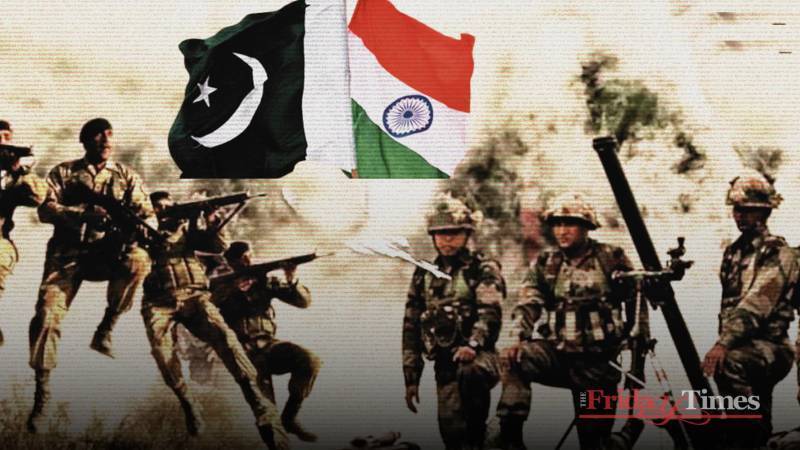
The moment I switched on the television, Mushahid Hussain was uttering the words, “Hum ne India ko phainti lagai hai” (We have given India a severe beating). Mushahid, with his innocent-looking face, was delivering a long monologue on the latest Pakistan–India conflict during a GEO Television prime time talk show. With the other pole of the debate occupied by the sober and intellectually graceful Dr Maleeha Lodhi, the discussion turned interesting when she suggested that excessive boasting and gloating lead to strategic complacency—something Pakistan cannot afford given the dangerous strategic environment it faces in the region.
Mushahid argued that the Pakistani nation has every right to be happy and celebrate the "military victory" against India. Maleeha, on the other hand, emphasised that this was a time for introspection, warning that complacency could be dangerous. She asserted that serious analysts cannot afford to be boastful. Mushahid insisted that the public had a reason and a right to celebrate. This debate between two towering journalist-turned-foreign policy thinkers most aptly exemplifies Pakistan’s internal strategic discourse in the wake of the May 7–10 Pakistan–India war.
Mushahid Hussain left journalism in 1993 and joined politics. Between 1993 and 1999, he remained the right-hand man of one of the most popular political figures in Pakistan’s history—former Prime Minister Nawaz Sharif. His political analysis often carries a tinge of popular politics. Maleeha Lodhi also left active journalism in the mid-1990s to join the foreign service as an ambassador. Hence, her public commentary tends to be more measured and sober. Sloganeering is the realm of politicians—slogans through which leaders rally the people around a cause. Analysis, on the other hand, breeds doubt and scepticism—not to create confusion, but to generate debate which eventually leads to conceptual clarity or a more precise strategic vision.
The four-day Pakistan–India war in May 2025 marks a turning point in South Asia’s military and strategic history. The bubble of nuclear deterrence—sustained for 37 years—burst on the night of May 7, 2025, leaving behind a landscape of strategic uncertainty. This is the new reality with which military planners in both India and Pakistan must now contend. We do not know when the next war will come. But we do now know that nuclear weapons alone will not prevent either side from initiating conventional military strikes.
Indian planners may have assumed that Pakistan’s military, preoccupied with internal crises, would hesitate to retaliate
The May 7–10 war was, by definition, a limited war below the nuclear threshold. India now understands that Pakistan will respond to conventional strikes in kind. We may not yet know when nuclear weapons will become relevant, but it is now clear that both states could engage in repeated conventional exchanges without escalating to the nuclear level—at least in the initial stages. So, can we say that limited war is now a real possibility?
On the aforementioned talk show, Mushahid Hussain was confident that India would not repeat the mistake of launching another conventional strike anytime soon. Dr Maleeha Lodhi, however, insisted that Pakistan cannot afford to grow complacent at this moment.
Without engaging in a debate over who “won” or “lost” the May conflict—let history decide that once more information becomes available from both sides—I would venture that limited war is now a real possibility between India and Pakistan. This conclusion is supported by public assertions from both sides. For example, Indian officials have repeatedly stated that they would respond to any future terror attacks with greater brutality. Conversely, Pakistani officials have warned that any Indian attempt to stop water flows into Pakistan would be considered an act of war. Both sides thus have their own rationales for initiating conflict. And with the myth of nuclear deterrence shattered, there are now fewer constraints preventing the outbreak of conventional war at a time of either side’s choosing.
In this context, I find myself agreeing with Dr Lodhi—Pakistan must avoid all forms of complacency.
The threat of limited war remains real. It is true that Pakistan’s nuclear capability has imposed a certain discipline on India’s military ambitions. However, the days when everyone believed that a conventional attack against a nuclear state was unthinkable are gone. Ukraine launched conventional strikes against nuclear-armed Russia during their four-year war. Hamas launched conventional attacks against nuclear-armed Israel on 7 October 2023. And finally, India launched conventional attacks against nuclear Pakistan on 7 May 2025.
Many in Pakistan believe that their massive retaliation against Indian military bases in northern India has convinced New Delhi that Pakistan's conventional response could approach levels that would be militarily unacceptable for India, thus producing a form of conventional deterrence. This is precisely the point in our military history where Pakistan’s strategic planners must not be complacent.
For 37 years, India operated under the illusion of nuclear deterrence in South Asia. In 1987, during the Brass Tacks military exercises, Pakistan first employed a veiled nuclear threat to deter India. In an off-the-record interview with Indian journalist Kuldip Nayar, Dr Abdul Qadeer Khan, the father of Pakistan’s nuclear bomb, hinted at the existence of a nuclear device and its potential use if Pakistan's survival were threatened. In the subsequent decades—through Kargil, the 2001–02 military standoff, the 2008 Mumbai attacks, and repeated Line of Control skirmishes—India refrained from launching a full-scale conventional attack, likely due to fear of nuclear retaliation.
So why did India choose to launch a conventional strike on 7 May 2025?
The answer to this question reveals why Pakistan must not indulge in complacency. There are increasing indications that India misread Pakistan’s domestic political environment. Indian planners may have assumed that Pakistan’s military, preoccupied with internal crises, would hesitate to retaliate. In recent years, one of Pakistan’s major political parties has conducted an aggressive social media campaign against the military, verging on open rebellion. Add to this the fact that the military is simultaneously engaged in two active insurgencies—one in the northwest and another in Balochistan—and the assumption of internal weakness may have seemed plausible to Indian analysts.
These assumptions, however, were based on flawed intelligence. A basic understanding of the socioeconomic base of Pakistan’s political parties would have revealed that none of them would ever act against Pakistan’s core national interests. But that is not the point. The more critical takeaway is that Pakistan’s internal political fragility likely contributed to this failure of deterrence.
The first reason we must not be complacent is that our house is not in order, while India’s military ambitions remain persistent. The Indian threat is not going away. Yet our political system appears increasingly unstable. Mainstream political parties continue to question the legitimacy of the political framework. Prime Minister Shehbaz Sharif has indeed managed to stabilise the economy to some extent, but much more needs to be done to strengthen state and societal cohesion—cohesion necessary to prepare for future military threats from our eastern border.
The ongoing political conflicts must be resolved urgently. These disputes create the impression of a house divided, and division invites aggression, as demonstrated by the events of 7 May. The unity briefly seen in Pakistan after the attacks should become the norm. We are not in the habit of critically analysing our political and social landscape. But we must understand that anti-military rhetoric on social media—rhetoric bordering on sedition—has harmed us more deeply than we realise.
With two insurgencies draining national resources, Pakistan has yet to fully mobilise itself for the possibility of another military confrontation. Trust me: complacency is not an option.