

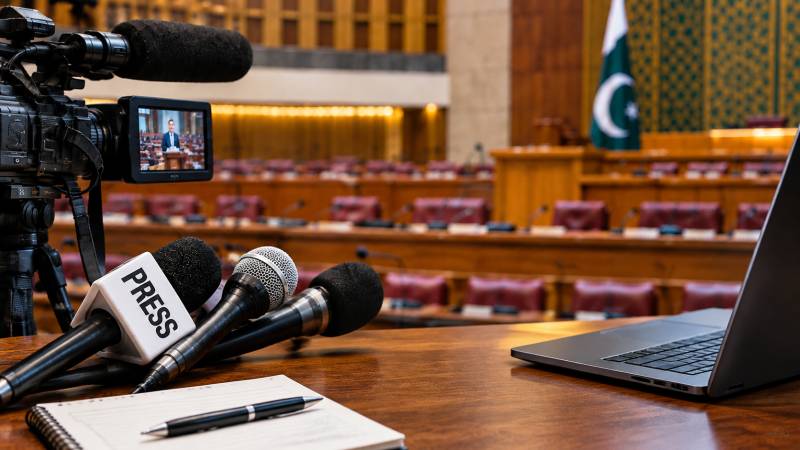
For Hammad Shafat, journalism has never been enough to pay the bills. After more than 15 years with Geo News in Faisalabad, his salary remains unchanged, forcing him to turn to an online clothing business to support his household. He joined electronic media in 2011 after a decade of working in print media on nominal honorarium, hoping he could finally focus entirely on journalism. Instead, rising living costs have pushed him to seek a second source of income. “I was delighted to join electronic media, but rising inflation has forced me to start an online clothing business,” he says.
Zulqarnain Tahir, a Dunya News reporter, has opened a pizza shop to supplement his income. Despite holding a master’s degree in Mass Communication, he says low salaries and months-long payment delays have made journalism an unreliable livelihood. Ashfaq Hashmi, a Jang crime reporter with more than two decades of experience, says his salary is less than half the minimum wage prescribed by the Punjab government, and payments are often delayed for months.
Women face additional barriers. Rana Hina Jameel, formerly associated with Hum News, says female journalists are often paid less than male colleagues and their work is treated as a personal interest rather than a profession. Lower salaries in smaller cities further discourage women from entering or remaining in journalism. The scale of the problem is difficult to establish because comprehensive, publicly available data on journalists’ salaries are lacking. But local journalists’ representatives describe a system in which unpaid and delayed wages are widespread.
Hamid Yaseen, president of the Faisalabad Union of Journalists, estimates that 90 per cent of more than 5,000 registered newspapers in Punjab do not pay journalists monthly salaries. Even at organisations that do, he says, salaries have remained stagnant for years and payments are frequently delayed. The estimate has not been independently verified, but it points to a serious gap in transparency and enforcement. Yaseen argues that the government should disclose the salary and staffing information newspapers submit to the Audit Bureau of Circulations when seeking certification. He also wants the government to publish advertising payments made to individual media organisations. Such disclosures, he says, would allow journalists and the public to scrutinise whether media employers receiving public money are meeting their obligations to workers.
The financial insecurity is also driving experienced journalists out of the profession. Shahid Ali, former president of the Faisalabad Press Club, says more than 50 journalists in the city with master’s degrees and over a decade of experience have lost their jobs. With few new media organisations opening, many are trying to establish alternative livelihoods.
Pakistan has a legal mechanism intended to protect newspaper employees’ wages. The Newspapers Employees (Conditions of Service) Act, 1973, provides for a Wage Board to determine salary scales and benefits for eligible newspaper workers, including reporters, sub-editors and photographers. A separate tribunal handles implementation disputes. But the system’s effectiveness has been undermined by delays.
Iqbal Khattak, executive director of Freedom Network Pakistan, says the eighth wage award was announced 16 years later than scheduled, leaving journalists’ earnings unable to keep pace with inflation and rising living costs. Khattak is campaigning for the immediate establishment of the ninth Wage Board. He says many journalists, particularly those employed by regional and smaller media organisations, earn less than the minimum wage prescribed for other workers. The framework also leaves a major gap: the newspaper Wage Board does not cover employees working for television, radio and digital news platforms, despite the growth of these sectors.
Independent journalism requires more than freedom from censorship and physical threats. It also requires the material conditions that allow reporters to work without being pushed into financial desperation.
Khattak says amendments to the Pakistan Electronic Media Regulatory Authority (PEMRA) Ordinance provide for councils of complaints in Islamabad and the provinces, offering a potential route for addressing grievances in electronic media. However, the effectiveness of this mechanism in resolving salary disputes remains unclear. Media employers point to falling newspaper circulation, rising paper and printing costs, and the migration of private-sector advertising to electronic and digital platforms. Tanveer Shaukat, deputy secretary general of the Council of Pakistan Newspaper Editors, says most newspapers depend heavily on government advertisements and that official advertising rates have not increased for years.
The Pakistan Broadcasters Association was approached for its position on salary delays and related financial difficulties in the electronic media industry but did not respond. The financial pressures are not confined to Faisalabad. The International Federation of Journalists’ Pakistan Press Freedom Report 2025–26 documents widespread wage arrears, layoffs and media closures. The report records job losses at several outlets in 2025. It also describes continuing salary arrears at television channels and financial difficulties affecting media workers across the country. These developments suggest that journalists’ economic insecurity is part of a broader structural crisis involving changing advertising markets, rising operating costs, shrinking newsrooms and inadequate employment protections.
Yet financial difficulties do not remove employers’ obligations to pay workers for services rendered. At its September 3, 2026, meeting, the National Assembly Standing Committee on Information and Broadcasting expressed serious concern over the non-payment and delayed payment of salaries to media workers. It stressed that employees should not suffer because of outstanding liabilities involving government institutions. The committee directed the Press Information Department to provide details of payments made to print and electronic media organisations, including outstanding amounts and pending claims. It also asked PEMRA to submit information about television channels’ liabilities, the periods for which payments had remained outstanding and the steps being taken to recover them.
The committee reiterated that timely payment of salaries was a fundamental responsibility of media organisations and called for effective measures to protect workers’ financial rights. The directions could provide a basis for examining the relationship between public advertising expenditure and media employers’ wage obligations. But their effectiveness will depend on whether the requested information is made public and whether authorities follow through. To examine the government's role in protecting media workers, information requests were submitted under the Punjab Transparency and Right to Information Act, 2013, to the Punjab Information and Culture Department, Labour Department and Punjab Employees Social Security Institution. A separate request was submitted to the Employees’ Old-Age Benefits Institution under the Right of Access to Information Act, 2017.
No responses had been received from these departments at the time of writing, and appeals had been filed with the Punjab Information Commission and Pakistan Information Commission. The missing information matters because it could help establish what authorities know about wage violations, what action they have taken and how effectively existing labour protections are being enforced. UNESCO and Free Press Unlimited have also recommended transparent, politically independent systems for allocating government advertisements, with public funding directed towards media organisations that employ journalists under formal contracts and pay salaries on time. Their recommendations include fair compensation for local news organisations and independent journalists whose work is used by global technology companies, tax relief for public-interest journalism, subsidies to reduce publishing and digital infrastructure costs, and grants for independent media organisations. They also emphasise the role of independent trade unions and wage boards in protecting journalists’ economic rights.
Such measures would not resolve every financial challenge facing the industry. But they could help ensure that the burden of an evolving media market is not borne almost entirely by workers. Economic insecurity is often treated as an internal employment dispute between journalists and their employers. In reality, it has consequences for the public. A reporter who cannot rely on a regular salary may be forced to divide time between journalism and other work. An experienced correspondent who loses a job may leave the profession permanently. A newsroom struggling to retain staff may lose the capacity to investigate complex public-interest issues or maintain a sustained presence in underserved communities.
Financial vulnerability can also weaken a journalist’s ability to resist pressure from powerful individuals, institutions and commercial interests. It does not mean that poorly paid journalists are necessarily less ethical or independent, but it creates conditions in which professional independence becomes harder to sustain. In smaller cities, where journalists already face limited employment options, these pressures can be particularly acute. Independent journalism requires more than freedom from censorship and physical threats. It also requires the material conditions that allow reporters to work without being pushed into financial desperation.