

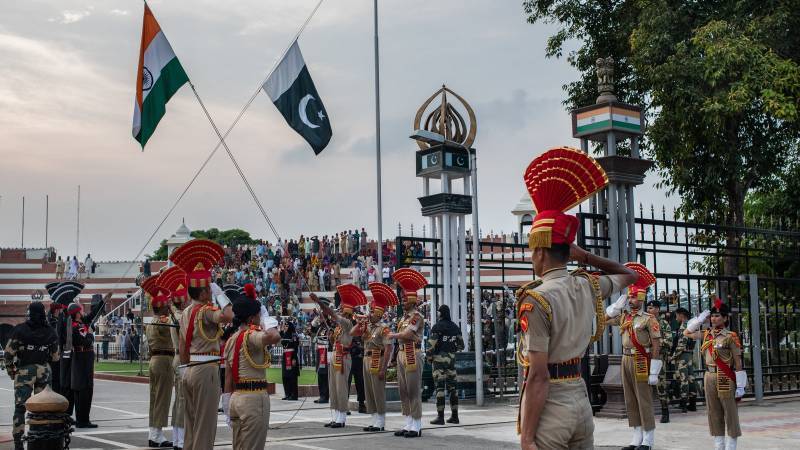
Since the attack in Pahalgam, a scenic meadow in Occupied Kashmir, India’s opinion makers have been hyperventilating and calling on their government to punish Pakistan. This, incidentally, has become India’s default position and, in most cases, remains independent of any verifiable evidence against Pakistan or other nuances that should generally attend issues of such gravity. While the more discerning voices in that country call for a limited yudh (war); the extreme warriors want a maha yudh (great war) and seek the total destruction of Pakistan as a state entity.
In Pakistan too discussions focus on what India can do or when it might initiate a hostile action. Also, what could that action be; what are India’s choices and whether any such action could drag the two sides into an escalation cycle?
Before I get into the details of what India can or cannot do, it’s important to state that initiating wars is never an easy option. By this I do not mean that wars can’t or don’t happen. The expectation that the potential warring sides will always act rationally and by weighing the destructive cost of war ex post will invariably settle for diplomacy ex ante is not borne out by evidence in many cases.
As political scientist James Fearon noted in a widely cited paper, Rationalist Explanations for War, “leaders may be unable to locate a mutually preferable negotiated settlement”, they could have “commitment problems” and they “might be unable to locate a peaceful settlement both prefer due to issue indivisibilities [issues that just don’t admit compromise].”
So, yes, wars happen.
Even so, the decision to wage war — limited or full-scale — is not like meet-us-outside high school brawl starter between two sets of charged boys. It requires planning, mobilisation, logistics, replenishment of men and materiel and, most crucially, depending on the duration and intensity of the conflict, sustainment.
A 1942 US Naval College report titled Sound Military Decision put it aptly: “Success is won, not by personnel and materiel in prime condition, but by the debris of an organisation worn by the strain of campaign and shaken by the shock of battle. The objective is attained, in war, under conditions which often impose extreme disadvantages.” (italics added)
While the conduct of war changes with innovative systems and platforms, the fundamentals remain the same. Trained human resource, equipment, logistics and replenishment and a state’s ability to take a battering are as crucial today as they were in the 1900s.
Modern war requires a very complex logistics and supply system with multiple tiers. The Table of Organisation and Equipment (TOE), a document in modern militaries, not only details the wartime mission, capabilities, organisational structure, and mission-essential personnel but also supply and equipment requirements for military units.
Markets, businesses and investments (especially foreign) don’t like wars and certainly not a conflict between a nuclear dyad with the potential to escalate
On land, tanks, Armoured Personnel Carriers and Self-Propelled Artillery – all essential components of manoeuvre warfare – are very logistics-heavy. A typical armoured division, for example, would have supplies based on troop strength, such as rations; items listed and identified in the TOE (clothing, personal equipment, vehicle replacements, etc); POL (Petrol, oil, lubricants); supply requirements for damaged equipment which cannot have a fixed quantity and would depend on attrition rates; and, yes, ammunition. Aerial and naval platforms and systems are even more expensive to operate and replenish.
Combined arms manoeuvres in an offensive increase the probability of attrition. Such manoeuvres also rely on speed and speed creates its own logistics problems. Supplies have to be transported by road. The supply points remain vulnerable (especially in modern war where a number of technologies allow adversaries to locate fixed positions and target them), as do long convoys of vehicles carrying supplies.
This is not an exhaustive list, just a bird’s-eye view. The point is simple: wars are tedious business even before the bloodletting begins. They become really messy after the first shots are fired.
While the war between Russia and Ukraine has a different strategic environment, operational requirements and context, it is important to note that stronger adversaries can often miscalculate the opening gambit.
When President Vladimir Putin sent his army into Ukraine, the aim was to move on Kyiv, take control of the city, install a Kremlin-supporting government, which presumably would have bludgeoned the Ukrainian morale, and then negotiate with the US-NATO alliance. If the plan had succeeded, the situation in Ukraine would likely be very different. It did not. The Ukrainian resistance and Russia’s inability to provide for the force and sustain the advance on Kyiv resulted in the Kremlin abandoning the main effort and shifting the focus to eastern and southern theatres. Since then, the war has dragged on with both sides trying to attrit each other. Both have run out of steam for any major combined arms offensive, Ukraine more so than Russia.
Another important aspect of any war planning (or waging one) is the environment. Wars are not fought and sustained in a vacuum. Let me explain. Away from India’s Pakistan troubles, New Delhi has, since the mid-90s, expressed its desire to play in the big league. Economic liberalisation under the late Dr Manmohan Singh helped unshackle entrepreneurial innovation in India. It has since done well economically, creating wealth for the middle classes and offering to the world a growing consumer market.
Economic growth requires years of effort and structural reforms but, most importantly, peace. Markets, businesses and investments (especially foreign) don’t like wars and certainly not a conflict between a nuclear dyad with the potential to escalate. On Thursday, India’s Prime Minister Narendra Modi inaugurated a four-day WAVE summit in Mumbai to boost Indian media and entertainment industry’s profile. Participants from 75 countries are attending this event. Clearly, they aren’t keen on a conflict.
Yesterday (Friday), Mr Modi inaugurated a Deep Water multipurpose seaport in Kerala, describing it as a symbol of new-age development. Then there’s Invest India, a body created in 2009 which seeks to target potential investors, promote and facilitate investment and take care of those who have invested. It boasts of a flourishing start-up ecosystem. It wants to reach $7 trillion economy and add 50 million jobs in the private sector.
Pursuing this beaten path is to no one’s advantage, not India’s and not Pakistan’s. It also, unnecessarily and avoidably exposes other states in the region to the risk of escalation between and India
These are big dreams and India, like other states eyeing to move up, can legitimately work towards achieving them. Problem is, this ecosystem abhors wars, conflicts and 56-inch chests. The warriors in this ecosystem, to quote Francis Fukuyama, are men without chests. That’s the way this “war” works.
During the 2001-2002 Twin Peak crisis when India ordered full mobilisation (Operation Parakram), the 10-month long standoff cost India $3-4 billion. It also sustained 1874 casualties, including 798 killed from December 19, 2001 to October 16, 2002. These are official figures given to the Rajya Sabha by then Indian Defence Minister George Fernandes.
Some might say that India is not looking for a full-scale war, only limited strikes. This is correct but misses the essential point. The lumbering mobilisation in 2001-02 was done under the Sundarji Doctrine. That experience forced the Indian Army to conceptualise and develop a doctrine that would require quick, short, sharp strikes against Pakistan by self-sustained groups comprising strike and support elements.
Dubbed Independent Battle Groups (IBGs), eight of them were to be in a forward posture and were supposed to launch break-out operations within 72 to 96 hours after a crisis had erupted. These were to be supported by pivot (holding) divisions with their own limited strike capabilities which would be deployed to forward obstacles. Two, preferably, three IBGs would strike Pakistani forces and defeat them by disrupting their cohesion at multiple points.
There were two assumptions in this planning: Indian IBGs will achieve their operational objectives and the strikes will stay below any escalatory line. Both assumptions were — and remain — arbitrary and cannot be guaranteed. If they don’t work as postulated, uncertainty sets in and with it the risk of escalation.
The details of how Pakistan has evolved its war-fighting doctrine, integrated ground and aerial platforms through tactical data links and conceptualised and validated force employment is beyond the scope of this article. Suffice to say that the Indian Air Force and Indian military planners got a glimpse of it through Op Swift Retort on Feb 27, 2019.
The essence of the point I am making is that (a) Pakistan’s integration across platforms means it will present a coordinated response to any Indian strike and (b) such a response would upend the first assumption inherent in India’s planning. That carries the risk of escalation in the absence of an offramp.
Finally, the most important tenet of any decision to go to war is the question of what is the war’s political objective for which the battles are to be fought. This is also where it is crucial to differentiate between victory in a battle and the war objective, the highest level in the grammar of war. If State X can achieve victory in a battle but cannot compel State Y to concede to X’s politico-strategic objective(s), in other words deter it, it has failed.
India has tried to coerce Pakistan, through unilateral decisions that have vitiated the atmosphere and through occasional use of force, to accept India’s position on what constitutes the regional balance of power. That has not worked. Given the military balance, it is further from achieving that objective. Pursuing this beaten path is to no one’s advantage, not India’s and not Pakistan’s. It also unnecessarily and avoidably exposes other states in the region to the risk of escalation between Pakistan and India. That must change, not just for the conflict dyad but also for other neighbours.
The implication should be clear: India has to understand that (a) it cannot compel Pakistan and (b) it has to talk to Pakistan on all outstanding issues and disputes. Not just that but to walk the talk. That is the only feasible balance of power.