

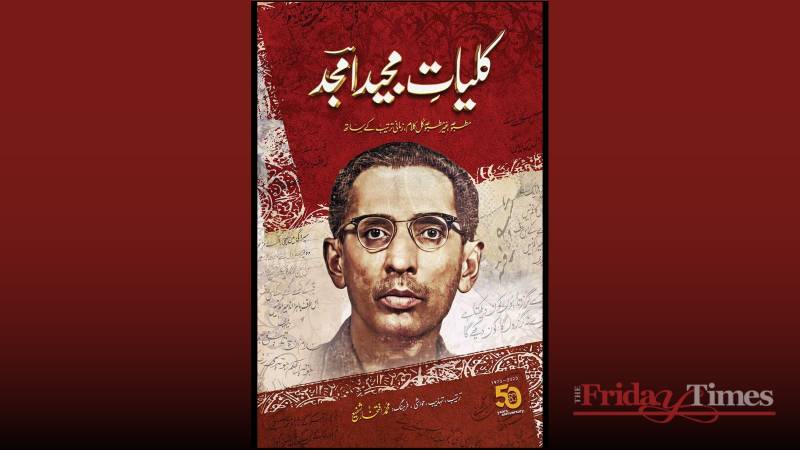
Majeed Amjad (1914–1974) remains one of the most distinctive voices in modern Urdu poetry. Though he was not widely known during his lifetime, his work has steadily drawn attention for its depth and originality. Born in the culturally rich town of Jhang, Amjad led a quiet life, working in a government job and writing with a focus and intensity that few noticed then but many admire now. He remained outside the major literary camps of his time—neither fully aligned with the Progressive Writers’ Movement nor with the romantic tradition. Instead, he followed a personal path marked by philosophical reflection, stylistic experimentation, and a quiet sense of detachment.
His growing reputation owes as much to the strength of his poetry as to those who have taken the effort to preserve and present it with care. Among the earliest and most consistent champions of Amjad’s work was the renowned literary critic and scholar Dr Khawaja Muhammad Zakariya. It was through his sincere and sustained efforts that Majeed Amjad began to enter the literary conversation. Dr Zakariya’s persistent writings on Amjad played a key role in introducing him to serious critical discourse—at a time when his name was scarcely mentioned in mainstream literary circles. Not only did he play a significant role in bringing out Amjad’s second collection of poetry, Shab-e-Rafta ke Bād (After the Night That Passed), he also edited and published the first Kulliyāt (Collected Works) of the poet. Both of these publications laid the foundation for future editorial and scholarly engagement with Amjad’s poetry. Over the years, thanks in large part to these efforts, Amjad's poetry has gained wide academic recognition and now features as a regular part of undergraduate and postgraduate Urdu curricula across the country.
Among the more recent and important contributions to that ongoing engagement is the publication of Kulliyāt-e-Majeed Amjad, edited by Dr Iftikhar Shafi. This collection is more than a gathering of poems—it is a thoughtful reconstruction of a scattered and often overlooked body of work. For the first time, readers have access to a dependable, coherent edition that reflects the full range of Amjad’s poetic vision.
This edition does not merely assemble poems; it curates an experience—an encounter with a poet who lived and wrote on the threshold of the familiar and the unexplored
Dr Shafi’s connection to Amjad is not simply academic. Living in Sahiwal—the city where Amjad spent the final three decades of his life—he has long been immersed in the poet’s world. Years before this edition, Shafi had compiled Amjad’s lesser-known prose writings, showing a lasting dedication to capturing the full scope of his thought. His work reflects not only scholarship but also a personal commitment to ensuring Amjad’s voice continues to be heard and appreciated.
In the preparation of this compilation, Dr Shafi has paid particular and deliberate attention to a number of significant elements. Most notably, a detailed account of Majeed Amjad's life has been included with care and insight, ensuring that the reader encounters the poet not merely through his verses but through the arc of his lived experience—an arc that may help illuminate the inner landscapes of his poetry and enable a deeper, more nuanced understanding of his creative vision. The Kulliyāt-e-Majeed Amjad has been thoughtfully divided into distinct sections to offer the reader a structured and meaningful journey through his poetic world.
The first section comprises his nazms, presented in chronological order. This temporal arrangement is not merely an editorial convenience but a philosophical choice, made to help the reader trace the subtle and profound evolution of the poet’s thought, emotion, and artistic maturity. To achieve this, the editor consulted previously compiled collections, drawing upon their sequencing to shape an order that speaks not only to literary history but also to the inner development of the poet himself.
The second section contains the ghazals. In most earlier collections—Shab-e-Rafta being the exception—ghazals and nazms were often grouped together without distinction, which unintentionally diverted attention away from Amjad’s ghazals. Consequently, they remained in the shadow of his more dominant nazms. In this revised collection, however, the ghazals have been given a distinct space and, like the nazms, are arranged chronologically, thus offering a fresh perspective on the range and richness of Amjad’s poetic voice across forms.
The third section gathers the scattered remnants—pieces that, for various reasons, had not been included in earlier published volumes but had found their way into literary journals. These include a few remaining nazms and a series of sehras written for the weddings of friends and relatives. These, too, serve to complete the mosaic of the poet’s creative life, revealing a more intimate and culturally rooted facet of his authorship.
What has been deliberately excluded, however, is the poet's early and uneven work—"the immature and uneven" poetry from the beginning of his journey. This exclusion was a conscious editorial decision made to preserve the overall impression and standard of the poet’s mature oeuvre.
Equally vital to this edition are its annotations. Dr Shafi has undertaken an exhaustive effort to trace Amjad’s scattered writings, often buried in obscure publications, and to juxtapose them with the versions found in published volumes. This comparative exercise has resolved many textual ambiguities, clarified variant readings, and illuminated changes in titles and phrasing that had previously puzzled readers and scholars alike.
Furthermore, recognising the linguistic uniqueness of Majeed Amjad’s poetic diction—his occasional use of unfamiliar words, and more distinctively, his penchant for coining neologisms and creating novel syntactic structures—Dr Shafi has included a glossary at the end of the volume. This addition is not merely a lexical aid but a window into the creative mechanics of Amjad’s mind, offering readers the tools to more deeply engage with a language that is at once rich in tradition and boldly inventive.
Thus, this edition does not merely assemble poems; it curates an experience—an encounter with a poet who lived and wrote on the threshold of the familiar and the unexplored, and whose legacy continues to demand thoughtful curation and interpretive generosity.
This edition of Kulliyāt-e-Majeed Amjad provides readers with a fuller and more carefully structured view of a poet who, though often overlooked in his own time, has come to be valued for the quiet depth and individuality of his voice. Through deliberate editorial choices, attentive arrangement, and a deep familiarity with the poet’s world, Dr Iftikhar Shafi has shaped a collection that allows Amjad’s work to be read with greater clarity and appreciation. The division of the poetry, the inclusion of biographical detail, and the supporting material such as annotations and glossary all work together to create a meaningful reading experience. It is a collection that does not merely preserve the poet’s legacy but opens it up—inviting reflection, rewarding careful attention, and offering space for the reader to encounter a body of work that speaks in its own tone, on its own terms.