

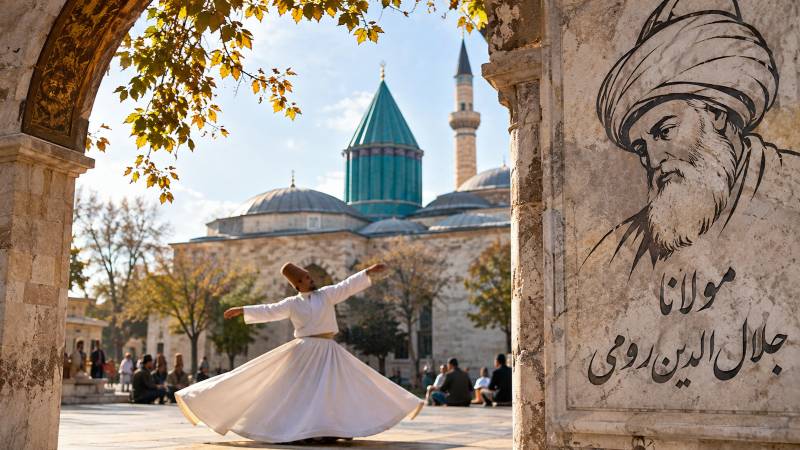
Rumi (1207–1273), the Muslim mystic and poet, enjoys an extraordinarily diverse appeal. He is revered by liberals, religious conservatives, atheists, singers, writers, academics, self-help gurus and LGBT activists, among others. Such cross-sectional popularity is rare, particularly in today’s deeply polarised world. In the age of social media and artificial intelligence, Rumi is readily “available” to almost everyone. As Professor Omid Safi of Duke University has observed, many people in the West turn to Rumi as a kind of quick-fix spiritual band-aid, essentially yearning: “Give me some Rumi.”
This approach has emerged alongside the poet’s immense popularity in the West, particularly in the United States, where he became one of the best-selling poets of the late 1990s. His popular image is that of a free-spirited humanist and libertarian poet. The traditional Eastern or, more accurately, Islamicate—understanding, however, places him firmly within the framework of Islamic mysticism and regards him as a Sufi deeply grounded in the Shariah. The question, then, is: how should we read Rumi today? Or, indeed, what does the “real” Rumi say? Here are a few ways in which the Persian mystic may be read more carefully and meaningfully.
First, it is necessary to understand the socio-religious and political environment of the 13th century. In many ways, Rumi’s thought represented a continuation and development of what came to be known in the West as Sufism, or tariqat—the spiritual path or way of life within the broader tradition of Muslim theological thought. Like many mystics and thinkers, Rumi drew extensively upon the intellectual and spiritual traditions that preceded him while introducing his own distinctive interpretations of enduring themes.
His Masnavi, comprising approximately 26,000 rhyming couplets, and his Divan-e Shams, containing thousands of ghazals, demonstrate his engagement with poets, mystics and scholars who came before him. Rumi also drew upon stories and traditions associated with the Bible, Hindu and Buddhist teachings, Greek mythology and other intellectual traditions, alongside pervasive references to the Quran and Hadith. To read Rumi properly, therefore, is also to recognise the vast intellectual and cultural world from which he emerged.
Secondly, Rumi’s thought, theology and theosophy are firmly rooted in the foundational texts and traditions of Islam. His works contain frequent references to Quranic verses, prophets, prominent figures from Islamic history, prophetic sayings and episodes from the history of Islam. A reader seeking to understand Rumi would therefore benefit greatly from at least a basic familiarity with Islamic history and religious traditions.
The Persian poet Abd al-Rahman Jami (1414–1492) is famously associated with the description of the Masnavi as “the Quran in Persian”—a phrase intended to emphasise the extraordinary depth of its engagement with Quranic ideas and imagery rather than to equate the two texts. According to Abdolkarim Soroush, the renowned Iranian thinker and author of several works on Rumi, the Masnavi contains more than a thousand direct references to or quotations from the Quran. Any reading of Rumi that entirely detaches him from this intellectual and religious universe is therefore likely to produce a partial picture.
Thirdly, the importance of a reliable translation cannot be overstated. Readers who do not speak Persian must necessarily rely on translations of Rumi’s works. Yet his immense popularity in the West has produced a proliferation of books marketed as the “essential”, “authentic” or “real” Rumi. Recent scholarship in Persian literature has raised important questions about the extent to which Rumi has sometimes been adapted—or, critics argue, significantly reshaped—to appeal to modern Western audiences.
Rumi belongs to the world, but reading him seriously requires more than extracting inspirational lines for social media or treating his poetry as free-floating modern spirituality.
One frequently cited example is the popular translation of a ruba‘i (quatrain) attributed to Rumi: “Out beyond ideas of wrongdoing and rightdoing, there is a field. I'll meet you there.” This rendering is widely associated with Coleman Barks, an American poet whose bestselling adaptations played a major role in introducing Rumi to contemporary Western audiences.
Rumi’s popularity has extended well beyond literature. Celebrities have quoted his verses, while singers and self-help figures—including Deepak Chopra, Wayne Dyer, Sadhguru and others have drawn upon or popularised ideas associated with him. However, critics of some popular translations argue that the original Persian often conveys meanings that are considerably more specific than the universalised language found in contemporary English adaptations.
The Persian lines are:
از کفر و ز اسلام برون صحرائیست
ما را به میان آن فضا سودائیست
(Az kufr-o ze Islam birun sahra’ist / Ma ra ba-miyan-e an faza sawda’ist)
Jawid Mojaddedi, a prominent scholar and translator of the Masnavi, renders the opening idea more explicitly in terms of Islam and unbelief:
Beyond Islam and infidelity,
There is a place where we experience ecstasy.
The contrast between such translations raises an important question about interpretation. In the popular English version, the explicit reference to Islam and unbelief disappears, replaced by the more universal language of “wrongdoing and rightdoing”.
This is not merely a linguistic question. Translation inevitably involves interpretation, selection and cultural context. When the religious vocabulary central to a text is repeatedly softened or removed, the reader may encounter a Rumi significantly different from the poet known to Persian-speaking and Muslim intellectual traditions. Yet Rumi itself is a toponym, referring to his association with Rum, the lands of Anatolia. In Persian-speaking traditions, he has also been known as Mawlana, Mawlavi and Mawlana Balkhi. If a secularising or universalising approach is consistently extended across thousands of ghazals and the approximately 26,000 couplets of the Masnavi, the cumulative effect on the reader’s understanding can be considerable.
Based on my own journey of more than a decade of reading and attempting to understand Rumi, I would argue that choosing a reliable translation preferably one produced directly by a scholar with a strong command of Persian is an essential starting point. For readers in the subcontinent, several scholars have produced valuable translations and interpretations of Rumi's works, including Maulana Sajjad Hussain, Maulana Nazir Naqshbandi, Maulana Ashraf Ali Thanvi, Shibli Nomani and Khalifa Abdul Hakim. Their works are available in both print and electronic formats.
Finally, those who wish to develop a deeper relationship with Rumi should consider taking the first steps towards learning Persian. For speakers of Urdu, Hindi, Punjabi, Sindhi and Arabic, Persian can be comparatively accessible because of shared vocabulary and long histories of linguistic and cultural interaction. Today, numerous websites, YouTube channels, Instagram pages, TikTok accounts and online communities offer free resources for learning the language.
Rumi belongs to the world, and there is nothing inherently wrong with readers across cultures finding their own meanings in his poetry. But reading him seriously requires more than extracting inspirational lines for social media or treating his verses as free-floating expressions of modern spirituality. To encounter Rumi in his complexity is to encounter a poet shaped by the Quran, Hadith, Persian literary traditions, Islamic philosophy, Sufism and the intellectual upheavals of his age. The more seriously we take that world, the closer we may come to understanding the poet himself.