

“Unhappy is the land that needs heroes.” — Galileo Galilei
This line from Bertolt Brecht’s play The Life of Galileo has haunted me since I first heard it performed in Karachi in the 1980s, with Aslam Azhar playing the lead role. For years, it seemed a riddle. And then, on 22 August 2025, in Gilgit-Baltistan, it found a chilling answer when a shepherd saved the lives of 300 villagers.
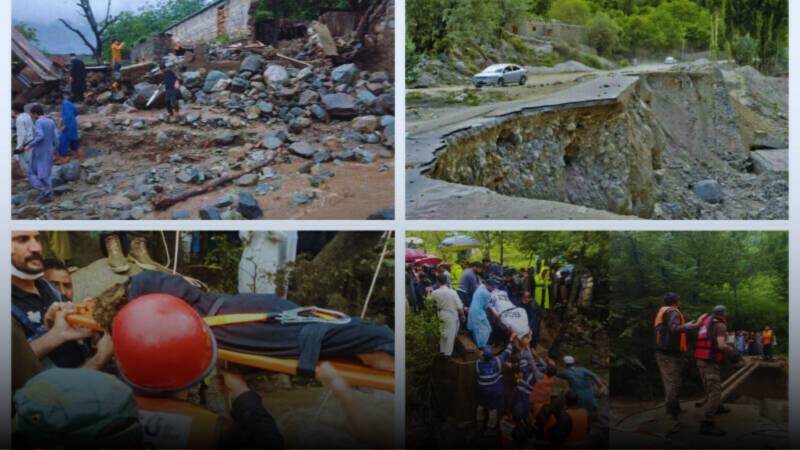
In the remote Roshan valley of Ghizer, Wasiat Khan awoke to a sound that froze his blood. A glacier had burst, sending a furious torrent of water, ice, and rock crashing down the mountain — a classic Glacial Lake Outburst Flood (GLOF). Below lay the village of Tali Das, home to 200 families, directly in its path.
Wasiat did not hesitate. Racing with his companions to the nearest peak for a mobile signal, he phoned villagers with an urgent plea: “Leave your belongings, leave your houses, take your wives, children, and elderly and get away from the stream to save your lives.” Their mission did not end there. They rushed to the local mosque and urged the muezzin to warn the community through the loudspeaker of the impending danger. In that moment, they embodied the very standard of disaster response that those in the air-conditioned offices of the NDMA fail to practise — issuing advisories and passing responsibility down the chain.
Minutes later, the flood roared through, obliterating 80 per cent of the homes but sparing every life. It was a miracle measured not in chance, but in courage and seconds.
All the while, not a single official was in sight. NDMA, PDMA, and the much-touted rescue teams were nowhere to be found — despite glacial activity ravaging Gilgit-Baltistan since 8 August, claiming lives and wiping out infrastructure. No emergency camp had been designated where Wasiat could report the danger. Rescue 1122, so visible across Punjab, was conspicuously absent there. The government’s early warning system had been broken for years. A $37 million GLOF project, funded by UNDP and the Green Climate Fund, proved equally useless. In the end, hundreds of lives were spared not by state preparedness but by the quick thinking of a shepherd.
Wasiat Khan’s bravery deserves celebration, but the greater duty lies in building systems that do not force ordinary citizens to shoulder such impossible burdens
The prime minister later announced a reward of 2.5 million rupees to each of them — a token, nice gesture for men who saved an entire community.
The Real First Responders
Wasiat’s story reminds us that in disasters, the first line of defence is often the community itself. He was no scientist or official — just a man whose knowledge of mountains and weather told him instantly what was coming. Community-based alert systems, rooted in local knowledge, can make the difference between life and death.
Climate Change at the Doorstep
This flood is part of a much larger story. GLOF events are growing alarmingly frequent across Gilgit-Baltistan. Rising global temperatures are melting glaciers at a dangerous pace, creating unstable lakes that burst without warning. Pakistan, despite its tiny carbon footprint, stands on the frontline of the climate crisis. For mountain communities, survival is increasingly a matter of chance.
The Tragedy of Neglect
That the official warning system lay broken is not a minor oversight — it is symptomatic of a pattern. Infrastructure is installed with fanfare, then neglected until disaster exposes the rot. Instead of proactive resilience, we rely on luck, improvisation, and human sacrifice. That is not governance; it is abdication.
This abdication is visible not only in Ghizer, but across Gilgit-Baltistan. When a glacial flood recently surged through Hunza, damaging farmland and highways, officials rushed to inspect bridges and retaining walls but set up no relief or support camps for at-risk families. In Phander, thousands were stranded for days when the Gilgit–Shandur Road was cut off, yet no temporary shelters were established. The state’s instinct is to protect infrastructure, not people.
Lessons in Communication
Wasiat’s hurried phone calls carried their own lesson. His message was the model of emergency communication: short, clear, urgent, and action-focused. In crisis, language can save as many lives as rescue operations. Our disaster agencies would do well to learn from an illiterate shepherd.
A Brechtian Truth
When Galileo’s pupil Andrea remarked, “Unhappy is the land that has no heroes,” the scientist replied: “No, Andrea. Unhappy is the land that needs heroes.”
This is the tragedy of Gilgit-Baltistan. It does not lack heroes — it has Wasiat Khan. What it lacks are systems that make such desperate heroism unnecessary. A resilient country should not leave its citizens dependent on the chance presence of a sharp-eyed shepherd with a working mobile phone.
Think of the 300 villagers of Tali Das, saved by their good fortune in having a hero among them. But also ask: what if the mobile signals had not been working when Wasiat tried to call and alert them? The outcome could have been unimaginably tragic. And then think of the 17 tourists stranded in the Swat River. They waited two long hours for a hero to arrive. By the time two locals finally came, fourteen had already drowned.
The Final Word
Yes, we need heroes — but only because our institutions fail us. Wasiat Khan’s bravery deserves celebration, but the greater duty lies in building systems that do not force ordinary citizens to shoulder such impossible burdens.
Galileo’s warning still stands: Unhappy is the land that needs heroes.