

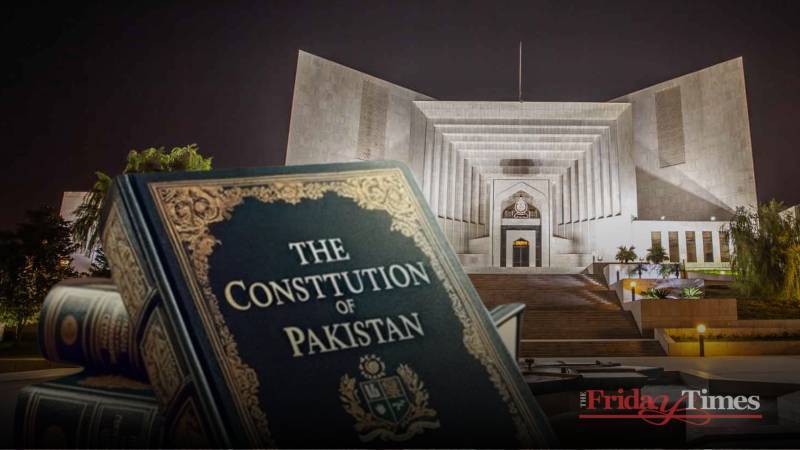
The New Constitution of Pakistan was passed on 10th of April 1973. It came into force under the leadership of Zulfikar Ali Bhutto and the President of the Assembly authenticated it on 12th April 1973. It is the third constitution of Pakistan. This constitution is considered a landmark achievement in Pakistan’s political history as it restored parliamentary democracy after years of constitutional instability. It not only provides the framework for governance but also defines the structure of the state and guarantees the fundamental rights of citizens. The fundamental rights of the people of Pakistan are explained in Articles 8 to 28, and we will discuss how these rights have been structured to protect the citizens of Pakistan.
The Constitution opens with a Preamble that sets the tone for everything that follows. It declares that sovereignty over the universe belongs to Almighty Allah alone, and that the authority exercised by the people of Pakistan is a sacred trust within His prescribed limits. It also formally enshrines the vision of Quaid-e-Azam Muhammad Ali Jinnah, recognising him as the founder of Pakistan and affirming that the state shall be governed according to Islamic principles of social justice. Islam is declared the state religion, and both the President and Prime Minister are required to be Muslim. These provisions reflect the ideological foundation upon which Pakistan was built: a democratic state with an Islamic identity.
At the start of the Constitution is its guarantee of fundamental rights. Chapter 1 is unambiguous on one point: any law that takes away or abridges these rights is void. The state cannot legislate against the freedoms of its own citizens. This is not a minor legal technicality; it is the backbone of constitutional democracy. As legal scholars have noted, fundamental rights and an independent judiciary must work together; without judicial independence, these guarantees become unenforceable. The Constitution recognises this, and it is why the independence of the judiciary remains one of the most contested political issues in Pakistan to this day.
The challenge has never been what the Constitution says; it has been whether those in power choose to honour it
Among the most essential protections are those relating to personal liberty. No person may be deprived of their life or freedom except through due process of law. Anyone who is arrested must be told why, and they have the right to consult a lawyer. No citizen can be detained without legal justification, punished for something that was not a crime when they did it, or tried twice for the same offence. Torture and degrading treatment are explicitly prohibited. These are not abstract ideals; they are direct responses to the kinds of abuses that have historically occurred when state power goes unchecked, and they matter enormously in a country where enforced disappearances and custodial mistreatment have been recurring concerns.
Beyond personal security, the Constitution guarantees a wide range of civil and social freedoms. Every citizen has the right to move freely within the country, to assemble peacefully, to form associations, and to choose any lawful profession or trade. Freedom of speech and freedom of the press are guaranteed, subject to reasonable limits on security and public morality. Citizens also have the right to access information of public concern, a provision that underpins the logic of the Right to Information framework that Pakistan has been developing in recent years. These freedoms are the infrastructure of a functioning democracy; without them, political participation becomes hollow.
Pakistan’s Constitution also takes deliberate steps to protect religious diversity. Every citizen has the right to practise and profess their own religion. No one can be forced to pay taxes to promote a faith other than their own, and no student can be compelled to receive religious instruction in another’s faith. All citizens, regardless of religion, have equal access to public places. These provisions exist because Pakistan is not religiously homogeneous; its Hindu, Christian, Sikh, and other minority communities are citizens with equal constitutional standing, even if the gap between constitutional promise and social reality remains painfully wide for many of them.
The Constitution also addresses equality and economic rights directly. All citizens are equal before the law. Discrimination based on race, religion, caste, sex, or place of birth is prohibited in public life and government service, where merit is supposed to be the only criterion for advancement. Every citizen has the right to own property lawfully, to pursue education, and to preserve their cultural identity and language. These provisions are especially significant in a country as ethnically and linguistically diverse as Pakistan, where tensions between different communities and between the federation and its provinces have historically run deep.
The Constitution of Pakistan 1973 is, on paper, a remarkably progressive document. It balances Pakistan’s Islamic identity with democratic principles, protects individual freedoms, guarantees equality, and recognises the rights of minorities. The challenge has never been what the Constitution says; it has been whether those in power choose to honour it. For ordinary Pakistanis, the Constitution is only as strong as the institutions that enforce it. Knowing your rights is where that enforcement begins.