


It is indeed true that archaeology in the South Asian Subcontinent was a colonial project that was used as a tool for governance. But ancient remains of the region did not just interest foreigners, the natives also seemed equally concerned about them. History tells us that the Princely states of the British Raj, which numbered more than 500, made archaeology a part of their state apparatuses, in parallel with the British Indian government. Surely, it was South Asian royalty’s keen interest in ancient past that led states to form archaeology departments, through which they vigorously worked for the cause of archaeology and initiated schemes for explorations and safeguarding ancient remains within their principalities.
Our understanding about archaeology undertaken by the princely states is very limited due to the lack of research, as very few scholars have paid attention to this topic. What we so far know is about only a few states. However, the archaeological legacies of hundreds of princely states remain forgotten. Thanks to the efforts of the historians of Indian archaeology, especially Upinder Singh and Nayanjot Lahiri, scholarly interest in the archaeology of the princely states has been growing recently.
Title: Princely Archaeologies and Plural Sovereignties in Modern South Asia
Editor: Rafiullah Khan
Publisher: Archaeopress, Oxford, United Kingdom
Year: 2025
Pages: 102
Price: £35.00 (Paperback) / PDF eBook (Free download for personal use)
A good example of such scholarly dedication is Rafiullah Khan’s recently published edited book Princely Archaeologies and Plural Sovereignties in Modern South Asia. The editor of this book, Rafiullah Khan, is a notable historian of Pakistani archaeology, whose research focuses on colonial archaeological projects, development of archaeology in Pakistan and past and present cultural expression
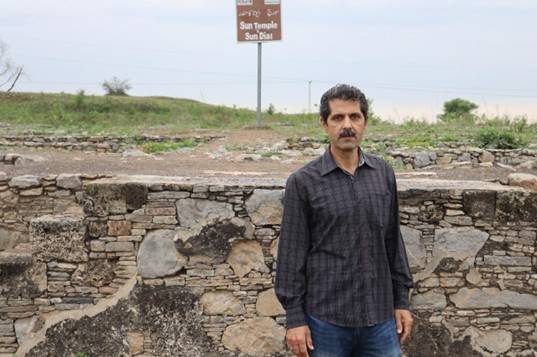
He works as Assistant Professor at the Taxila Institute of Archaeology and Civilisations, Quaid-i-Azam University, in Islamabad – where he teaches courses on ancient history, civilisations, Gandharan archaeology, heritage legislation, research methodologies etc.
Among other cases, the book explores the discovery and research on the Gilgit Manuscripts, a set of Buddhist scriptures discovered under Giuseppe Tucci
Princely Archaeologies consists of thirteen chapters organised into three parts, with a foreword written by eminent historian Upinder Singh and an introduction by the editor.
The first part has eight chapters which deals with archaeology and conservation of monuments in the princely states of Hyderabad, Mysore, Baroda, Jammu and Kashmir, Gwalior, Travancore, Jaipur, Bhopal, Nagod and Mayurbhanj. It is reproduced from J Cummings’s edited volume Revealing India’s Past: A Cooperative Record of Archaeological Conservation and Exploration in India and Beyond, published in 1939. The second part contains four studies by different scholars separately arranged in four chapters. Of these, first is Nayanjot Lahiri’s paper discussing Sanchi vis-à-vis Bhopal Durbar and the colonial power; the second a study by Upinder Singh determines the role of local sovereigns in the preservation and protection of heritage sites; third is Rajasri Mukhopadhyay’s article on archaeological research in the Mayurbhanj state; and fourth is a paper of Luca Maria Olivieri discussing the discovery, provenance, acquisition and research on the Gilgit Manuscripts, which is a set of Buddhist scriptures, discovered under Giuseppe Tucci. Lastly, in the third part, a chapter is added by the Editor which explores further venues for historical investigation in the field of princely archaeologies.
It needs to be understood that in this book, as reflected in its contents, the term “princely archaeology/archaeologies” means archaeology of the princely states, archaeology by the princely states and archaeology for the princely states. By princely archaeology, the editor does not, at all, mean royal inheritances.
Lastly, I would like to invite historians and archaeologists to read this scholarly and appealing work. I hope this book will develop a sense among them and bring their attention to this less-explored area of South Asian archaeology.