

In our educational journey, there come certain moments of transition that illuminate the path to our goals—transitions that make life more meaningful and purposeful. I experienced two such turning points in my academic life: in September 2016, when I got enrolled at HITEC University, and in September 2019, when I joined Istanbul Technical University as an exchange student.
It was the landscape of HITEC University that first attracted my heart. When I saw photographs of the campus scenery, my inner self instantly responded positively; to some extent, it was love at first sight. I thought, at the very least, I would be able to enjoy the ambience, the mountains, and the evenings there. I then passed the admission test and became a part of the Mechanical Engineering department as '16-ME-174'.
Over time, I realized it wasn’t just the location, ambience, or the mountains—the people were amazing too. My teachers and classmates, the incredible Section-B, hostel life, and friendships—everything aligned with my nature. I spent three years at HITEC, remained an average student in terms of grades, managed to keep my CGPA above 3, and nurtured my passion for Urdu literature—though I couldn't win a single seat in the literary society elections. I did win some chess competitions and gathered a great deal of indelible memories. Despite some grievances and differences with the university system, I had always been satisfied with being a Hitonian—and I still am. HITEC has my heart.
The second transition began with my selection as an exchange student to Istanbul Technical University, Turkey. I received the opportunity despite my average CGPA, as the selection criteria weren’t solely based on grades but also included interviews and communication skills. I secured the first preference, and alongside me, another student, Haider Ali from the Electrical Engineering department, was selected. We met for the first time, developed a bond of friendship and respect, and together stepped into a new realm. The program was of one year's duration, allowing us to complete the final two semesters of our graduation in Turkey.
When I returned to Pakistan, I felt something was missing. I realised I had left a part of myself in Turkey
Next came the immigration process and registration at ITU. After the uphill tasks of documentation, embassy interviews, and visa processing, followed by farewells and heartfelt wishes from loved ones, we finally took our flight to Istanbul. The excitement was overwhelming. I was euphoric, filled with childlike joy and deep gratitude.
Soon after, on September 11th, 2019, we attended orientation at ITU. Mrs. Sibel GÜÇKIRAN was our program coordinator. She welcomed us warmly and equipped us with all the necessary information. To me, she was the first embodiment of the great hospitality and affability of the Turkish people. Her support, kindness, and care from day one to the last are beyond words. Turkish people, I found, are not only welcoming but also share a unique bond of warmth with Pakistanis. And so, a fascinating chapter of my academic life began at ITU.
Life at ITU was academically rich and diverse. The experience was new, different, and challenging. Everything was well-structured—the grading system, class schedules, campus infrastructure, labs, libraries, cafés, dormitories, and student communities. The faculty was erudite, cooperative, and exceptionally professional. I studied my required courses and also explored subjects like Power Transmission in Vehicles, HR Management, and Academic Writing. My Final Year Project focused on Co-generation. Interestingly, I performed well despite my vagabond nature and constant craving to explore Istanbul. From the very beginning, Istanbul had me in its charm.
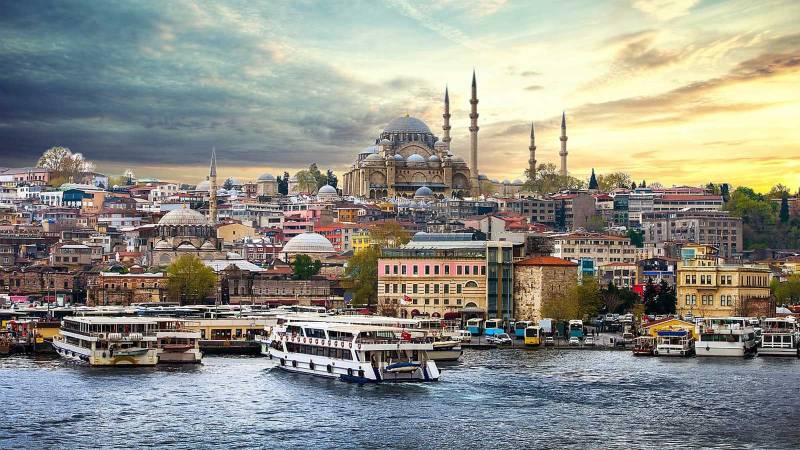
I remember our first evening in Istanbul. Haider and I were walking around the city when I had a sudden realization—I was really here: in the magnificent Istanbul, the crossroads of East and West, where churches and mosques meet. I stood gazing at the Marmara’s waters, witnessing a majestic sunset from the Galata Bridge.
There were countless moments of awe and wonder—roaming Istiklal Street, exploring Byzantine and Ottoman architecture, crossing the Bosphorus on ferries, witnessing the season's first snowfall, and praying in Istanbul’s splendid mosques. The Eyup Sultan Mosque, in particular, became my spiritual home throughout the year.
A significant part of this voyage was the international exposure and intercultural interactions. I met wonderful and colorful people. My Turkish roommates—especially my brother Halil Ibrahim—were a true blessing. There were friends from my tajwid class, the warm-hearted Indian-Pakistani fraternity, classmates, and notably, the Erasmus exchange students. Though our program was distinct, our coordinator linked us with them, enriching the experience. We shared weekend trips, heritage tours, cultural events, Islamic gatherings, city excursions, and unforgettable food adventures. These became cherished, everlasting memories.
I am deeply thankful to everyone who made my final year so beautiful and memorable—my parents and family, my teachers (especially Sir Osman Akin KUTLAR, Sir Barbaros Soyer, and Sir Turgat Yilmaz), my friends and colleagues. I owe them my gratitude and love. And above all, I owe my happiness and success to Allah Almighty. Alhamdulillah for everything.
When I returned to Pakistan, I felt something was missing. I realised I had left a part of myself in Turkey. I now carry a precious treasure of memories, from which I can draw joy at any time. Sometimes, I find myself wandering Istanbul’s streets again: hiking mysterious trails on the Princes’ Islands, exploring ancient caves in Cappadocia, watching the calm Black Sea from a balcony in Şile, or praying in Yıldız Hamidiye Mosque. I see myself sitting in front of Ayasofya or enjoying a sunset at Florya Sahil. I walk the ITU campus under a blanket of snow or savor kunefe with Turkish tea at Hafiz Mustafa in Taksim Square.
I live in these moments. And now, my mind drifts back to one particular twilight in Istanbul. I’m aboard a ferry sailing on the Bosphorus, from Kadıköy to Beşiktaş. Standing on the deck, I try to absorb the fact that I’m part of this moment. The sky looks unreal, the sun paints red on the clouds behind the hills, and the Galata Tower rises among the shadowy minarets. As dusk prevails, the sea darkens. I sit on a bench, put on my headphones, and play a ghazal:
“As soon as His thought appeared,
He appeared in my heart.
What wondrous miracles the heart has accomplished!
Though nothing was said to Him face to face,
What wondrous conversation occurred behind the curtain of the heart!
Those heart-stopping glances, those mischievous graces—
What wondrous calamities we're seeking!”