

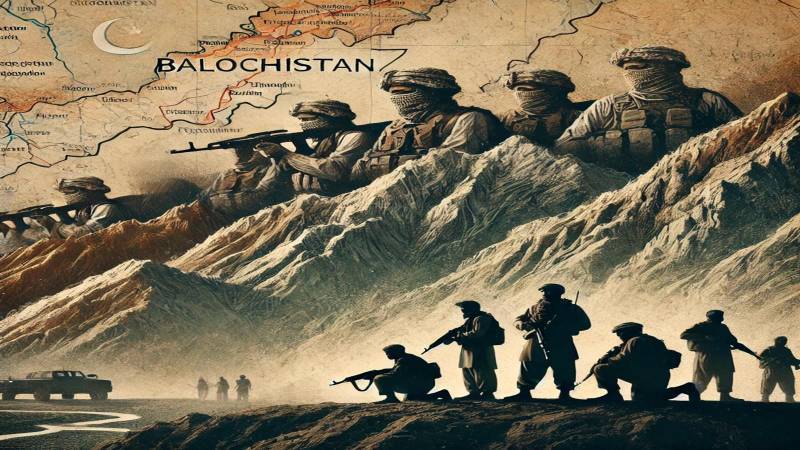
It is crucial for a country like Pakistan with fragile relationships with neighbouring countries, to have both strong security and peripheries that are well integrated with the Centre. Despite our strong security, all our peripheries are in trouble, risking our stability and economic ambitions. Escalating insurgencies evidence deeply fractured state-society relations that are turning us into an ungovernable state, susceptible to being exploited by our “enemies”. One thing is clear, enhanced security or “hard state” prescriptions are not sufficient, the hard governance issues also need to be resolved. Unfortunately, there is a total absence of leadership on these vital issues, at a time when they can no longer remain unaddressed.
Our eastern border with India was always hot. But now the western border from the newly Merged Areas to Balochistan including Gwadar is even more active with unrest. Gilgit-Baltistan (GB) and Azad & Jammu Kashmir (AJK) are also simmering with their discontent.
Following the Jaffar train attack, we are back to launching new military operations to contain the BLA violence and creating another National Action Plan (NAP). Before we move on to NAP II, we should examine why NAP I (December 2014, revised 2021) failed in its kinetic and non-kinetic domains. These included revamping and reforming the criminal justice system (2014) and the Balochistan Reconciliation Process (2021). So, despite these, why has the situation deteriorated?
Unfortunately, accountability and meaningful debate about our blunders are missing. In the Merged Areas, our failure to honour our commitments to address historic underdevelopment whilst implementing a “hard state” approach has resulted in a sense of betrayal and alienation. Folly continues to inform our policy and strategy. So, why are we so sure that NAP II will be any different?
Arguably, NAP 2014 and 2021 were designed to contain rather than address actual on-the-ground grievances. A qualitative shift in thinking is required that brings the focus to the quality of state-society relations, prioritising trust, governance and the peripheries that have long been marginalised.
Kinetic domain or military action has severe limitations. At best, it can provide a brief respite from terrorism and create space for negotiations to deal with underlying grievances that fuel the discontent and the insurgency. It is a not a solution.
Moreover, the Armed Forces confronting its citizens weakens vital public support for their actions and exacerbates the sense of grievance. Since the Armed Forces are mandated and designed to fight, to protect the borders, they do not possess the mindset and tools to deal with issues that are essentially political and pertain to civilians -for that, capable civil security services should always be at the forefront.
The entire province of Balochistan has less of a voice and share in power than the single Lahore division. Its seats in the National Assembly amount to a mere 5.95pc, 20 seats out of 336 seats
The government needs to demonstrate leadership with earnestness and empathy; to negotiate a peaceful solution with the citizens of Pakistan, who are after all entitled to respect and dignity.
It must compensate for the trust deficit created by failing to honour past agreements such as the 18th Amendment provision relating to the shared ownership of minerals, oil, and gas (Art. 172(3)). Exclusion has effectively pushed smaller provinces, poorer classes, and the younger generations outside of the political process. The historic under-development in the peripheries demands priority.
Political exclusion is, however, structurally built into our Constitution and legal frameworks. It is grossly unfair that an entire province has fewer seats than a single division in Punjab. Balochistan holds 44pc of Pakistan territorially- and yet has only 20 seats in the National Assembly, whereas Lahore division alone has 24 general seats. The entire province of Balochistan has less of a voice and share in power than the single Lahore division. Its seats in the National Assembly amount to a mere 5.95pc, 20 seats out of 336 seats. With these numbers, Balochistan is structurally and permanently condemned to political exclusion. There is little incentive for the aggrieved to resolve their grievances through the political process that is loaded against them and demonstrates little sensitivity to their concerns.
Therefore, Balochistan and other peripheral regions must be Constitutionally and legally empowered to have a meaningful share in power. There could be a formula that considers both area and population to work out the National Assembly seats to enable a fairer distribution of power and resources. People need to feel active participants in negotiating their destinies and solving their problems locally. Meaningful devolution and decentralisation are therefore part of the solution.
One option is to increase the number of provinces significantly by converting each division into a province to gain an even distribution of power, resources, and opportunities with the Senate as the revising chamber for all the provinces to improve political integration and policy coherence. Smaller provinces would be administratively more manageable. Alternatively, through a Constitutional amendment, local government could become an independent third tier of governance with its own constitutional list of subjects and share of resources. Ideally, both options would lead to smaller provinces with strong local governance. Punjab’s overwhelming dominance in the Federation, which is a major source of grievance for the other smaller provinces would also be addressed.
We need policy and strategy premised on the realisation that an unjust state and society are not sustainable; eventually, they will disintegrate
Our politics also need both a generational and a class change to bring in new thinking and be genuinely representative of the local demographics. This requires electoral reforms to reduce financial and other barriers to ensure wider participation in electoral politics (see Mohammed Sarwar Khan, “Electoral Reform”, The News, 1 Dec. 2021). Genuine intra-party elections would create a new generation of leadership that is more in tune with shifting public aspirations. An anti-dynasty law would reduce the concentration of power in small families and elites that only represent themselves, a key reason for underdevelopment and discontent. Moreover, only genuine representatives possess the credibility to draw the aggrieved into the political process and confront the militancy sustainably.
The practice of selecting favourites for political and bureaucratic positions and rigging elections is a major part of the problem. It robs the political process, Parliament, and the “elected representatives” of both legitimacy and efficacy and crucially, effective interlocutors between state and society. Consequently, the political process is so fragile that legitimate grievances are pushed out of the political space and/or silenced, only to resurface as organised rage and violence challenging the political order.
GB and AJK are also simmering. Whilst preserving their special status for purposes of international politics, they must be provided credible and meaningful representation in the Senate and National Assembly, which presently, decides their budget and other matters without their input. The younger generation deeply resents this “colonial” mode of governance that alienates them from the Centre. The failure to timely meet their legitimate demand to be a real partner in the Federation, with a say in matters affecting them, only promises that GB and AJK will follow the newly Merged Areas on the Baluchistan trajectory.
What binds the State and society is a vibrant and inclusive Constitution that is a living and responsive document, accommodating the wide spectrum of public opinion and identities, and providing a more even distribution of power, resources, and opportunities.
We need policy and strategy premised on the realisation that an unjust state and society are not sustainable; eventually, they will disintegrate. It is the Constitution that ensures the public’s voluntary compliance with all that flows from the State. A weak and/or unfair Constitutional order, where everything is permissible for some, and not others, can only yield more discontent and chaos. The question is: Are our political and institutional elites willing to set aside their cravings for dominance, hegemony, and vested interests in favour of the national interest to negotiate a Constitutional and political order that responds to all?