

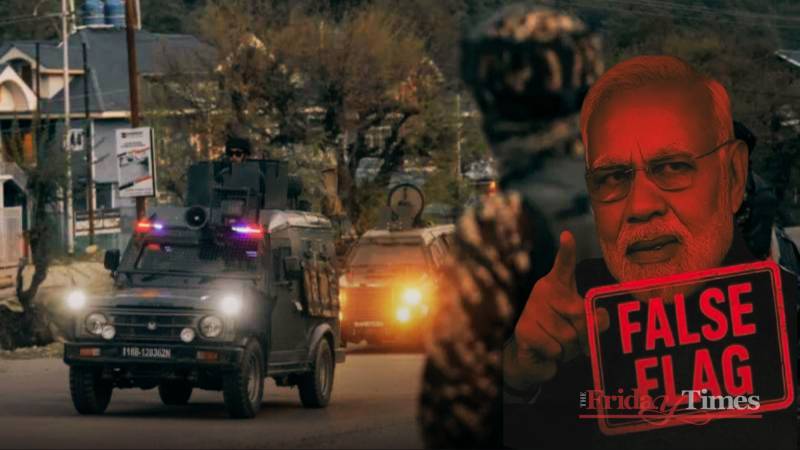
Indian authorities have apprehended two thousand Kashmiri suspects in connection with the recent Pahalgam killings.
Former Air Vice Marshal of the Indian Air Force, Kapil Kak, a Kashmiri Pandit, described the response as a form of collective punishment of the Kashmiri people in a podcast with Arfa Khanum Sherwani. Some two thousand Kashmiris have been taken into custody for investigation – or, as many reasonably suspect, for brutal torture. More broadly, Indian Muslims are being labelled as terrorists, jihadis, and other terms drawn from the post-9/11 Western lexicon. War hysteria now grips India, likely fuelled by a decade of Godi media rhetoric that cast the country as a superpower capable of obliterating Pakistan at will.
However, it is time for India to confront some painful realities.
The abrogation of Article 370 in 2019 created the illusion for many Indians that Kashmir was now a settled matter. The 1949 UN resolution on Kashmir – which India itself had secured – was dismissed as irrelevant. Nor was the issue open to bilateral negotiations with Pakistan, as had been stipulated in the 1972 Simla Agreement. A façade of normalcy was constructed in Kashmir. After Pakistan failed to respond to the Kashmiris’ call – a point made by exiled Kashmiri leader Dr Mubeen Shah in a recent interview with me – the Kashmiri people appeared to have abandoned their struggle for freedom from Indian occupation.
The Kashmiris seemed to have reconciled themselves to their fate, but had not truly accepted it in their hearts.
Across the border, tensions escalated to the point that war drums began to beat. In Pakistan, the initial reaction was one of disbelie
This emboldened the far-right, extremist Hindu regime of Narendra Modi to believe that Kashmir had been fully annexed, and that it was safe to declare the region under complete control. Their servile media – the Godi media – reinforced this narrative, prompting ordinary Indian citizens to flock to the Kashmir Valley as summertime tourists, drawn by its pleasant climate. In 2024, the valley experienced a surge in Indian tourism. Yet, while the local population benefitted economically from this influx, their political rights were steadily eroded.
The region’s security apparatus was directly controlled by the Minister of Home Affairs, Amit Shah, and the Lieutenant Governor, Manoj Sinha – both appointed by the central government, not by the elected Chief Minister of the occupied valley, Omar Abdullah. It is worth noting that this Chief Minister was the product of the much-publicised elections held in the valley. However, real power remained with New Delhi. The semblance of normalcy was a charade, particularly given that the Hurriyat (freedom) leader, Mirwaiz Umar Farooq, was barred from leading Friday prayers.
The repression that followed the abrogation of Article 370 – including an internet blackout, the silencing of independent journalists, the constant persecution of the local population, and the high-handedness of the Modi government – succeeded in creating an atmosphere of fear and enforced silence. This, in turn, misled the Indian public into believing that the Kashmir conflict had been resolved. It was assumed the freedom struggle had ended. Pakistan was seen as too weak, mired in its own crises, and therefore unworthy of engagement – after all, if force worked, why negotiate?
True, force did suppress the Kashmiri people – but it did not win their hearts. They had resigned themselves to an unwanted fate, but resentment simmered beneath the surface. Strangely, the Modi government and its supporters had become so intoxicated by their own rhetoric that they lost touch with reality. In the absence of a free press, perhaps the only news they consumed was that which reaffirmed their own illusions.
Dr Hasnain Javed holds the view that Modi has been set up. He explained this in my live show, Political Zone on Federal Post, which was banned in India on 29th April.
The Godi media wasted no time in blaming Pakistan. Even before the Indian government could formulate an official stance, an atmosphere of hostility had already been created – leaving little room for the government to adopt a balanced position, even if it had wanted to. Let us not forget: while these attacks took place, Modi was on a business tour of Saudi Arabia, and the US Vice President was sightseeing in India with his Indian-born wife, Usha.
According to Dr Javed, the real target is not Pakistan – it is China. As circumstantial evidence now suggests, it was perhaps a third party that orchestrated the attack, pushing a panicked Modi into reckless statements and actions. His speech at an election rally in Bihar, delivered in English, was a masterpiece of miscalculated bravado. He promised a charged-up crowd that severe punishment would be meted out to the perpetrators of the attack – clearly alluding to Pakistan. His rhetoric, amplified by the Godi media, stirred a wave of war hysteria across the country.
The media had already laid the trap – and he walked straight into it.
Meanwhile, Pakistanis looked on in confusion – what did we have to do with any of this? The country is still mourning the victims of the Jaffer Express and numerous other tragedies. The questions being asked across Pakistan were: Why would we carry out such an attack? What possible motive would we have? This is simply not Pakistan’s modus operandi.
Across the border, tensions escalated to the point that war drums began to beat. In Pakistan, the initial reaction was one of disbelief. Memes flooded social media, mocking Indian media’s demonisation of Pakistan and the theatrics of shouting news anchors predicting its annihilation.
But India made one critical error: suspending the Indus Waters Treaty.
That changed the mood in Pakistan. All three armed forces are now on high alert, prepared for any aggression from the Indian side. With this, the last illusion of a politically divided Pakistan has evaporated. If it has come to this, the collective resolve is clear – we are ready.
Yet across the border, uncomfortable truths may now be dawning on the Modi government. This is a two-front war. “We support Pakistan’s sovereignty,” China has declared.
It is time for Mr Modi to pause and reflect: Who set me up?