

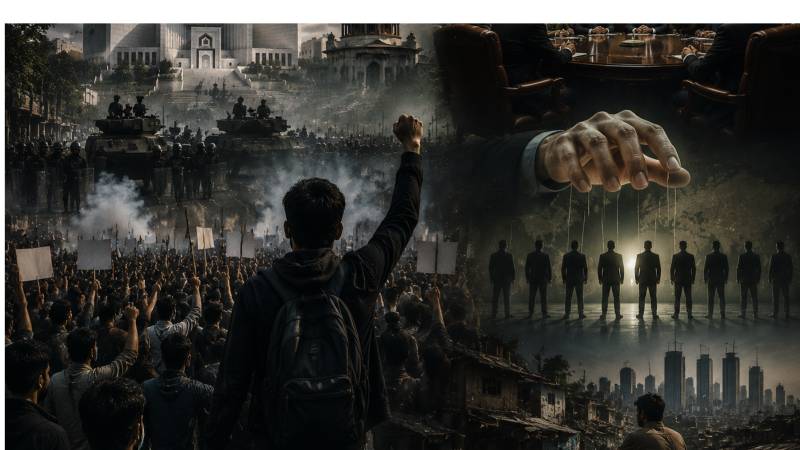
After the rise of a youth-led movement in India called the Cockroach Janta Party, many writers and analysts are wondering if something similar could happen in Pakistan. This is both an interesting and important question. Let's explore it in Pakistan's context.
To understand why state power in Pakistan endures, traditional political analysis often focuses too much on direct force. Military takeovers, judicial overreach and police crackdowns are important, but they do not fully explain why the country's social and institutional structures stay the same, even after years of political crises and protests. To see how power survives in such unstable times, it helps to look at Antonio Gramsci's ideas about hegemony, the integral state and passive revolution.
In postcolonial societies, those in power do more than just use force. They build support by taking in popular demands, bringing new social groups into the fold and reshaping national stories. Through repeated cycles of passive revolutions, the state changes itself from the top, bringing in groups that could cause disruption while stopping any real change from ordinary people.
Gramsci’s idea of the integral state says that state power is not just about government offices. It is shaped by the mix of political society and civil society, where the former uses force and the latter produces consent. In Pakistan, this works through what sociologist Hamza Alavi called an "overdeveloped state," meaning a strong administrative and military system left over from colonial times, which was much more organised than local political parties or civil groups at independence.
When public anger threatens those in power, the state almost never gives in or falls apart. Instead, it carries out a passive revolution by slowly bringing new social groups, political figures and opposition leaders into the system. By making some concessions, introducing technical reforms and reshaping national slogans—often mixing religious nationalism, anti-corruption messages, and promises of development—the ruling group keeps its main power while making it seem like real change is happening.
Mainstream political parties in Pakistan claim to be democratic alternatives to military or bureaucratic rule. However, their history shows that they often help carry out ‘passive revolution’ and keep the existing power structure in place. Reinforced by mainstream party politics, the mechanics of passive revolution operate to either absorb or exhaust them.
The PPP, led by Zulfikar Ali Bhutto, started in the late 1960s as a movement against dictatorship rallying workers and rural people with a left-wing agenda. But once in power, the party carried out a passive revolution by removing radical leftists, bringing labor unions under state control, and making deals with traditional elites. Over the years, especially after the 2007 Charter of Democracy and the Lawyers' Movement, the PPP became a typical patron-client party, turning popular demands in Sindh and elsewhere into elite-controlled politics.
The PTI's rise marks a newer and neoliberal form of passive revolution. It grew out of the fast-growing urban middle class in the 2000s and used a populist message focused on efficiency, moral change, fighting corruption, and a modern city-based Islamism. Instead of changing the basic structure of the state, the PTI described deep problems as just "rent-seeking," "leakages," or the personal faults of corrupt leaders. By channeling the frustration of educated youth and urban professionals into a movement led by a strong leader, the PTI brought this new social class into the larger state project.
When public anger threatens those in power, the state almost never gives in or falls apart. Instead, it carries out a passive revolution by slowly bringing new social groups... into the system.
Parties like the Pakistan Muslim League-Nawaz (PML-N) were created as part of state-led passive revolutions, especially under Zia-ul-Haq, to fight left-wing movements. The PML-N is rooted in the rural-urban middle classes, such as small business owners and local brokers. It keeps its power through local patron-client networks and by building roads, transit and other big projects. These projects offer development but also keep poorer groups dependent on local elites and state support.
The Pashtun Tahafuz Movement (PTM) started as a peaceful movement for the rights of marginalized people in the former Federally Administered Tribal Areas (FATA). By calling for constitutional rights, an end to extrajudicial killings, accountability for disappearances and the removal of landmines, the PTM directly challenged the power and control of the security state.
Since the PTM's demands directly challenged the military's core interests, the movement could not be easily absorbed. Instead, the state tried to weaken it through media blackouts, criminal charges and by keeping it out of mainstream media, while also labeling it as foreign-funded or anti-state.
The state used ongoing arrests, sedition charges, travel bans and targeted violence against PTM leaders. These actions stopped the movement from forming strong alliances with other labor or regional groups in cities. Along with these tactics,, some PTM leaders were allowed into parliament, thus making a dent. Because of these state actions, the PTM did raise awareness among Pashtun youth, but it could not turn its moral influence into a nationwide political movement. The state kept it limited through ongoing, low-level pressure.
The PTI's story shows that absorption has its limits. The state first used the PTI to take in middle-class frustration, but later the party clashed with the military when its popularity conflicted with the establishment's goals. The state applied intense coercive and administrative pressure to dismantle the party's formal organisational structure. However, the energy of the movement highlights a key Gramscian principle: when a passive revolution fails to integrate or satisfy the social forces it once mobilised fully, the resulting crisis of transformism creates deep, volatile cracks in the state's hegemonic facade. Yet in the case of PTI,, which is driven by one charismatic man’s ideals and promises no real change in Pakistan's political arena,, it is unlikely that youth associated with its charismatic leader can think independently about the hegemonic affairs of the state. On the other hand, PTI is a Pakistani nationalist party favouring a strong centre with strong rightist tendencies; it cannot mobilise the youth around deep structural issues within the Pakistani state. The tension between the PTI and the military-led federal set in Pakistan seems to be based on the egos of two powerful men—at one end the field marshal and at the other Imran Khan.
Since the state has often absorbed popular movements and worn down radical ones, we have to ask: Can a truly transformative youth movement happen in Pakistan today? Demographically, the conditions for mobilisation are overwhelming. Nearly two-thirds of Pakistan’s population is under thirty, facing structural unemployment, high inflation, severe climate vulnerability, and above all an eroding and shrinking democratic space. Thus the chances for youth mobilisation are huge. But having a large youth population does not guarantee big change.
Digital media make it easy to share information and expose state abuses, but social media activism often leads to emotional reactions, division and movements focused on single leaders. Hashtags and viral campaigns cannot take the place of slow, steady work to build strong, democratic groups like student unions, trade councils, legal funds and local organizations. Without these roots, youth anger can be easily taken over by the state or quickly fade away. The state in Pakistan now keeps its power by promising big, top-down development projects, like large infrastructure, foreign investment and urban real estate. For a youth movement to be radical, it needs to offer a different idea of development and put democratic values at the lead of the development narrative.
A radical youth movement in Pakistan is not just possible; given the country's population and economy, it is bound to happen. But whether it brings real change or just becomes another part of the country's history of passive revolution depends on its strategy. If young people only follow charismatic leaders, focus on elections or react online, their energy will end up supporting the same old system. To break this cycle, they need to build a real alternative: a long-term political project that links the hopes of urban youth with the struggles of workers and people in less-represented regions. Only by creating strong, inclusive organizations can Pakistan's youth move from watching elite power struggles to shaping a truly democratic future.