

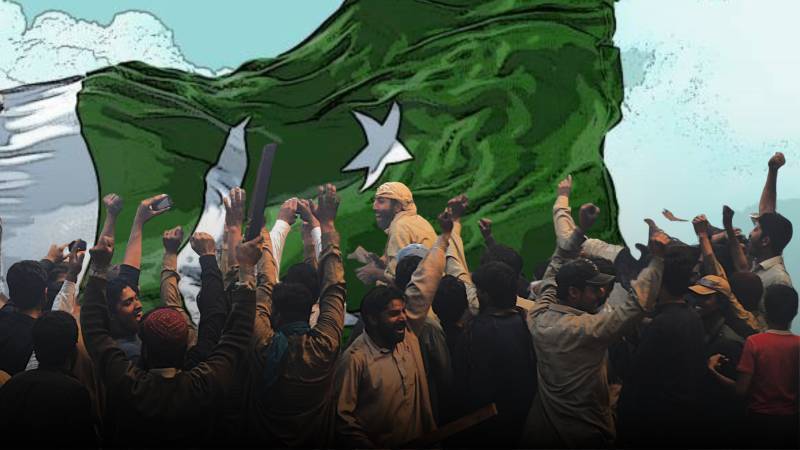
Utopia has a bad reputation. It should not.
When Rutger Bregman, a Dutch historian, argued that the most practical thing a society can do is take its own imagination seriously, he was not writing fantasy. He was making a historical observation. Every institution that today appears self-evident—the eight-hour workday, universal suffrage, the welfare state—was, at some point, dismissed as dangerously naive. The people who built those institutions did not wait for permission from the existing order. They decided, first, what kind of world they were building towards. The mechanics followed.
Pakistan has never done this. It has managed, reacted, and survived. It has never seriously asked what it is for.
Begin with the question of scale. Pakistan is the fifth most populous country on Earth. Its median age is under twenty-two. It has the largest irrigation network in the world. It sits at the only overland junction connecting South Asia, Central Asia, West Asia, and China simultaneously. No other state occupies this geographic position. These are not talking points. They are the raw material of a serious civilisational project, if the political imagination exists to treat them as such rather than as bargaining chips in someone else’s strategic calculation.
The civilisational question is where the utopian argument must begin, because the technocratic argument has been exhausted. Tax reform papers exist. Regional trade frameworks have been modelled. Civil service restructuring proposals have been written, shelved, rewritten, and shelved again. The problem has never been the absence of a blueprint. It has been the absence of a compelling account of what the blueprint is actually building towards. People do not absorb the costs of transformation for the sake of a fiscal adjustment. They absorb them for a picture of collective life that seems worth the cost.
What would that picture look like, concretely, for Pakistan?
A country of two hundred and forty million people, the majority of them young, in which the state’s primary relationship with its citizens is educational rather than extractive. Where the public university is the primary site of social mobility rather than the private school, the foreign scholarship, or the military career. Where the forty per cent of children who currently do not complete primary school are understood not as a welfare problem but as the central economic and civilisational failure of the state, and are treated accordingly in budget allocations and political prioritisation.
The utopia on offer here is not a perfect state. It is a state pointed in a different direction. Towards its own people rather than towards its patrons
A country in which the Indus basin, the most elaborate river management system constructed in the colonial period, is governed as a shared resource across provincial and national boundaries rather than as a site of interminable jurisdictional conflict. Water scarcity is not a distant threat for Pakistan. It is a present condition in Balochistan and northern Sindh. A state serious about its own future treats its hydrological reality as a first-order political question, not as a technical matter to be delegated to an underfunded authority.
A country in which Karachi functions as what its geography and population warrant: one of the major port cities of Asia, comparable in ambition, if not yet in execution, to what Istanbul or Shanghai represent for their respective regions. Karachi has been governed, for most of its post-independence history, as a problem to be managed rather than a city to be built. The consequences are visible in its infrastructure, its water system, its transit, and in the persistent failure to convert its enormous informal economic energy into formal institutional capacity.
The political form this requires is not a new ideology. It is a different relationship between the state and the people who live under it. Democratic procedure in Pakistan has been present without being substantive. The missing element is not elections. It is accountability that runs downward rather than upward. A parliament that answers to its constituents more than to its patrons. A bureaucracy that is evaluated on service delivery rather than on political loyalty. A judicial system whose reach extends to the powerful as reliably as it extends to the powerless.
The foreign policy dimension of this picture is the most radical departure from current practice. A Pakistan genuinely oriented towards its own development, rather than towards strategic availability, would find, in its neighbourhood, a set of economic relationships more valuable than anything its current patron network provides.
Central Asia’s landlocked economies need access to the Arabian Sea. Iran’s educated, urbanised population is a natural trading partner for Pakistani industry. Afghanistan’s reconstruction, however distant it appears, passes through Pakistani territory regardless of who governs in Kabul. India’s economy, the third largest in the world by purchasing power, shares a border that has been effectively closed for most of seven decades, at incalculable opportunity cost to both sides.
The state that could build these relationships does not yet exist. But its preconditions are not exotic. They are a provincial settlement in which peripheral regions have genuine stakes in the national project rather than accumulated grievances against it. A security doctrine that defines threat in terms of economic and ecological vulnerability rather than exclusively in terms of military competition. A public sphere capacious enough to debate these questions without the conversation being narrowed from above.
Bregman’s core argument was that the distance between the world as it is and the world as it could be is shorter than we are encouraged to believe. The obstacles are political and distributional, not civilisational or geographical. Pakistan is not poor because of where it is or who its people are. It is organised, at the moment, around priorities that reproduce poverty rather than address it. That organisation is not permanent. It is a political choice, sustained by political arrangements, and therefore changeable by political means.
The utopia on offer here is not a perfect state. It is a state pointed in a different direction. Towards its own people rather than towards its patrons. Towards its region rather than towards its sponsors. Towards the next generation rather than towards the next programme.
That reorientation is the work. Everything else is detail.