

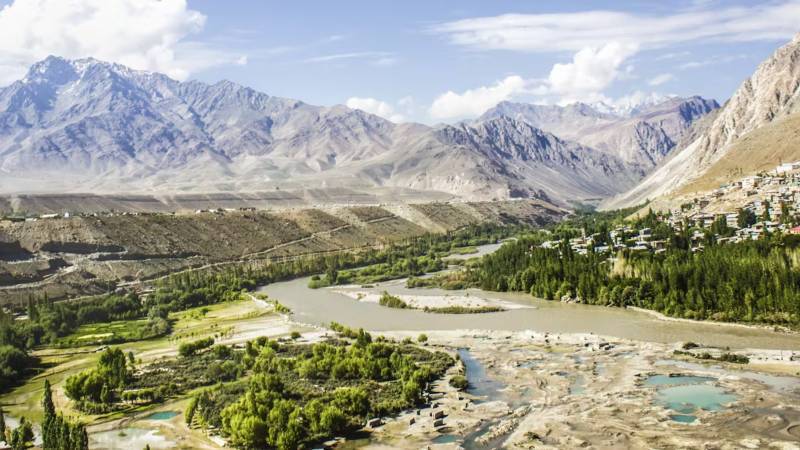
In recent days, the Indian government under Narendra Modi has once again issued reckless threats regarding Pakistan’s water rights under the Indus Waters Treaty (IWT). The latest provocations focus on the Indus, Jhelum, and Chenab rivers, which are essential lifelines for Pakistan’s agriculture, economy, and rural livelihoods. It must be made absolutely clear: under international law, India cannot legally or unilaterally divert or block the waters of these rivers. The Indus Waters Treaty, signed in 1960 with the World Bank acting as a guarantor, remains a binding legal commitment. Any attempt by India to violate it would amount to an unlawful and unjustified act, drawing serious global attention and consequences.
While these threats might cause concern among ordinary citizens, it is important to remember that water cannot be weaponised as easily as some politicians imagine. India already has control and infrastructure over the eastern rivers - the Sutlej, Ravi, and Beas - under the Treaty. Yet, every year during heavy monsoon rains and floods, these rivers overflow. Despite all their dams and barrages, the water first wreaks havoc on Indian territories before even reaching Pakistan. Nature does not obey political commands. Floodwaters will continue to cross borders regardless of nationalism or ideology.
Adding to the crisis is the environmental threat of pollution. While India controls the Sutlej, Ravi, and Beas, it has allowed massive pollution to contaminate the rivers. Industrial waste, untreated sewage, and agricultural runoff from Indian cities and farms are routinely dumped into these rivers before they enter Pakistan, causing serious health, agricultural, and ecological hazards. Reports and studies have documented alarming deterioration in water quality, especially in the Sutlej and Ravi. Under the Treaty, water must not only flow but must remain usable and lawful for its intended purpose. Pollution violates this spirit. Pakistan must respond firmly by taking this evidence to the World Bank, raising formal environmental complaints under international law like the UN Watercourses Convention, and pushing for joint monitoring mechanisms, as recommended by global experts. Allowing unchecked pollution is a slow form of environmental aggression and must be stopped with scientific diplomacy and legal firmness.
The world must see through India’s double standards - a country that preaches climate leadership at global events but practices climate terrorism against its neighbours
At the same time, it is vital to highlight the broader injustice in climate responsibility. India is now the third-largest greenhouse gas emitter globally, releasing nearly 2.7 billion metric tons of carbon dioxide annually. Pakistan, on the other hand, contributes less than one percent to global emissions but suffers some of the worst climate impacts. Pakistan faces deadly floods, heatwaves, droughts, and water scarcity, making it a clear victim of global climate injustice. It is tragic that a country already suffering from others’ environmental recklessness now faces additional threats to its very survival.
This hypocrisy is particularly glaring when one recalls how India has projected itself internationally. In 2013, I personally attended the Delhi Sustainable Development Summit (DSDS), hosted by The Energy and Resources Institute (TERI) in New Delhi. Indian leaders at that summit loudly committed themselves to leading climate action in the Global South. Major Indian newspapers carried proud headlines Environment and developmental agendas linked: PM (The Hindu), . India has also hosted major events like the India Water Week, the South Asia Water Initiative Conferences, and international meetings under the Ministry of Environment, Forest and Climate Change where it presented itself as a responsible climate and water leader. Today, however, India's actions stand in complete contradiction to those lofty promises, exposing the current government’s hypocrisy.
What makes India's threats even more dangerous is the global precedent they could set. The Indus Waters Treaty is not just about India and Pakistan; it is a symbol of how nations with deep hostilities can still cooperate on shared natural resources. Breaking such an agreement would weaken international trust everywhere. Across Africa, Asia, and Latin America, many developing nations depend on similar treaties to share rivers and water resources. If India disregards its obligations, it will encourage others to do the same, pushing the global system toward chaos. Even India’s neighbors who have their own water-sharing arrangements with India - would see this as a warning sign, destabilising the region.
Pakistan's farmers, the unsung heroes of the nation, are at the center of this struggle. They are not just workers growing food; they are food security soldiers. They sustain the economy, feed the population, and support rural life. Any disruption in water supply attacks the heart of Pakistan’s survival - its ability to produce food, sustain employment, and maintain national stability.
The threats issued by India reflect political desperation, not genuine strength. Pakistan must remain calm but firm like our civil and military leadership has responded in the past few days. Our government must raise this issue at every important international platform - the United Nations, the World Bank, the Organisation of Islamic Cooperation (OIC), and the South Asian Association for Regional Cooperation (SAARC). The world must see through India’s double standards - a country that preaches climate leadership at global events but practices climate terrorism against its neighbours.
Water is a source of life, not a tool of political blackmail. Pakistan’s farmers, rural communities, and future generations must be protected by standing united and upholding the principles of international law and justice. No threat, no act of political aggression, and no hypocrisy can steal Pakistan’s right to survive and prosper.
Pakistan’s rivers are not just channels of water - they are the veins of the Pakistani nation’s heart. Every drop that flows sustains life, nourishes generations, and binds Pakistani Farmers’ identity as a resilient people. No government, no threat, and no injustice will ever dam the spirit of Pakistan. The Pakistani nation will protect their waters, farms, and future with truth, unity, and unwavering resolve.