

As Pakistan reflects on the airspace hostilities of May 2025, we must not allow momentary tactical gains or nationalistic fervour to obscure the hard-earned lessons of our past. The 1965 war, initiated by Pakistan’s ill-conceived Operation Gibraltar, offers one of the clearest cautionary tales in our history—a reminder that military adventurism, driven by emotion rather than strategy, has exacted grave costs.
In 1965, Pakistan sought a military solution to the Kashmir dispute under the flawed belief that Kashmiri Muslims would rise in revolt. Operation Gibraltar—planned in secrecy by President Ayub Khan’s regime—sent thousands of irregulars into Indian-administered Kashmir to incite an uprising. The assumption was both unrealistic and tragically misplaced: the local population not only failed to join the insurgents but actively reported them to Indian forces.
The result was a full-scale war. What had been planned as a covert manoeuvre turned into open hostilities, drawing Indian retaliation across the international border near Lahore on September 6, 1965. President Ayub Khan, in a dramatic radio broadcast, declared:
“India has attacked Lahore, and Pakistan is at war. My fellow countrymen, move forward and confront your enemy.”
Public sentiment surged—but it masked a dangerous strategic misstep that would soon exact a heavy price in men, matériel, and diplomatic capital.
The 1965 war did not bring Kashmir closer to Pakistan. Instead, it shattered alliances, exposed military weaknesses, and provoked political crises. Most damaging was the sudden suspension of U.S. military assistance on September 8, 1965, announced by President Lyndon B. Johnson, who felt betrayed by Pakistan’s unilateral escalation.
“They have gone off and started a war, thinking we’d come in like the cavalry. We won’t,” Johnson said.
Secretary of State Dean Rusk was even more blunt:
“You cannot, on the one hand, be our friend and, on the other, start a war without even informing us.”
While West Pakistani elites exalted the war effort, East Pakistan, left virtually defenceless, watched with growing bitterness
This abrupt severance permanently damaged a once-close relationship with the United States, Pakistan’s principal military and economic ally. The American embargo disproportionately weakened Pakistan, whose armed forces were dependent on U.S.-supplied tanks and aircraft. Islamabad’s strategy had assumed U.S. pressure or intervention—none came.
In the wake of diplomatic isolation, Pakistan turned to China, then recovering from the devastating Great Leap Forward. Though Beijing issued stern warnings to India and moved troops near Sikkim, it did not intervene militarily. Both the U.S. and Soviet Union privately urged China to stay out.
Beijing’s support remained largely rhetorical—a symbolic gesture that signalled future alignment, but little immediate utility. As Ayesha Jalal later observed:
“The war and its aftermath transformed Pakistan’s strategic calculus. The loss of American support and China’s rhetorical solidarity laid the groundwork for a strategic reorientation—born less out of coherent policy than reactive necessity.”
In reality, China in the 1960s and early 1970s was a poor country and a minor global power, offering moral support but unable to tip the balance in 1965 or in the 1971 war.
The war laid bare the institutional flaws in Pakistan’s military culture and decision-making.
Air Marshal M. Asghar Khan, Pakistan’s first native PAF chief, offered a scathing post-war assessment in his book The First Round (1979):
“Even senior commanders in the counter-attack force had been kept in the dark about their role, objectives, and the exact area of operation. Large-scale maps… were not available until about twenty-four hours after the attack had been launched.”
Lt. Gen. Asad Durrani, former ISI director, called Operation Gibraltar “a huge embarrassment” based on flawed assumptions.
“The decision to send infiltrators to Kashmir… had not been adequately thought through… Worse, it damaged the Kashmiris’ faith in Pakistan’s commitment to their cause.”
Brig. A.R. Siddiqui, head of ISPR during 1967–73, pinpointed a deeper rot within the institution:
“A sort of image-craze grips the top military echelons, producing ‘self-love’, ‘self-righteousness’ and ‘self-complacency’—qualities that are suicidal for the military profession.”
Rather than admit to misjudgement, the leadership crafted an official narrative of ‘victory’—one more interested in salvaging political legitimacy than acknowledging military reality.
Many scholars now agree that the 1965 war marked the beginning of Ayub Khan’s political decline. Rasul Bux Rais concluded that the war “proved that Pakistan could neither break India’s defences nor sustain an all‐out conflict,” exposing the regime’s strategic incompetence.
Zulfikar Ali Bhutto, then foreign minister, publicly attacked the Tashkent Declaration as a diplomatic sellout, catalysing a populist movement that would force Ayub’s resignation in March 1969. Bhutto’s critique, delivered in the National Assembly, captured popular frustration:
“The Tashkent Declaration did not stipulate the various measures which should bring those disputes to an end… it is only a declaration of intent.”
Bhutto turned this disappointment into a mass movement that unseated Ayub and transformed Pakistan’s political landscape.
The war’s most tragic consequence may have been the deepening rift between East and West Pakistan. While West Pakistani elites exalted the war effort, East Pakistan, left virtually defenceless, watched with growing bitterness.
National security lies not in bravado, but in wisdom; not in adventurism, but in diplomacy; not in slogans, but in sober, historical reckoning
With only an understrength division and 16 aircraft, East Pakistan was militarily naked. The Bengali press and intelligentsia condemned the neglect, seeing it as confirmation of their second-class status. A Dhaka observer noted:
“This helplessness was tempered by faint stoicism that India wouldn’t open a second front in the east.”
In February 1966, Sheikh Mujibur Rahman stated in Lahore:
“The question of provincial autonomy appears more important after the war… East Pakistan must become self-sufficient in all respects.”
The war “further aggravated the feelings of alienation in East Pakistan,” and bolstered support for the Awami League’s Six-Point campaign, sowing the seeds of secession that would culminate in 1971.
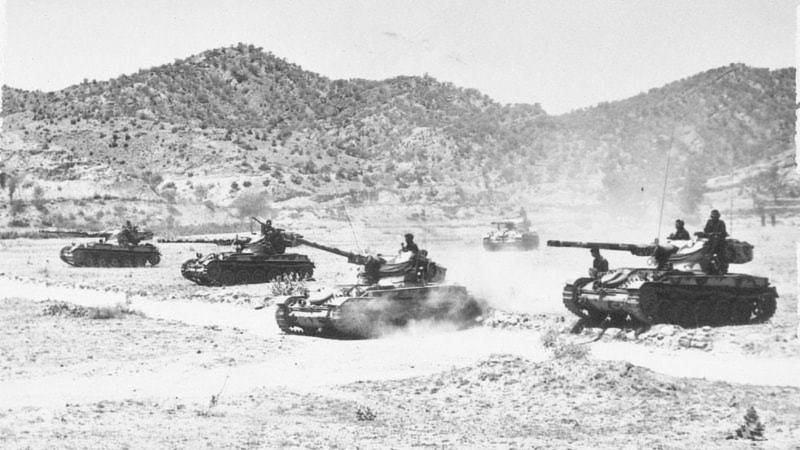
The war itself featured large-scale engagements, including the Battle of Asal Uttar (September 8–10), where Indian forces destroyed more than 90 Pakistani Patton tanks—a devastating blow to Pakistan’s armoured corps. In the air, Pakistan lost between 20–43 aircraft; India between 75–95.
Territorial gains were modest. Pakistan captured about 550–700 km² in Chhamb–Jaurian, while India took 1,800 km², including the strategic Haji Pir Pass.
As Shuja Nawaz put it:
“1965 was at best a draw, at worst a strategic blunder born of overconfidence.”
The Soviet-brokered Tashkent Declaration on January 10, 1966, restored pre-war boundaries but failed to resolve Kashmir. For Pakistanis, the aftermath felt like a betrayal of sacrifices made, of hopes raised, and of leaders who failed to deliver. The regime that had promised a decisive victory found itself discredited.
Pakistan, having alienated the U.S. and unable to rely on China, now stood isolated. Yet, rather than reassess its security doctrine, it would double down on strategic shortcuts.
In the decades that followed, especially during the 1980s, Pakistan turned to non-state actors to pursue its strategic aims—first in Afghanistan, then in Kashmir. This policy backfired spectacularly.
Today, Pakistan remains haunted by the global consequences:
UN sanctions against figures like Hafiz Saeed, Masood Azhar, and Zaki-ur-Rehman Lakhvi
Repeated grey-listing by the Financial Action Task Force (FATF)
International reputational damage
As Ayesha Jalal warned:
“Pakistan’s reliance on non-state actors has compromised both its foreign-policy credibility and internal stability.”
Today, nearly 80% of Pakistan’s population is under the age of 40. Most did not live through 1965, 1971, or even the early years of the Afghan jihad. They deserve the truth—unvarnished, unromanticised, and unapologetic.
The 1965 war was not a triumph but a turning point—and not in Pakistan’s favour. It ruptured our alliances, exposed our vulnerabilities, and sowed the seeds of internal disintegration.
If we are to chart a different course in the 21st century, we must learn from our historic blunders. National security lies not in bravado, but in wisdom; not in adventurism, but in diplomacy; not in slogans, but in sober, historical reckoning.
Let us never again allow emotion to override strategy, or illusion to substitute for truth.