

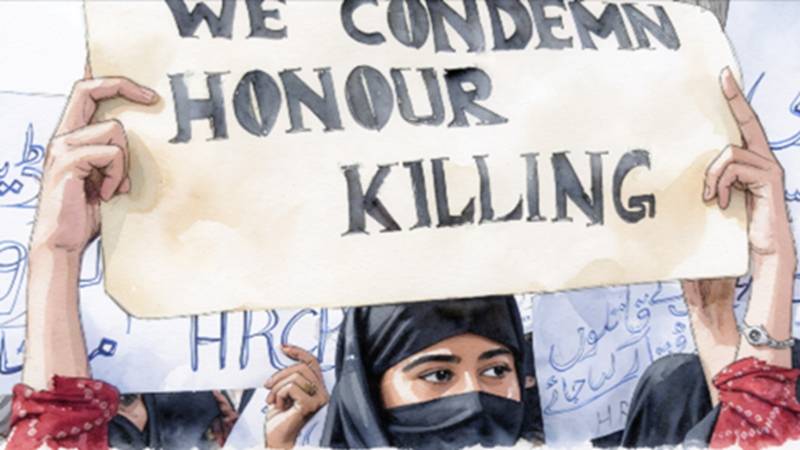
In mid-2025, a video from Balochistan forced Pakistan to confront a reality it has long tried to ignore. The video shows the woman, Bano Bibi, being handed a copy of the Holy Quran by a man identified by police as her brother. "Come walk seven steps with me, after that you can shoot me," she says, and she walks forward a few feet and stops with her back to the men. The brother, Jalal Satakzai, then shoots her three times, and she collapses. The video went viral in mid-2025. It sparked protests in Quetta. Politicians issued statements. Sixteen arrests were made, including a tribal chief. And then, as it always does in Pakistan, the news cycle moved on, while the killing did not.
The Human Rights Commission of Pakistan (HRCP) recorded at least 405 honour killings in 2024, with most victims being women killed by relatives claiming to defend family honour. Even this figure is widely considered an undercount. “The actual number is believed to be higher due to underreporting,” noted HRCP council member Sadia Bukhari. The trend is volatile but persistently high: In 2023, the country saw a total of 490 ‘honour’ killing incidents taking place, while in 2022, as many as 590 people lost their lives to ‘honour’ killings. The pattern is clear, fluctuation in numbers, but no meaningful decline in violence.
A broader 2024 assessment of gender-based violence found that incidents of rape, domestic abuse, and honour killings increased significantly across Pakistan, while conviction rates remained extremely low, around 0.5 per cent for honour killings. The gap between law and justice remains stark.
Pakistan's legal architecture, including the 2016 reforms, falls short due to enduring Qisas and Diyat laws that allow families to pardon perpetrators
The violence is overwhelmingly domestic. The “reasons” are often framed as moral judgment: refusal of arranged marriage, choice of partner, or perceived “immodesty.” Recent reported cases underline the pattern. A mother of three, Amina Bibi, was shot dead by her brother in Pakpattan after he alleged she had a “questionable character”. In another case, a mother of five in Faisalabad was killed by her husband and younger brother over accusations of infidelity; her body was later disposed of using a donkey cart. In Karachi’s Orangi Town, a young couple who had married against family wishes were shot dead by the woman’s brother. These are not isolated incidents but variations of the same pattern: punishment for autonomy. Even urban visibility offers no protection: Islamabad-based content creator Sana Yousuf, who had over 400,000 followers, was shot dead at her residence by a male relative. What emerges is not merely a catalogue of crimes, but a systemic failure, one that persists despite the presence of law.
Pakistan’s legal architecture against so-called honour killings has evolved, but not decisively enough to disrupt this pattern. Legislative efforts began in earnest with reforms in 2004, and gained momentum after the high-profile killing of Qandeel Baloch, which prompted the Criminal Law (Amendment) Act of 2016. The reform aimed to curtail the long-criticised practice whereby perpetrators could escape punishment through familial forgiveness. It introduced stricter sentencing where a crime is established as being committed in the name of “honour.” Yet the law stops short of being absolute. The enduring framework of Qisas and Diyat law, which allows heirs of a victim to pardon the offender, continues to shape outcomes, particularly when families collude or when the perpetrator and victim belong to the same household.
More critically, the burden of proving “honour” as motive has created a prosecutorial grey zone. When that motive is not conclusively established, cases are often tried as ordinary homicide, where compromise, evidentiary gaps, and weak investigation can significantly reduce the likelihood of conviction or lead to lesser sentences. The result is a legal system that signals condemnation but delivers inconsistency. Data from provincial reporting indicates that while a substantial number of cases reach trial each year, conviction rates remain uneven and, in many districts, strikingly low, reflecting not a deficit of legislation, but chronic failures in enforcement, policing standards, and witness protection.
Geographically, the violence cuts across provinces, defying the assumption that it is confined to remote or tribal regions. In Khyber Pakhtunkhwa, scores of cases are reported annually, the majority involving women. In Sindh, the numbers have shown periodic increases, with both women and men targeted, often together, when relationships defy familial approval. Nationally, hundreds of individuals are killed each year in the name of honour, according to data compiled by rights organisations. Men, too, are among the victims, frequently murdered alongside the women they chose to marry or associate with. The distribution of cases underscores a critical point: this is not a peripheral issue, but a nationwide pattern embedded across rural and urban contexts alike.
Yet the numbers, stark as they are, tell only part of the story. A significant proportion of cases never enter official records. Killings are routinely disguised as suicides, accidents, or sudden illnesses, particularly in areas where families exercise near-total control over reporting and burial. Local officials and activists have repeatedly pointed to the growing sophistication with which such crimes are concealed. In one case from Rawalpindi, a 17-year-old woman who had married of her own choice was reportedly suffocated; her burial was carried out swiftly, and the ground levelled to erase evidence. Such incidents rarely progress to formal investigation, let alone prosecution.
In other instances, there is no attempt at concealment at all. Perpetrators openly justify their actions, framing them not as crimes but as obligations, acts necessary to restore familial or communal honour. This normalisation is perhaps the most insidious dimension of the crisis. It reflects a social environment in which violence is not only tolerated but, in certain contexts, legitimised. Silence, within families, communities, and institutions, becomes both shield and accomplice.
Pakistan has witnessed cycles of outrage before. The killing of Qandeel Baloch in 2016 triggered national and international condemnation, much like more recent cases have done. Each moment brings renewed promises of reform, sharper media scrutiny, and temporary political attention. Yet the underlying conditions remain largely intact. Laws exist, but they are applied unevenly, and enforcement remains inconsistent in practice. Cases are registered, but not consistently pursued. Public condemnation surfaces, but rarely translates into sustained structural change.
As long as enforcement remains inconsistent, evidentiary standards are unevenly applied, and social norms continue to conflate honour with control over women’s autonomy, the cycle is unlikely to break. The persistence of these killings is not the result of legal absence, but of legal insufficiency operating within a broader framework of social acceptance and institutional hesitation.
Until that changes, the final moments of victims, often documented, sometimes denied, but rarely forgotten, will continue to echo across the country. Not as isolated tragedies, but as a pattern that refuses to end.