

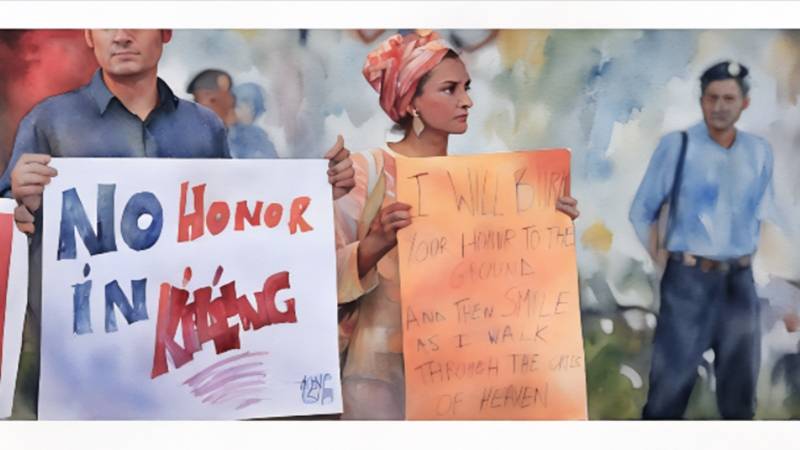
While scanning regional WhatsApp groups—often the only source for unreported news from rural Balochistan—I came across two shocking cases of honour killings: in Usta Muhammad, a husband stabbed his wife to death, and in Bhag’s Gareebabad, a brother murdered his sister. These cases expose a grim reality where tribal patriarchy, feudal oppression, and state neglect converge to sustain violence against women.
In the rugged terrain of Balochistan and adjacent Baloch-dominated areas of Sindh, a silent epidemic of honour killings continues to claim lives with alarming regularity. Recent incidents highlight the brutal reality. In Dera Bugti, four individuals, including two women, were gunned down in the Beh Loti area. Similarly, an 18-year-old girl was shot dead by her uncle in Dera Murad Jamali's Tamboo area over an alleged honour dispute. In Jacobabad, a man killed his daughter and son-in-law on suspicion of an illicit relationship. Other horrific cases include the murder of Masma Sultana in Jhal Magsi, accused of so-called "Siyah Kari," and the killing of 14-year-old US-born Hira Anwaar in Quetta over her social media activity.
Honour killings are not relics of the past but present-day atrocities enabled by systemic failures. They represent not only the loss of individual lives but also society’s collective failure to protect its most vulnerable
The actual death toll is likely far higher. Due to government apathy and social norms, very few cases are reported. Women’s rights organisations note that fear and societal pressure suppress reporting, particularly in feudal strongholds like Naseerabad and Jaffarabad. In Sindh, 766 honour killings were recorded between 2018 and 2022, many linked to the 'Karo-Kari' tradition in Baloch-majority districts such as Jacobabad, Kashmore and Larkana.
Honour killings are a violent manifestation of patriarchy and class oppression, rooted in feudal and capitalist structures that treat women as property to maintain social and economic control. The ideology of "honour" serves ruling-class interests, enforcing gender hierarchies while diverting attention from material exploitation. The state’s reluctance to address such crimes reflects its alignment with conservative forces that uphold oppressive systems.
Economic deprivation exacerbates the crisis. In impoverished regions, women are often viewed as economic burdens or assets, their lives subject to brutal calculations of family honour. Limited access to education and employment reinforces patriarchal control, while dependence on feudal systems perpetuates violent traditions as tools of social order. The state’s half-hearted religio-political narratives further worsen conditions for women.
The path forward requires a multi-pronged approach: stricter law enforcement, women’s helplines, and awareness campaigns. Most crucially, it demands addressing the economic and educational disparities that fuel these violent traditions. As long as women remain economically dependent and isolated, the cycle of violence will persist.
Honour killings are not relics of the past but present-day atrocities enabled by systemic failures. They represent not only the loss of individual lives but also society’s collective failure to protect its most vulnerable. The time for passive condemnation has passed—only sustained, coordinated action can end this barbaric practice.