

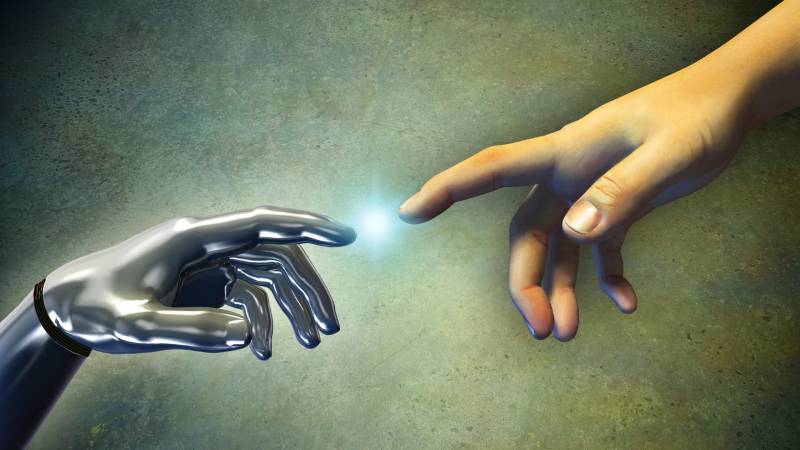
When Socrates chose to drink hemlock rather than compromise his pursuit of truth, he exemplified a timeless struggle—the battle for knowledge, truth, and ethical integrity. Throughout history, philosophers and scientists such as Spinoza, Copernicus, Galileo, Kant, and many others have faced threats to their ideas, often at significant personal cost. Yet today’s crisis is unlike any we have encountered before. What happens when we no longer trust the knowledge that shapes our lives? What happens when we fix the moral responsibility of an action on a machine? What happens when we perceive something we created as an existential threat?
The current crisis of knowledge is closely tied to high-speed information technology threatening established systems of knowledge, truth, morality, and politics. The core assumptions regarding the sources of knowledge, identification of the right authority, and how knowledge is validated and disseminated are brought under scrutiny. The AI-generated expertise and the rise of social media use have contributed to the spread of misinformation and fabricated knowledge, leading to a Crisis of Trust. The lines between genuine knowledge and misinformation have been blurred, creating a crisis that demands the urgent attention of philosophers and other social scientists. Numerous issues await discussion and resolution. This article highlights three critical areas that need to be addressed- the demarcation of genuine knowledge from fake knowledge, the moral and political dilemmas arising within the context of the Information Age, and the broader worldview and language surrounding AI.
Demarcating knowledge from pseudo-knowledge has long been a challenge. A very rich tradition of philosophers and philosophical movements has been engaged in epistemic debates. Knowledge was conceived and defined differently in the pre-Socratic era. During the times of Socrates, Plato, and Aristotle, various schools of thought emerged, leading to a constant struggle among them regarding the nature of knowledge, truth, ethics, and politics. In the medieval ages, there was a discursive struggle to reconcile knowledge with religion. Many medieval philosophers believed that reason could be used to understand divine truths revealed through faith. Transitioning into modernism, the empiricists argued that knowledge comes primarily through sensory experience rather than other sources- they argued that the mind begins its journey of acquiring knowledge as a tabula rasa (empty slate). The Discussions around tabula rasa and innate ideas led us to Kant’s Copernican Revolution in epistemology. Kant argued that we know the external world on our terms- we do not know the world as the world is rather we know the world as we are. In the twentieth century, Pragmatists presented a novel theory of truth and knowledge, asserting that knowledge is connected to practice and practical significance. Nietzsche’s Perspectivism introduced a different viewpoint connecting truth with perception and interpretation shaped by experience, culture, and context.
Both early and later Wittgenstein, emphasising language, presented different theories viewing reality and truth in different ways. Logical Positivists introduced their Principle of Verification to demarcate knowledge from pseudo-knowledge, declaring metaphysics meaningless. In contrast, Karl Popper argued that a hypothesis cannot be conclusively verified; it can only be conclusively falsified- so Falsifiability is the criterion of demarcation- thereby, challenging the foundations of the positivist epistemology. Postmodernist epistemology rejects objective knowledge, rationality, and universal truth, emphasising a variety of perspectives and diverse human experiences. Finally, Epistemic Contextualism suggests that the truth conditions of knowledge claims can vary depending on the context in which they arise. These historical debates on the demarcation of knowledge are more relevant than ever in today’s AI-driven world.
Anyone with a mobile phone or a laptop and an internet connection can access the pseudo-knowledge and misinformation they disseminate
Firstly, we have to understand the nature of the current crisis. AI systems are often attributed to an undue level of epistemic authority. AI-generated outputs are frequently treated as indisputable truths, akin to dogmatic beliefs, without consideration of the underlying data quality, biases, or limitations. This misplaced trust can lead to decisions based on flawed or incomplete information. Secondly, we witness many fake gurus, psychologists, relationship coaches, climate experts, and political analysts addressing significant issues with unwarranted authority and confidence. Millions of people consume and practice the pseudo-knowledge they promote, which is easily accessible. Anyone with a mobile phone or a laptop and an internet connection can access the pseudo-knowledge and misinformation they disseminate. At an academic level, students utilise AI tools to write proposals and research articles, creating fabricated research that undermines the efforts of scholars who rely on their capabilities, potential, and genuine research. The lines between knowledge and pseudo-knowledge are fading away. We find ourselves again at the crossroads of developing a theory of knowledge that demarcates knowledge and truth from pseudo-knowledge in the information age.
The spread of unauthentic knowledge and misinformation is not only undermining trust but also contributing to political and social polarisation. For example, in Pakistan, this issue has become particularly evident on the political front. To combat false news, propaganda, and criticism, the government banned certain websites and VPNs. Propagandists and critics have been labeled as “Digital Terrorists”- a metaphor entailing propaganda, criticism, and dissent as an act of terror. Other examples include China’s use of the “Great Firewall”, Russian legislation in 2019 against “Fake News” and “Blatant Disrespect”, and India’s shutdown of the internet to combat “Anti-National” content.
This situation highlights that we are facing not only a Crisis of Knowledge but also Moral and Political Dilemmas. If we ban social media and technology, we will risk curtailing civil liberties; however, if we do not implement a ban, then we allow the spread of false knowledge leading to a crisis of knowledge, truth, and trust. Limiting access to technology restricts the dissemination of fake news and fabricated knowledge; however, it adversely affects the business community, educational activities, and many others who rely heavily on technology. Ultimately, society will not function effectively under such circumstances.
Other moral issues may also arise as AI enters almost all areas of our lives. We have AI-driven cars, drones, chatbots, mobile devices, and more. If an AI-driven car hits someone or an AI-controlled drone attacks innocent civilians, who will be held responsible? Numerous examples of AI-driven cars, trucks, and chatbots malfunctioning have been reported, raising serious ethical concerns. AI is increasingly integrated into healthcare and mental health support, typically as a tool or adjunct rather than a complete replacement for human professionals. In some scenarios, AI systems can perform diagnostic tasks with a level of accuracy that even exceeds that of human experts; however, ethical concerns such as accountability and liability, informed consent and autonomy, data privacy, and bias must be addressed. Tackling these ethical challenges requires a clear and comprehensive understanding of the issues and collaborative efforts among healthcare professionals, AI developers, philosophers, and policymakers to establish guidelines that ensure the responsible and equitable deployment of AI in medical diagnostics.
Another issue that philosophers need to address is the language and worldview surrounding AI and social media. Aside from other framings, war framing is most often utilised in the context of AI. Metaphors such as the AI Arms Race, AI Warfare, Great Firewall, Digital Bullets, AI Battlefield, AI Threats, AI Defense, AI Risks, New Cold War, and Digital Terrorism evoke war imagery, as terms like Arms, Warfare, Bullets, Threats, Defense, Risks, and Terrorism are defined and understood within war frame. Metaphors, frames, and framing shape our worldview. Viewed through a conceptual lens of war, AI entails fear, resistance, hostility, and a focus on conflict rather than collaboration, peace, and progress.
Politicians predominantly utilise these metaphors, leading to moral and political dilemmas. Due to this worldview, the generation of fabricated knowledge and the moral and political issues arising from the misuse of human agency are often labeled as shortcomings of AI. This perspective undermines the significant potential of AI. The current situation demands urgent attention from philosophers and scholars. This crisis may deepen if left solely to political discourse, leading to greater societal and ethical challenges. We must work on a language exploring alternate metaphors that ensue a worldview in which we see AI as an extension of human consciousness and creativity- a transformative tool designed to ease human burdens and create new possibilities- a mindset that portrays AI, as helping and collaborating with us as a companion- Not as an enemy and existential threat.
As history has shown, crises of knowledge and truth are not new. However, today’s challenges, driven by social media, AI, and misinformation, demand new philosophical frameworks. If left to politics alone, the crisis of trust and truth may deepen, leading to greater social polarisation and ethical dilemmas. Philosophers must work on demarcating genuine knowledge from pseudo-knowledge, helping scientists and policymakers address ethical concerns, and exploring new ways of framing AI, not as an existential threat, but as a collaborator.
The choices we make today will determine the future of trust and knowledge. We must rise to this challenge, just as Socrates, Copernicus, Kant, and countless others did before us, to ensure a world where truth and knowledge continue to flourish.