

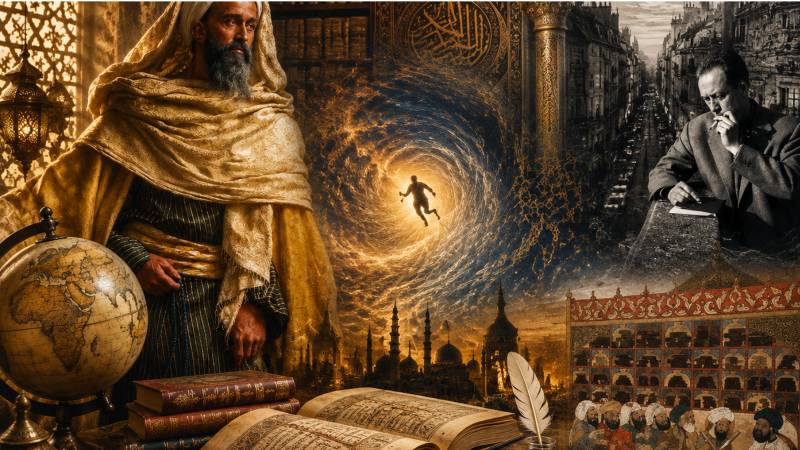
Islamic philosophy is often treated as a historical bridge between Greek thought and the European Enlightenment, rather than a living intellectual tradition in its own right and essence. This sidelining is not accidental, and it has real consequences; especially for students and thinkers grappling with meaning, morality, and philosophic thought today.
The contemporary secular framework used to teach philosophy is one of the main causes of Islamic philosophy's marginalisation. Philosophy is "rational," theology is "religious," and mysticism is "subjective," according to Western academic traditions. These categories do not describe Islamic philosophy. Imam al-Ghazali, Ibn Sina, and Ibn Arabi were among the popular Islamic thinkers who combined logic, metaphysics, ethics, and spiritual experience in their writings. Their approach is often mislabeled as just theological rather than philosophical since it refuses to distinguish transcendence from reason. This is not an impartial evaluation; rather, it is an intellectual misinterpretation.
What is seen as "serious" philosophy has also been influenced by colonial and post-colonial narratives. Non-Western traditions are represented as cultural or theological curiosities, whereas European intellectuals are seen as universal. Because of which, Thomas Aquinas was affected by Ibn Sina's profound metaphysics, but he rarely studied with him. Ibn Arabi is rejected as a mystic-poet rather than an ontological philosopher, despite the fact that his profound views on existence and selfhood resemble those of the likes of Heidegger. The global history of ideas is distorted by this selective acknowledgement.
Our response to contemporary existential anxiety or crises is also diminished when we disregard Islamic philosophy. Thinkers like Nietzsche and Albert Camus are popular among today's students because they brutally honestly describe the experience of meaninglessness. The conflict between the apparent silence of the universe and man’s quest for meaning is encapsulated in Camus' concept of the absurd. However, diagnosis is often the end of modern philosophy. In a similar vein, Ibn Arabi's writings directly address sentiments of alienation and fragmentation. His conception of life places a strong emphasis on depth of being, purpose, and interconnectedness. Such literature does not provide simplistic solace to readers who are experiencing nihilistic thoughts. It provides existential comfort along with intellectual seriousness: meaning is found via interaction with the self and the outside world rather than being created out of nothing or imposed mindlessly. I believe, you are and therefore meaning is and shall remain.
Islamic philosophy and literature are important because they reject the false dichotomy between hollow rebellion and unquestioning religion. They demonstrate that it is possible to be emotionally realistic, spiritually honest, and intellectually demanding all at once. Re-examining these customs is not a sign of nostalgia in a time when many students feel caught between scepticism and tiredness. It is a critical intellectual need. Modern thought would be completed rather than replaced by the reintroduction of Islamic philosophy into popular discourse.
Albert Camus represents a generation that has lost faith in inherited meaning. While writing in the midst of conflict, suffering, and moral collapse, Camus argued that people long for meaning in a universe devoid of answers. He famously called this contradiction between the stillness of the world and our yearning for purpose "absurd". Camus didn't act comforting. Rather than being antagonistic, he rejected religious solutions because he believed they dealt with the problem too quickly. Instead, he promoted honesty: living fully, intelligibly, and defiantly in the face of meaninglessness. His idea is still relevant today because it captures a feeling that many students can relate to: the exhaustion of searching for purpose in a seemingly heartless world. Yet Camus purposely falls short of transcendence. His rebellion is dignified, but unfinished. Some of his most famous works such as The Stranger revolve around fictionalised absurdism. Emotionally flat, morally grey,. shows what life looks like when meaning is stripped to the bone.
Nearly nine centuries prior to Camus, Imam al-Ghazali encountered a crisis that was remarkably similar in structure, if not outcome. He questioned tradition, reason, sense perception, and even his own intellectual authority. He rejected consoling illusions, just like Camus. He was as serious about doubt as Camus was. Ghazali deviates in his actions following uncertainty. He contends that reason has a limit that it cannot cross on its own, rather than coming to the conclusion that meaning must be produced in opposition to the outside world. Our expectation that meaning must be fully understood through rational control is the failure, not meaning per se.
Ghazali and later scholars like Ibn Arabi have shown that Islamic philosophy contextualises existential dread rather than denies it. Instead of seeing estrangement as proof of meaninglessness, it sees it as an indication of a damaged mode of knowing. This framework holds that faith is not an escape from philosophy, but rather what is left behind once philosophy is fully and honestly pursued. Deliverance from Error (al-Munqidh min al-Dalal) is a short intellectual autobiography that is perfect for students and stands a sufficient crisis of doubt that rivals any modern existential text.