

For decades, Pakistan's Barelvis had a fairly predictable set of religious rivals: Deobandis, Ahl-e-Hadith and, at times, Shias. Their sermons, debates and political gatherings were as much about defending their own interpretation of Islam as they were about attacking those of their sectarian rivals.
Today, that is no longer the defining battlefield.
The biggest political force to emerge from Pakistan's Barelvi tradition, Tehreek-e-Labbaik Pakistan (TLP), has built its politics around a very different question: who is willing to defend the honour of the Prophet?
It has transformed the political possibilities available to Barelvi clerics, allowing an essentially sectarian religious identity to claim a much broader constituency around the politics of blasphemy and Khatm-e-Nabuwat.
The transformation can be traced through the careers of clerics such as Dr Muhammad Ashraf Asif Jalali and Khadim Hussain Rizvi, the political mobilisation around Mumtaz Qadri after the assassination of Salmaan Taseer in 2011, and eventually the emergence of TLP.
Jalali launched his “Tehreek Sirate Mustaqeem Pakistan” in the late 2000s, and his focus at the time seemed to be countering the Deobandi and Ahl-e-Hadith onslaught that the Barelvis were under. It was a time when Pakistani Taliban were gaining ground at a rapid pace not just in Khyber Pakhtunkhwa but also in parts of Punjab. By the late 2000s, Pakistan was experiencing levels of militant violence that had become almost unimaginable in peacetime. The country was among the world's worst-affected by terrorism, while neighbouring Afghanistan and Iraq were engulfed in wars and insurgencies.
Barelvis were under attack too. Taliban, after having decimated Sufi shrines of Rahman Baba, Mian Umar Baba, Panj Peer and Pir Baba among others in Khyber Pakhtunkhwa had turned their attention to Punjab and Sindh, the two provinces with largest Barelvi populations.
I still remember how after the Data Darbar bomb blast in 2010, a firebrand Barelvi cleric had taken oath from his listeners during a speech at Lahore’s Mall Road that they’d each kill at least one Deobandi. I still remember a friend of mine asking himself why couldn’t Barelvis produce suicide bombers.
It was a tough time for Barelvis. Barelvis accused Deobandi groups of forcibly taking over their mosques and police were often reluctant to intervene in what they regarded as a sectarian turf war.
Ashraf Asif Jalali would deliver long sermons condemning Shias, Deobandis, Ahle-Hadith, with the latter two being on the receiving end most of the time. He’d hold annual public meetings, first at Data Darbar Lahore and later at the Railway Stadium, a few kilometres west of the 11th-century shrine of Lahore’s patron saint.
His arguments were theological in nature. He’d defend the core Barelvi beliefs like celebrating Mawlid-un-Nabi (S.A.W), intercession (tawassul), Sufism (tasawwuf) and visiting Sufi shrines and believing that the saints buried there could intercede on behalf of lowly sinners like us.
He’d make masterful use of logic, tradition and the Word of God to prove that the verses about idols being unable to help you had nothing to do with the shrines and that the Prophet himself walked into the Uhud graveyard and spoke to the dead, proving thereby that the dead could hear us.
Then came 2011. Mumtaz Qadri murdered Punjab’s governor Salmaan Taseer on January 4, marking the beginning of the new year as well as a new era in Barelvi politics.
This was a watershed moment in Pakistani politics in more ways than we normally appreciate. It not only pushed Barelvi politics in a far more radical direction, but was also one of the major reasons why Pakistan People’s Party – one of the most culturally liberal political parties in Pakistan at least since the slain Benazir Bhutto took it over after her father’s execution in 1979 – saw its vote bank completely erode in Pakistan’s largest province of Punjab, which makes around 56% of the total population of the country. Even rickshaw drivers on Lahore’s roads who love to strike up political conversations with their passengers would say they had always been PPP voters but Mumtaz Qadri had done the nation a great service by murdering Salmaan Taseer.
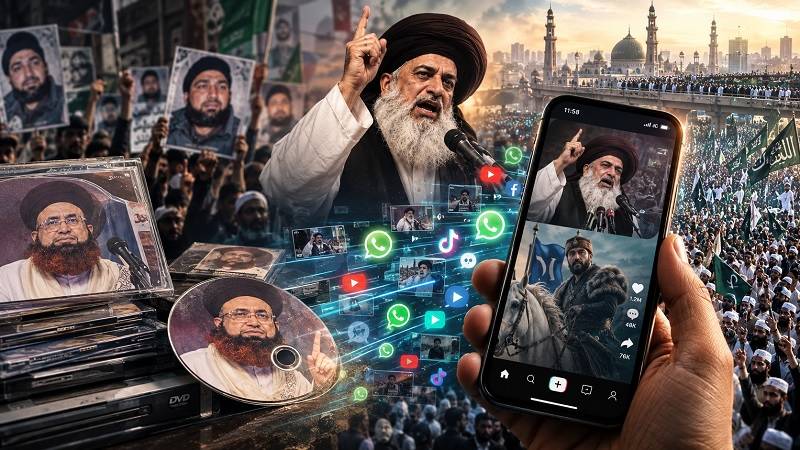
Jalali’s audio and video DVD circulation was in full swing at the time, as Pakistan still hadn’t yet been introduced to 3G and 4G internet connections while broadband access remained beyond the reach of many ordinary Pakistanis. We’d see them being sold like hot cakes at his congregations.
But after Taseer’s murder, the subject of the sermons changed. Ahle-Hadith Hafiz ur-Rehman and Deobandi Ilyas Ghumman were no longer the villains. The villain now was the state of Pakistan which, to him, was bent on executing a ‘mujahid of the Prophet’s honour’ who had killed a ‘western agent trying to abolish Pakistan’s blasphemy laws’.
For five years, saving Mumtaz Qadri was the mission of Jalali’s life. In Muharram, Qadri would become a true follower of Hussain (AS), who had stood up to the ‘godless’ and ‘secular’ ideals of the Pakistani ruling elite (traits often used to describe Yazid). During the month of Rabi-I, he’d become a great defender of the Prophet’s honour. Jalali, alongside Khadim Hussain Rizvi, who would co-found Tehreek-e-Labbaik Pakistan a few years later, left no stone unturned in his efforts to mobilise Barelvis across the country, especially in Punjab and Karachi to rally them behind the cause of Mumtaz Qadri.
Qadri was eventually hanged in February 2016 after the Supreme Court rejected his appeal. But the campaign the two clerics had led over the previous five years had already proved to be a precursor to the formation of first the Tehreek-e-Labbaik Ya Rasool Allah (TLYRA) in 2013 as a protest movement and later Tehreek-e-Labbaik Pakistan (TLP) in 2015 as a political party.
The five-year Save Mumtaz Qadri campaign changed Barelvi politics completely. It outgrew those sectarian debates. All of a sudden, Deobandi and Ahl-e-Hadith clerics found themselves with little political ground from which to challenge them. There were a number of reasons for that. Firstly, many Deobandis who sympathised with the Taliban and attended the Raiwind Ijtema had little disagreement with what Qadri had done. These Deobandis and Ahle-Hadith had for decades faced aggressive campaigns from Barelvi clerics who’d flaunt Darul Uloom scholars’ ‘heretical’ and ‘blasphemous’ statements from the 19th- and early-20th-century books in munazira debates. They couldn’t afford to be seen defending someone accused of blasphemy. Besides, Barelvi sect is by far the largest Sunni constituency in Pakistan. The sheer number would overwhelm them. As a result, even notoriously anti-Barelvi clerics were forced to retreat. Ibtisam Elahi Zaheer, who would deride Barelvi theology and politics in his Friday sermons at his mosque on Lahore’s Lawrence Road in the years gone by, cowered into downplaying the video in which Khadim Hussain Rizvi openly mocked the call to prayer from an Ahl-e-Hadith mosque as “suwaraan di azaan” — “pigs’ call to prayer” — when journalist Irshad Bhatti specifically asked him about the clip on a podcast.
Meanwhile, the introduction of 3G and 4G, alongside much cheaper Android phones imported from China, changed the game completely. There already was a strong strain in Barelvi politics of mobilising large crowds in the name of blasphemy. The 2006 protests called by Sunni Tehreek even turned violent when the mobs started attacking western food chains like KFC, Pizza Hut and McDonald’s on and around Lahore’s Mall Road. Madressah networks could be activated within hours. We’ve seen that tool used repeatedly by religious political groups across sectarian lines over the years.
But after Pakistan’s 2014 auction of 3G and 4G licences, access to the internet changed everything. TLP proved itself to be far savvier at handling social media than most traditional political parties in the country. The way the party used Whatsapp groups, broadcast lists to proliferate its message needs to be studied.
CDs and DVDs gave way to WhatsApp forwards. Groups and broadcast lists could be created at a minute’s notice and the state had no or insignificant mechanism or resources to keep a check on this non-mainstream proliferation of hate speech. In 2009, an extremist had to go through the trouble of going to a mosque nearby to gather mobs in Muridke to lynch Mian Najeeb Zafar. But in 2021, a Sri Lankan factory manager in Sialkot was lynched by a mob whose participants were clearly operating within an ideological ecosystem shaped by TLP propaganda, much of it circulated through WhatsApp, TikTok and other social-media platforms. Two young men from the mob spoke to a citizen journalist and proudly repeated the Arabic slogan من سب نبیا فاقتلوہ, derived from an unauthentic hadith that literally means “kill whoever insults a prophet”. The slogan had been popularised by Khadim Hussain Rizvi and was increasingly circulated by his followers on social media. Videos using Rizvi's voice alongside violent scenes from the popular Turkish drama Ertuğrul turned the slogan into something resembling a piece of digital pop culture; shorter versions were even circulated as WhatsApp status videos.
Today, Barelvis in Pakistan are far less concerned with debating intercession with Deobandis or Ahle-Hadith online, although Engineer Muhammad Ali Mirza has managed to turn himself into a mild inconvenience to the group’s leaders and followers alike.
Their attention is now also directed towards figures such as Geert Wilders and his proposed ‘Draw Muhammad’ contest in the Netherlands. They express anger over Quran-burning events in Norway.
The internet has turned Barelvis of Pakistan into a much more potent political force than they were at the time of Salmaan Taseer’s murder in 2011. Saad Rizvi is currently in the hiding, or somewhere in state custody; we don’t know. The number of TLP-linked attacks and incidents of incitement targeting Ahmadis and other minorities has also fallen drastically over the past ten months. But the lull by no means indicates that the group has been completely dismantled. They have resurfaced this summer in Karachi and if the state and political leadership do not come up with a counter-narrative, there’s no reason to believe that TLP won’t return – and come back with a vengeance.