

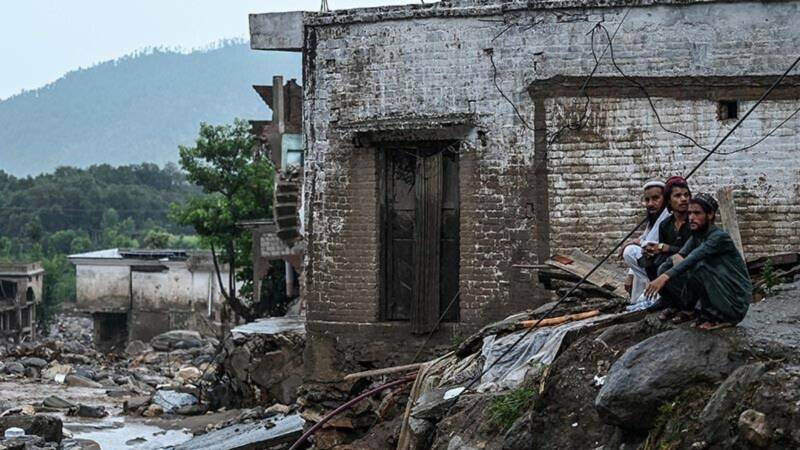
2025 August Friday 15th, 10 am or thereabouts, the earth moved, the mountains shook, and homes perched on hamlet Jabbo disappeared in an instant. Fifteen households — not a single person who was inside the home survived. I met Muslim Bibi, who happened to be in Karachi. She returned to Charghazai in Buner to her village to bury her father, her brother, and eight other cousins. Bhakti Bibi is still looking for her loved ones in the rubble. Rukaya Bibi looked at me, eyes spaced out and unable to speak, still in shock over a week since the catastrophe.
Disasters in Pakistan are frequent, man-made and natural disasters. The outcry in Islamabad continues to inform the world how vulnerable Pakistan is as a result of other countries’ emissions and the impact it has had on Pakistan’s climate change.
Where the hell is Buner? Formerly part of Swat in the north-west of Pakistan, home to 900,000, divided into six tehsils (Gadezei, Daggar, Gagra, Chamia, Totalai and Chagharzai). This corner of Pakistan is so beautiful, green, lush, mountainous, with River Barandu flowing, weaving its magical mist, it takes your breath away. Those of us who have been privileged to travel and see Switzerland, Sweden, Canada, even my beloved Ireland, Buner is 50 shades of green, lush, tropical, and mountains that reach the skies — beyond, beyond beautiful. How can such a place bear such pain and suffering?
Dr Harindar Singh in Peer Bazaar’s Gurdwara shared how his 10-year-old son barely made it alive as the 14 feet of water engulfed his classroom. He witnessed children washed away by the force of the flash flood/cloudburst that fateful Friday. There are 120 Sikh families who live in Buner, including professionals and shopkeepers. The entire Peer Baba Bazaar was washed away by a cloudburst, which flooded everything 14 feet high. Thinking about it makes me dizzy.
As I moved from one hamlet to another, travelling to provide rations and relief, all I could sense is the need to be heard. The Ganchar mountain is home to hundreds of families far from the roadside relief camps. This area is all mountains with lush valleys, connected roads and paths which have been washed away. Elum Duma, Guru and Sinawar are but a few mountains I can remember. I passed a beautiful river, but I was informed that it is a stream which has become a river as a result of flash flooding, cutting off entire two union council residents from the main roads. How are we going to get to them? was my first thought.
If Buner had a functional local government, these kinds of recurring emergencies could save lives
As Haimat Bibi said, ‘We don’t have time to go to these camps, we are digging our loved ones still, I don’t even have time to properly shed tears.’ The sense of helplessness and the need to see the community of Pakistanis empathise was the loudest message I got.
Imtiaz sb, a political worker of one of the parties, was very keen for me to understand that I should not be providing tents or provisions for these families in the mountains. ‘They are in a declared red zone, Nilofer Bibi; the Geological Survey of Pakistan has declared this place uninhabitable. Please do not encourage or enable them to stay here. They need to move.’
I got such a déjà vu listening to this — 2005 Balakot, today 2025 — what have we done to safeguard millions of Pakistanis who live similarly, on the banks of rivers, in the mountains, and in earthquake and landslide areas?
As I trekked up and down the Ganchar mountain, visiting cluster hamlets, I wondered how aid came here. How do the injured travel? They cannot. Treacherous, winding, slippery stones are the paths. This is not trekking but everyday living. Where are the schools, shops, community centres, and normal life for a 21st-century habitat?
As we moved from one place to another, I met a young girl on a charpoy, her spinal cord snapped by rubble that fell on her. I shiver thinking of Saira Jan, only 10. She was unable to really speak. What kind of comfort can I possibly offer? But the state has failed her, our governance system has failed her. What future does she have without assisted recovery? Disability is not a death sentence in the 21st century, but in places like here, I shudder to imagine her future.
We are in the second week of the disaster, and the mobilisation of civil society and donor-funded NGOs has arrived to provide the relief they can. The generosity of Pakistanis is unmatched. The sirens of the ambulances remind us that bodies are still being found under rubble and washed down the rivers and streams far, far away from their homes.
As I drove through the rubble of Buner, flattened crops were everywhere, the agriculturally dependent livelihoods wiped out. Shopkeepers’ stocks in the bazaars were destroyed. Mud mountains everywhere as the locals are cleaning the debris. There is no insurance in the Land of the Pure; what are the working class supposed to fall back on?
What is the bloated government body, PDMA at the district, doing? Good question. If Buner had a functional local government, these kinds of recurring emergencies could save lives. But it remains non-existent. The lack of technical capacities and skills required at the district level is stark. Godowns are full, I was told, but have not been distributed. Political parties, even those in power in the province and in the centre, are busy politicking, not providing. Only under threat from their local political workers have one or two or three turned up for a ‘photo op’ and to provide tokens.
Amidst the pain and suffering, there remains hope that someone will come to help them. I wish that hope was not the only way these communities can survive. Before I left Buner, I went to pay my respects to Pir Baba Syed Ali Tirmizi (1583 AD), a Sufi saint revered by many. I prayed for his blessings to instil a better tomorrow for the Buneris.
Until Pakistanis decide the one lesson every natural disaster teaches us: our rebuilding efforts are an opportunity to build resilience to withstand the imminent next one.