

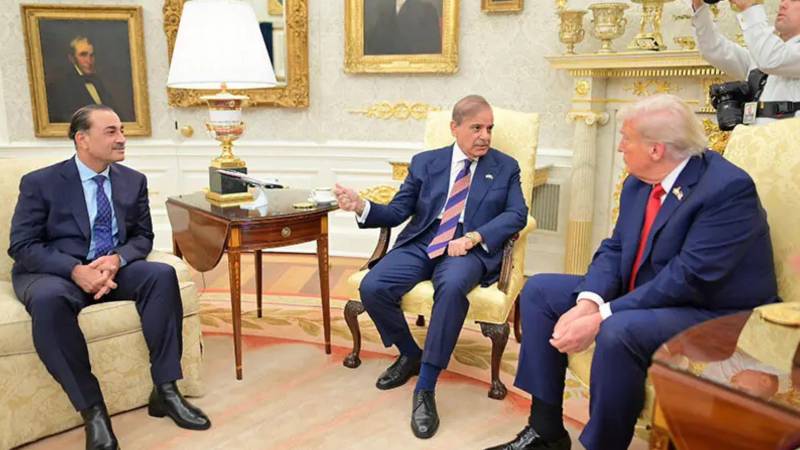
Without a doubt, there has now been a major reset in the US-Pakistan relationship. For the first time in seven years, a Pakistani prime minister was invited to the White House for a meeting with the US President.
In fact, in the case of Shehbaz Sharif, this was the second meeting with US President Donald Trump within a few days, since he was also part of the multilateral meeting of key Arab and Muslim leaders whom Mr Trump met in New York on the sidelines of the UN General Assembly. It was Pakistan Army Chief Field Marshal Asim Munir’s second meeting with the US President in three months, and his third visit to the US in that time period.
Before the meeting, which lasted over 80 minutes and in which President Trump was assisted by US Vice President J. D. Vance and Secretary of State Marco Rubio, the US President was speaking to reporters and described the Pakistani prime minister and the army chief as “great” people. The clear reset in ties between the US and Pakistan – arguably the biggest shift in Pakistan’s history – comes at a time when America’s ties with India are perhaps at their lowest.
And it has all happened in the space of a few months. The obvious question that comes to mind is: are the major changes in these two bilateral relationships that the US has with the two South Asian neighbours related? The answer is a guarded ‘yes’. One country is now decidedly more important and seen as a strategic partner – while the other is seen as a stubborn and unreliable country which refuses to trade more openly with America, continues to buy oil at discounted prices from Russia helping it fuel (no pun intended) its war with Ukraine, and whose leaders keep insinuating that the US President is repeatedly lying when he takes credit for ending the conflict between India and Pakistan.
Before we dissect this further, it would be opportune to address those who are upset at these developments. Of course, Indians by and large, especially BJP supporters, but Indians in general as well, are not happy with these developments. But I am not talking about them – one is, of course, referring to PTI supporters and Imran Khan’s acolytes who are more interested in when their leader will be released from jail than anything else. Many say – especially after the 25 September meeting at the White House – that this relationship will be one where Pakistan will be used, and then discarded when it is no longer of ‘use’.
Pakistan has considerable value and utility for the US, and having good ties with the US is in Pakistan’s interest as well
The logical response to this is: are they suggesting that Pakistan should do nothing, retreat, and tell the US – the world’s most powerful country – that it is not interested? Do they think that if their leader were still Prime Minister, he would have refused to have such an elevated relationship with the US? So if the answers are neither, then what are they suggesting? Or are they just bitter that while they had been fed stories – mostly by YouTube supporters of the former prime minister – that he would be released soon and that this would be the result of pressure by the Trump administration, no such possibility seems even remotely in sight.
Having said that, there is nothing wrong with countries building ties and relationships because of their utility for each other. And let us not forget a simple fact that certain recent developments have made Pakistan a partner that many countries may be interested in building up ties with. Its remarkable success in the military conflict with India showed the world that its military is as good as, if not better than, the Indian military. This was followed by the strategic mutual defence security pact that it signed days ago with Saudi Arabia, and there are reports of other major Arab countries interested in entering into similar agreements with Pakistan.
This latter development suggests that Pakistan is now being seen not just as a player in South Asia but that its influence is now going beyond the region, to the Middle East. Even in the conflict between Iran and Israel, it played a key role, and this was alluded to by US Secretary of State Marco Rubio as well when he met Pakistan’s Foreign Minister Ishaq Dar in Washington following the cessation of hostilities between the two countries. And there is now the demand by the US that it wants the Bagram base back in Afghanistan, and in this as well, Pakistan could be seen as playing a crucial role.
So clearly, Pakistan has considerable value and utility for the US and having good ties with the US is in Pakistan’s interest as well. It should not be seen as a zero-sum game that if America gains, Pakistan necessarily loses. The fact is that both countries stand to gain from this elevated relationship and increased levels of cooperation.
For starters, Pakistan would like increased investment in its economy by US companies, and the US President has already indicated that he would like to see that happen in Pakistan’s energy and critical minerals sectors. There is talk that the US wants the Muslim and Arab countries to help in the reconstruction effort in Gaza, and to that end, the plan that has been floated envisages a peacekeeping force drawn from these countries being a guarantor of security. And in that, if it were to happen, Pakistan would be expected to play a key, if not leading, role. But again, there is nothing wrong with that – if anything, it is perhaps an overdue recognition of the power and efficacy of the Pakistan military, very clearly evidenced in its May conflict with India.
What Pakistan should not do is become complacent and/or overconfident. The coming few years are going to present it with many interesting opportunities as well as challenges. It will have a chance to play a key role well beyond South Asia, with the defence pact with Saudi Arabia and with the reported plan for the reconstruction of Gaza. It should leverage these opportunities for improving its economy through increased investment and in using that increased wealth and income to reduce the national debt and enhance development spending, which in recent years has been drastically cut because of financial pressures.