

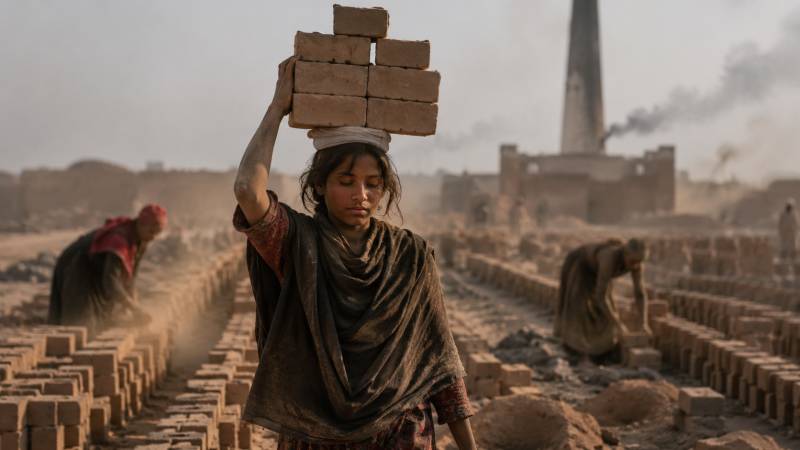
Every year, millions of Muslims circle the Kaaba and then run between the hills of Safa and Marwah. They re-enact the desperate search of a Black slave woman named Hajar, who ran seven times in the scorching desert heat, searching for water to save her dying son. Her effort, her Sa'ee, is so sacred that it is a pillar of Hajj. Without it, the pilgrimage is incomplete.
Islam could have chosen any prophet, any king, any warrior to model its central ritual. It chose a woman. A Black woman. A slave. A single mother. Abandoned. Desperate. Running.
That is the Islamic narrative.
Now look at Pakistan, a country born in the name of Islam. What has it done with Hajar's living embodiment: the struggling woman, the domestic worker, the brick-kiln labourer, the poor single mother?
It has abandoned her.
Pakistan's female labour force participation rate is among the lowest in the world, just 22.6% for working-age women, compared to a global average of 52.6%. The World Bank reports this stark gap. For every 100 working-age men in the workforce, only 23 women participate. Of those who do work, 75% are in vulnerable employment, self-employed, or unpaid family work with zero legal protection.
When women are paid, they earn dramatically less. The median gender pay gap in Pakistan is 37.5%. Even when a woman has a higher education than her male counterpart, she still earns less. The International Labour Organization Global Wage Report 2020–21 confirms a gap of 34%.
Eighteen million young women in Pakistan are NEET: not in education, employment, or training. That is 56% of all female youth. More than half of young women have no path to economic dignity.
In December 2025, a domestic worker named Yasmin was filmed being brutally beaten on a staircase in Karachi by her employer. The accused fled. Police could not find her.
The World Bank estimates that removing gender distortions in Pakistan's labour market could boost GDP by roughly 25%
In September 2025, a 12-year-old girl named Zainab suffered severe burns from a clothing iron after accidentally burning a dupatta while ironing. Her employers, a couple, were granted bail by a court. In 2023, in Lahore, a 10-year-old domestic worker named Sonia was tortured to death by her employers for a minor mistake. She was earning Rs. 8,000 per month, approximately 28 US dollars. In 2020, in Rawalpindi, an 8-year-old girl named Zahra died after being beaten for letting pet parrots escape.
These are not anomalies. They are the predictable outcome of a system that declares the home a "private space" where the state does not enter. And the home is precisely where the most vulnerable Hajras, domestic workers, mostly young girls, are tortured, raped, and killed with impunity.
In North Sindh, a 2025 study published in Humanities & Social Sciences Communications revealed a brutal reality. Few women (8.5 males to every female) are employed as kiln workers, and they earn wages that have been consistently lower. The wage gap at kilns is 18.5%. The faster they could get into the kilns, the more urgent loans they had to make, meaning 97% of workers were in the kilns as a result of debt bondage. 90% do not have written contracts.
Seven out of ten families live in one cramped room. 60% said they were verbally abused. Numerous beatings, torture, and disappearances were reported. The kilns require women for particular work, such as brick making. The labour shortage for women would decrease production by 4%. However, women are paid less for the same work, they are caught in a debt trap they cannot get out of, and are beaten when they complain.
Why does this happen in a country built on an Islamic narrative?
Because Pakistani society has chosen culture over scripture. Tribal honour codes that demand female seclusion have overwritten the Qur'anic elevation of Hajar's public, desperate, physical struggle.
Because the law exists but is not enforced. Labour laws protect workers on paper, but 90% of kiln workers have no contracts. Domestic workers have no legal framework at all. When a child is tortured, the employers get bail.
Because Hajar has been spiritualised. Muslims celebrate her in ritual, running between Safa and Marwah, but refuse to see her in the exhausted face of a maid or a kiln labourer. Her Blackness, her slavery, her womanhood is venerated in Mecca and despised in Karachi.
The World Bank estimates that removing gender distortions in Pakistan's labour market could boost GDP by roughly 25%. That is not charity. That is economics.
But beyond economics, this is a spiritual crisis. A country that claims Islam as its identity cannot simultaneously abandon the very women its own scripture has elevated as models of faith.
Hajar ran. She did not sit. She climbed hills. She did not hide. She shouted for help. She did not wait silently.
The modern Hajra of Pakistan is running too, from debt, from abuse, from a system that does not see her. But unlike Hajar, she finds no Zamzam. She finds no angel. She finds no justice.
Until Pakistani society learns to honour its living Hajras the way it honours her ritual memory, the Sa'ee will remain a performance. And the abandonment will remain a sin.