

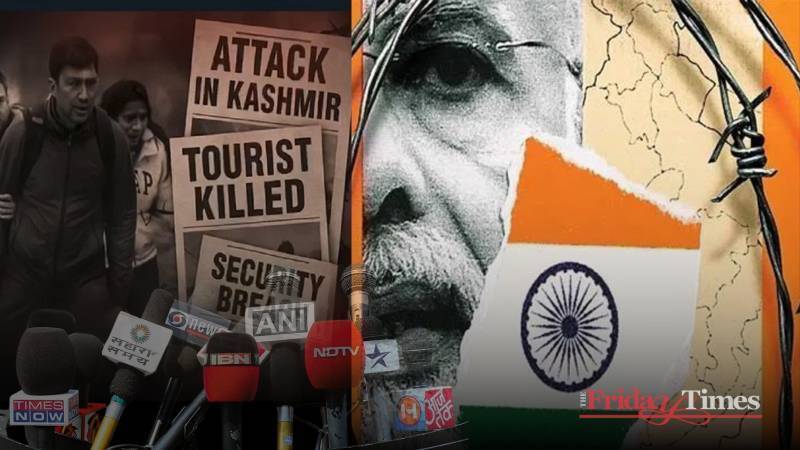
Social media is where the battle of the narratives is played out in today’s world. And that couldn’t be truer than for the ongoing Pakistan-India conflict. And the reason the word ‘ongoing’ has been used by me is because while the aerial battle and firing of drones and missiles on one another may have stopped, the battle of narrative and building perceptions is still happening and will continue to be fought for the foreseeable future.
I will give just two examples of this from the past week alone. One is an excerpt of a longer interview that Indian Foreign Minister S Jaishankar gave to the NOS TV, a Dutch public broadcaster. In it, the Indian foreign minister comes across as a bumbling fool, and the video clip has gone viral on social media. For instance, he is asked a question (which most Indian journalists and TV anchors have yet to ask him or anyone in the Indian Government) where is the US in all of this, as in the ceasefire and so on, and his answer is that the “US is well in the US”. He is also asked specifically about how the ceasefire came about – again a very basic question that any Indian news reporter or TV anchor has yet to ask the Indian foreign minister – and he again gives a fumbling reply, trying to evade the question, given that his boss, Indian Prime Minister Narendra Modi, has yet to publicly acknowledge that the US had any role to play in the ceasefire. That said, Mr. Modi is reminded of this almost on a daily basis by none other than US President Donald Trump since the latter often talks publicly about his integral role in the ceasefire and preventing a nuclear war between the two countries.
The other example is of Indian Member of Parliament Shashi Tharoor, who has been tasked by the Government of India to travel overseas and try and salvage some of the humiliation that India faced at the hands of Pakistan’s air force as well as at the hands of US President Donald Trump for again internationalising the Kashmir issue. Indian social media is awash with his clips and for now, the narrative is that he should replace S Jaishankar as India’s foreign minister.
It would be important to remember that the task here is not to target Pakistani audiences since that would be akin to preaching to the converted, but to international audiences
For its part, Pakistan has assembled a team of its senior politicians, and they include former foreign ministers as well as an information minister who are well-spoken and articulate and should be able to press Pakistan’s point-of-view and narrative well in foreign capitals. Led by Bilawal Bhutto Zardari, the delegation includes seasoned and accomplished politicians and speakers like Senator Sherry Rehman and former foreign minister and current MNA Hina Rabbani Khar and will visit various key foreign countries.
However, the Pakistani government and the military should understand that the push to build a narrative and the management and moulding of perception is not something that the state alone can do. A good example of this is the use of soft power by states which have plenty of hard power as well, such as the US. To that end, both state actors need to take on board professionals who know how to and have proven successes in pushing narratives in media and in managing and building perceptions.
It would be important to remember that the task here is not to target Pakistani audiences since that would be akin to preaching to the converted, but to international audiences. Doing that would require a certain level of subtlety and finesse which, quite frankly, is not the forte of state-run and managed media platforms and entities. Besides, privately-run and managed media entities would be more successful at building links and connections with overseas media counterparts, given that the latter, by and large keep away from any lasting contact with foreign governments.
Related to that is also the reality that the formulation, construction, execution, and dissemination of a narrative by a state-owned media platform or entity is not likely seen as as credible as that coming from media platforms and entities that act and operate independently of the state and exercise their own editorial control and policies. To that end, the Indians now have a disadvantage in that their mainstream media committed such massive blunders in its coverage of the conflict and indulged in such excessive and blatant propaganda and disinformation that it stands thoroughly discredited for the time being – so much so that any narrative that it pushes out will be seen as one that is indistinguishable from that of the Government of India and its military. Pakistan’s mainstream media covered the conflict far better and is therefore not hampered by any similar fatal damage to its perceived neutrality and credibility.