

Flattery is normally an individual’s insincere praise of a person to get some favour. But it can be practised at collective levels in politics and public affairs to similar ends. In Pakistan these days, flattery is being practised at the national level, in the statements of political leaders, in the media and across public institutions.
Pakistan’s political parties are almost one-person/family enterprises, be it the Muslim League (ML-N), the Pakistan People’s Party (PPP) or the Jamiat-e-Ulema-Islam (JUI). Even the popular but out-of-favour Pakistan Tehreek-e-Insaf (PTI) is a personal fiefdom of Imran Khan. By their organisation, they are prone to submission to the leader and his/her unqualified admiration. Adoration of the leader(s) is baked into their structure.
It is a pathetic spectacle to watch long dedicated and competent members of these parties submissively accepting the young, inexperienced children of the party founders as the successors to their elders. A dynastic party is an emblem of flattery.
A genuine praise for distinguished performance of responsibilities or good deeds does not fall in the sphere of flattery. It is an essential element for sustaining organisations. Appreciation of good performance should be distinguished from exaggerations and unearned praise.
Flattery is more harmful for a nation as practised at the institutional level, over and above individuals. Pakistan has had many periods of collective flattery, inevitably leading to crises.
The present hybrid system of government, where the establishment oversees the policies of the political parties, eulogising the leaders of the military, has become a common practice.
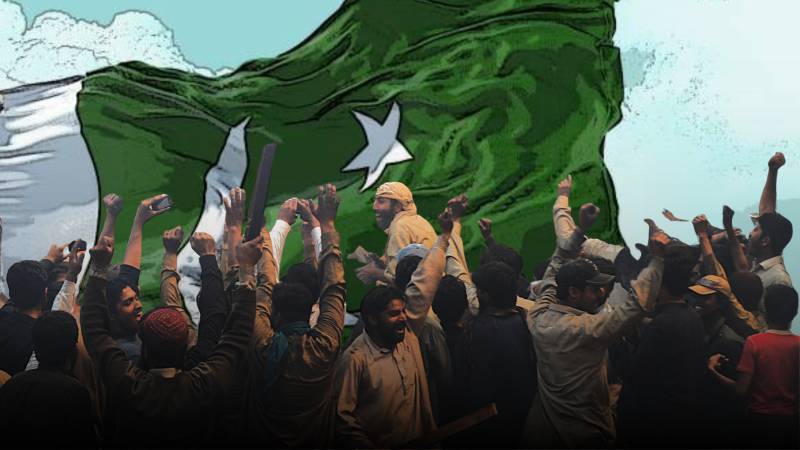
Currently, the four-day (7–10 May 2025) exchange of missile and drone attacks between India and Pakistan has been turned into an occasion to flatter the military and its commanders. Almost every national political leader has registered admiration of the military’s bravery and ‘teeth-breaking’ performance. Undoubtedly, Pakistan’s air force had an upper hand, but the rest was an unremarkable engagement from a distance on both sides. There were no notable ground clashes. Yet the media and civilian leaders draw parallels to the 1965 war and its proclaimed success.
Flattery, self-congratulations and hangers-on’s obedience should not lull the hybrid leaders, particularly those in the establishment
The federal and provincial civilian leaders’ eulogising of the military leadership on national TV becomes embarrassing to watch week after week. I have cringed watching national news, showing missiles rising in the air with cheers for days on end. The quick promotion of the commander to the highest rank worldwide has been an act of getting into good books. The dependence of the civilian government on the oversight of the establishment in this hybrid form of government underlies this eulogising.
The civilian leaders of the government are also flattered almost as much as the military commanders. The cabinet members and party leaders can be found daily on one or the other TV panels, giving unqualified praise to the prime minister’s or provincial premiers’ resolve and policies.
Undoubtedly, public flattery in all its forms takes its toll on national policies. It lulls the leaders into believing in their wisdom and understanding. It distances them from critical and contrary evidence, which leads to disastrous policies and national crises. It distracts from objective understanding and long-range implications of public policies. Pakistan’s history is imprinted with misperceptions reinforced by overconfident leaders.
For illustrative purposes, I will cite two examples that put Pakistan on undemocratic paths and turmoil. One was General Ayub Khan’s unceremonious downfall, resulting ultimately in the 1971 break-up. The other was the charismatic leader of the early 1970s, Mr Zulfiqar Bhutto’s ousting and eventual hanging by the military ruler.
General Ayub Khan, who ruled for almost 10 years in the 1960s, began to lose people’s trust. Although most of his rule was marked by the promotion of his image as a national saviour, the signs of public discontent were persistent. Yet in 1968, while the president was bedridden, his cabinet and advisers decided to launch a countrywide celebration of his ‘achievements’ in the form of highlighting the Decade of Development. This act of public flattery had the opposite effect. It brought out the discontented masses, leading to the fall of his regime and the 1971 break-up of Pakistan.
The other example was equally an event that changed the path of Pakistan’s political development. Mr Bhutto, the founder of PPP, resurrected Pakistan after the fall of Dacca in 1971. He was very popular, capable of moving masses in the early 1970s.
He brooked no opposition to his views. His capable second-tier party leaders had to be submissive to survive. He lost many party companions for not being obedient enough. Flattery was the ticket to being close to him.
By 1976–77, enough popular discontent with his policies had built up, joining Islamists with merchants and entrepreneurs to organise an opposition movement called Pakistan National Alliance (PNA). In the controversial 1976 election, Bhutto initially failed to have a strong majority. The PNA’s protests turned into extensive riots. Those prompted General Zia, his chosen C-in-C, to stage a coup and eventually hang him on a dubious judicial judgement. This again changed the course of Pakistan’s history both politically and ideologically.
These examples should stand as a lesson to our current leaders. Flattery, self-congratulations and hangers-on’s obedience should not lull the hybrid leaders, particularly those in the establishment. Militaristic force is not the solution to all regional, economic and political problems. It is time for Pakistan’s rulers to be open and objective, not viewing every demand or criticism as a threat to national integrity.