

History is not a finished product; it is a work in progress. It is a study of past events in a particular socio-political environment. Historiography rises above the contextual limitations of historians and studies their works critically, demonstrating how history was sourced, recorded, and interpreted.
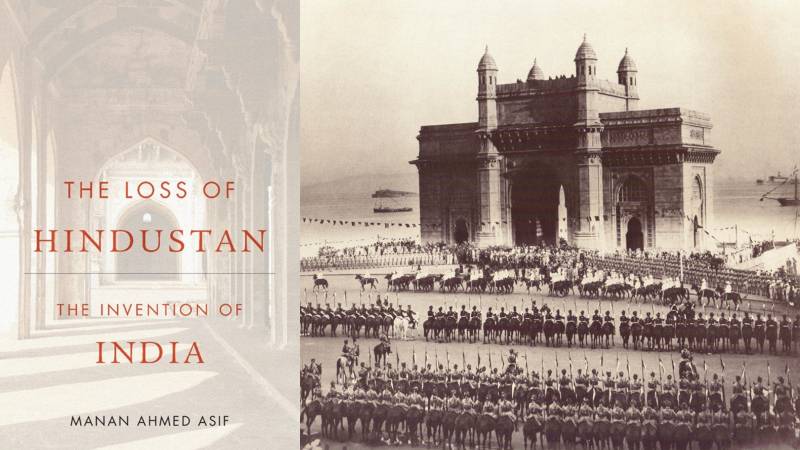
Manan Ahmed Asif’s The Loss of Hindustan, The Invention of India is a scholarly, though controversial, work of historiography. The book is part of the growing body of post-colonial scholarship aimed at intellectual decolonisation. Dr Asif, a prominent historian, is an Associate Professor at Columbia University, New York. His earlier publication Chachnama earned him scholarly acclaim.
In his present publication, he claims that European scholarship, from the seventeenth to the early twentieth century, was essentially aimed at advancing the interests and ideology of the Colonial West. The book takes up Muhammad Qasim Firishta’s sixteenth-century Tarikh as a case study to establish how this book of history was misinterpreted, distorted in translation, and entered European imagination both as a foundational piece for understanding Hindustan, and at the same time, dismissing it as a book of history written by the people who “have no conception of history”.
The author views Hindustan as a holistic intellectual space where intellectual, military, trading, farming, social customs, religion, politics, caste, tribe, and familial activities took place. India, on the other hand, is perceived as a European construct where the Hindu-Muslim divide is unbridgeable, and ancient India had a ‘golden age’ disrupted and destroyed by the Muslim invaders. The “INDIA” that colonial powers constructed was “filled with clichéd natives, invented temporalities, and religious antagonisms presumed to be factual and true”. In contrast, “HINDUSTAN” was made to be figurative, a place of false harmonies, limited geographies, and forgotten languages.” Colonial scholarship sees Hindustan awash in wealth, but it is because of natural bounty and not because of the efficient governance or hard work of its farmers, traders, and artisans. The author employs the “method of textual mining” to deconstruct the colonial episteme.
In Asif’s words, "Under the guise of a purported universalism, the field of world history stripped Hindustan from geography and supplanted it with another concept, India." What this process entailed was the collection, archiving, organising, and excerpting of textual and material forms to produce histories of India. European scholarship bifurcated “Hindustan’s past as a history of Muslim despotism, and that of the backwardness and timelessness of Hindus (who are)…. Incapable of any historiography because Hindus have no history in the subjective sense… and are incapable of thinking historically.”
Hindustan, as an intellectual space, was finally erased with the denouement of the 1857 failed War of Independence, when British India was officially born
The European age of Enlightenment, personified by Hegel, Hume, Voltaire, Kant, etc., wanted to come up with a universal philosophy of the rise and fall of civilisations. They claimed to be universal while in fact their thought process remained Eurocentric. Their knowledge and understanding of the world outside Europe were incomplete, distorted, and fragmented, as they viewed the outside world through the colonial lens. Their understanding of Hindustan was based on “distorted fragments” of Firishta’s Tarikh that reached them through the likes of Alexander Dow, a military officer of the British East India Company.
In European political philosophical thought, conflict among human beings was inevitable, and state sovereignty, residing with the ‘general will’ or the ‘monarch’, was absolute. Qasim Firishta addressed the same issues of state and the king without making conflict an inevitability. It is colonial historiography that made multiculturalism something ‘strange’ and conflict something ‘natural’. In Asif’s words, Firishta “is concerned with constituting them as a coherent populace, to highlight the duties and responsibilities of the ruler to the public. The populace of Hindustan was diverse, with many faiths, political allegiances, and social hierarchies. Not one community, nor people, are introduced or described by Firishta in terms of `otherness’, nor does he remark that one faith supersedes another".
The book is insightful in exposing how innocent-looking undertakings like reading a text, translating it, reproducing historical records, and making observations of a traveller are all turned into colonising tools. All this emerges from the self-assumed sense of superiority, and then benignly takes upon itself to bring the fruits of civilisation to the “native brute” in India, Africa, America, and Australia.
Hindustan, as an intellectual space, was finally erased with the denouement of the 1857 failed War of Independence, when British India was officially born. Over the decades that followed, INDIA as a new intellectual space had been internalised by both Hindus and Muslims. The independence movement led by anti-colonial leaders like Jinnah, Ambedkar,and Savarkar amounts to “internalising the colonial argument about Muslim foreignness and considering the past five thousand years of the subcontinent as representative of despotism and decay”. It was the acceptance of the colonial episteme that Indians are irreconcilably divided on religious lines, and Muslimness is foreign to India. The 1947 partition was the culmination of this outlook.
The book also claims that Muslim scholars who challenged the European episteme asserted their claim with reference to the “history of Islam” rather than of Hindustan. (The author ignores historical works of Muslim scholars who wrote mostly in Urdu and Persian to refute the Colonial and Hindu claims of Muslim despotism and foreignness. Firishta’s Tarikh quoted the Mahabharata in detail and presented it as a source book of history. Shibli, among others, wrote on Indian history and challenged the European episteme.)
To say that the partition of India and the erasure of Hindustan was the internalisation of the colonial argument is a stretch. It was the rise of nationalism, which coincided with the rise of Napoleon, that first divided Europe along nationalistic lines and led to internecine European conflicts. Nationalism then spread to the rest of the world, and to this day, national identity remains the prime identifier of individuals and collective entities.
Colonial interest in divide-and-rule is understandable as an effective tool of governance by rulers who never intended to be Indian and had no interest in becoming one with the natives. The Mughal rule and the era that preceded them were not a Hindu-Muslim thing, where divide-and-rule was required to establish and perpetuate their rule. Muslims fought against Muslims; Hindu rajas had their own kingdoms. Hindus and Muslims often fought together against enemies who had both Muslim and Hindu forces.
The HINDUSTAN of Asif is rather imagined and romanticised. The claim of total erasure of precolonial life, thought, and intellectual space is an exaggeration. This line of argument can be useful to build nationalist mythology by “decolonising history”, but not in a serious work of history or historiography.