

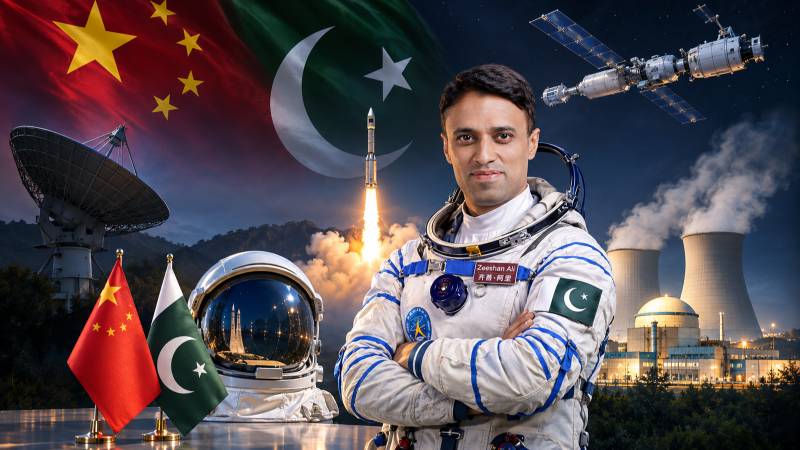
Two significant developments within a single week have brought the ever growing China Pakistan relations to lime light. On November 10, the successful placement of the reactor dome at the 1,200-megawatt Chashma-5 nuclear power plant marked another milestone in the two countries' longstanding cooperation in civilian nuclear energy. Just days earlier, China announced that a Pakistani astronaut would join its Shenzhou-24 mission, becoming the first foreign national to visit China's space station. The significance of these developments extends well beyond their immediate scientific and technological achievements. Together, they reflect the strength, resilience and increasingly sophisticated nature of a relationship traditionally described as an iron-clad friendship.
For Pakistan, the prospect of sending an astronaut into space aboard a Chinese spacecraft carries extraordinary symbolic and historical significance. That the first foreign participant in China's crewed space programme will be a Pakistani is a powerful expression of mutual trust. More importantly, it demonstrates that a relationship generally viewed through the lenses of defence cooperation, diplomatic coordination and economic connectivity is steadily expanding into advanced scientific and technological fields. The partnership is no longer confined to conventional strategic interests. It is acquiring a broader developmental dimension, encompassing energy security, technological empowerment and scientific progress.
Chinese Foreign Ministry spokesperson Guo Jiakun aptly captured this expanding relationship on November 9 when he expressed Beijing's willingness to deepen cooperation in space and other fields and take bilateral relations to "new heights". The expression carries particular significance as the two countries commemorate 75 years of diplomatic relations. Despite changing regional circumstances, geopolitical competition and international uncertainty, Pakistan China relations have demonstrated remarkable continuity. The latest developments give further substance to their all-weather strategic cooperative partnership and suggest that technological collaboration could increasingly define its next phase.
There is also a larger international significance to these developments. The contemporary international order is increasingly characterised by technological protectionism, strategic competition and attempts to control access to critical technologies. Advanced scientific capabilities have become important instruments of geopolitical influence, while restrictions on technology transfers and competition over innovation threaten to widen the existing divide between developed and developing countries. Against this backdrop, China has sought to project an alternative philosophy of international cooperation, emphasising mutual benefit, shared development and what Beijing frequently describes as win-win cooperation.
Participation in a human spaceflight mission offers valuable exposure to astronaut training, mission operations, experimentation and sophisticated engineering systems. But the benefits of such experience should not remain confined to the individual astronaut or the immediate mission.
This orientation is reflected in several initiatives advanced by President Xi Jinping, including the Belt and Road Initiative, the Global Development Initiative and the Global Civilisation Initiative. Although differing in their immediate objectives, these frameworks collectively articulate China's preference for development-oriented partnerships and broader international engagement. China's growing technological capabilities are consequently being presented not merely as instruments of national power but also as resources for international partnership. A relevant example comes from artificial intelligence. The Chinese company DeepSeek attracted international attention by making its DeepSeek-R1 model weights and associated software publicly accessible under an open licence. At a time when many leading artificial intelligence systems remain proprietary, such initiatives demonstrate how technological advances can create opportunities for researchers, developers and institutions beyond the countries where they originate. For countries of the Global South, this aspect of technological cooperation is particularly consequential. Their principal challenge is not simply the availability of advanced technologies but the capacity to participate meaningfully in their development and application. China's cooperation with Pakistan in satellite launches, space research and now human spaceflight illustrates the possibilities of partnerships that provide developing countries access to sophisticated scientific platforms.
Yet these achievements also raise an important question for Pakistan: how effectively can such opportunities be translated into sustainable national capabilities? Celebrating technological milestones is understandable, but their lasting value must be measured by the institutional knowledge, scientific expertise and indigenous capabilities they help generate.
Pakistan's experience in civilian nuclear energy has been remarkable and progressive. Decades of flawless operations have developed substantial engineering and regulatory expertise in nuclear power generation. Chashma-5, expected to begin generating electricity in 2030, will further strengthen Pakistan's capacity to produce reliable, low-carbon electricity.
Pakistan's space programme, however, requires a broader and more sustained developmental push. While the country possesses a longstanding institutional presence in space research and has made progress in satellite development and applications, its ambitions must be supported by greater investment in research, advanced engineering, scientific education and indigenous technological capabilities. Participation in a human spaceflight mission offers valuable exposure to astronaut training, mission operations, experimentation and sophisticated engineering systems. But the benefits of such experience should not remain confined to the individual astronaut or the immediate mission. The lessons learned should be institutionalized. Equally important is connecting space technology with Pakistan's developmental priorities. Satellite-based applications can contribute to agricultural productivity, water-resource management, climate monitoring, urban planning and disaster preparedness. For a country increasingly vulnerable to climate-related emergencies, improved earth observation, remote sensing and data-analysis capabilities are not technological luxuries; they are essential tools of effective governance and sustainable development.
The significance of Pakistan–China technological cooperation must therefore be understood in both strategic and developmental terms. While Beijing's willingness to share platforms, expertise and scientific opportunities provides an important foundation, Pakistan's own institutional preparedness will determine the extent of the benefits it can secure. International cooperation can open doors, but national investment, policy consistency and scientific capacity are necessary to walk through them.
As Pakistan and China celebrate 75 years of diplomatic relations, their partnership appears poised to enter an increasingly technology-driven phase. The Chashma-5 milestone and the forthcoming Shenzhou-24 mission offer compelling evidence that bilateral cooperation is evolving beyond traditional strategic and economic domains. The challenge for Pakistan is to ensure that this evolution produces not only moments of national pride but also measurable advances in its scientific and technological development.