

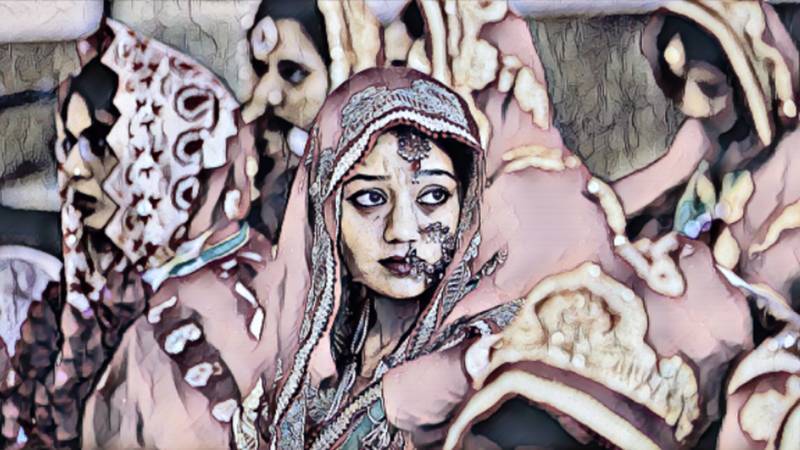
Despite international commitments and constitutional guarantees, child marriage remains a stark reality in Pakistan—silently stealing childhoods, endangering lives, and cutting short the potential of millions of girls across the country.
According to the United Nations Convention on the Rights of the Child (CRC), a child is anyone under the age of 18. While this definition is globally accepted, the legal age of marriage in Pakistan tells a different story. Nationally, the legal age for girls to marry is just 16—two years younger than for boys. Only Sindh and the Islamabad Capital Territory (ICT) have aligned the marriageable age for both boys and girls to 18.
As per the Pakistan Demographic and Health Survey (PDHS) 2017-2018, 3.3% of girls are married before the age of 15, and 18.3% before they turn 18. These figures are not just statistics—they reflect a systemic failure to protect the rights of the most vulnerable.
Efforts to raise the legal marriage age across the country have met strong opposition, particularly from religious hardliners who argue that physical maturity, marked by menstruation, is sufficient for marriage. However, this perspective overlooks a key Islamic principle: mental maturity (aql) is equally important. The Quran repeatedly emphasizes both physical and intellectual maturity as necessary conditions for adult responsibilities.
National statistics show that 32% of married adolescent girls report physical violence, and 31% face spousal abuse
Child marriage is often driven by a mix of poverty, harmful traditional practices, and a deeply ingrained fear of social dishonor. Practices such as vani, swara, and valvar—where girls are married off to settle disputes or social debts—continue under the guise of tradition. For low-income families, marrying off daughters early is seen as a way to reduce financial burden and uphold notions of honor. For wealthier families, it often serves to consolidate social ties and property.
The consequences are devastating. Early marriage almost always leads to adolescent pregnancies, significantly increasing the risk of maternal mortality. The PDHS reveals that 8% of girls aged 15–19 have begun childbearing, mostly in rural areas. Pakistan’s maternal mortality rate stands at 186 per 100,000 live births, with 92% of maternal deaths among girls under 20 linked to pregnancy complications.
These young brides face alarming levels of health and social disadvantages. A staggering 90% of married girls aged 15–19 are unable to discuss reproductive health with anyone. Only 24% are involved in decisions about their own healthcare. Many lack access to family planning information, leading to short birth intervals and poor maternal and child health outcomes.
Children born to adolescent mothers are more likely to suffer from premature birth, malnutrition, and even early death. According to the National Nutrition Survey 2018, among children under five, 40% are stunted, 18% are wasted, and 29% are underweight.
The mental and emotional toll is equally severe. Most adolescent girls are neither physically nor mentally prepared for marital responsibilities. Many suffer emotional trauma, and a significant number experience marital violence. National statistics show that 32% of married adolescent girls report physical violence, and 31% face spousal abuse. Alarmingly, 53% believe it is justified for a husband to beat his wife.
Education is a powerful shield against child marriage. Yet, more than half of Pakistani girls—54%—receive no formal education. Ensuring that girls stay in school is one of the most effective ways to delay marriage and improve their chances of leading healthier, more empowered lives.
Pakistan’s Constitution guarantees the right to life and education. These rights must be reflected not only in laws and policies but in how society values and protects its children—especially girls. Raising the minimum legal age of marriage to 18 nationwide is not just a policy decision—it is a moral imperative. It is a step toward ensuring that every girl has the chance to live a life of dignity, free from violence, and full of opportunity.