

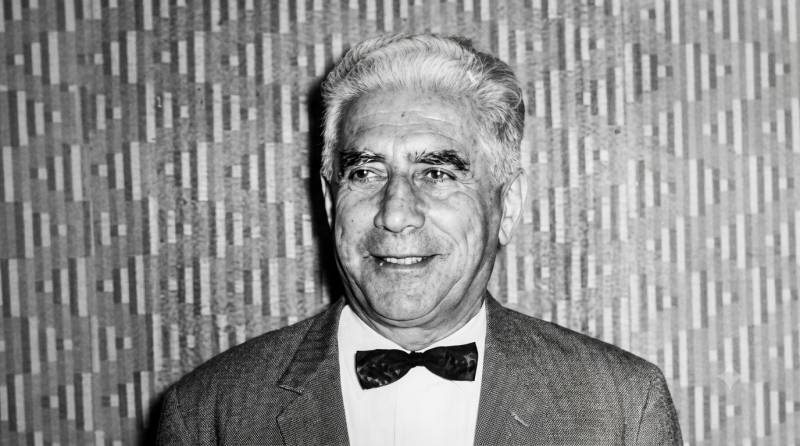
His name has travelled through history in several forms: Nasreddin Murat-Khan, Nasiruddin Murat Khan, Nasirud-din Murat-Khan and, in Russian records, Muratkhanov or Murat-Khanov. Yet he himself preferred Nasreddin Murat-Khan – the name lovingly preserved in his family archive, and perhaps the one by which he hoped history would remember him. He was far more than an accomplished architect, civil engineer and town planner; he was a quiet visionary who gave shape to stone, order to cities, and dignity to the landscapes upon which he left his enduring mark.
He was born in 1904 in Temir-Khan-Shura, now Buynaksk, in Dagestan, then part of the Russian Empire. He belonged to the Kumyks, a Turkic-speaking Muslim people of the North Caucasus. His father, Atloo Khan, served as an officer in the Imperial Russian Army; his mother died while the children were still young. Nasreddin, the eldest of three, grew up in a household soon overtaken by bereavement, revolution and the quiet collapse of the world into which he had been born.
He entered school in Buynaksk in 1911, but the Russian Revolution and the disorders of 1917–18 interrupted his education. Family photographs show him in traditional Dagestani dress: a young man still rooted in an old culture, though history was already loosening the ground beneath his feet. In 1925, he went to Leningrad and, five years later, qualified in architecture, civil engineering and town planning. He emerged not merely able to draw graceful buildings, but to plan cities, shape public spaces and calculate how great structures might endure.
His Soviet career was distinguished. Works attributed to him included a prize-winning national theatre at Derbent, an 800-student polytechnic institute and a 600-bed hospital in Makhachkala, a large residential township, a Lenin memorial and several civic buildings. By the late 1930s, he was a member of the Union of Soviet Architects. Yet distinction offered little shelter under Stalin. Murat-Khan was arrested during the purges of engineers and technical professionals, though he survived and returned to high office. By 1940, he was chief engineer and chief architect of the Pyatigorsk branch of the North Caucasian Project Trust, later directing its operation in Voroshilovsk, now Alchevsk, in Ukraine.
According to his family, the Murat-Khans were associated with resistance to Soviet control. His daughter Meral recalled that the family was blacklisted, his brother sent to Siberia, his sister driven into exile in Iran and several relatives killed. Not every detail has been independently verified, but the central truth is unmistakable: Murat-Khan had become unsafe in the very land of his birth. The country that had formed him could no longer hold him.
He did not regard Pakistan as a temporary refuge or a convenient resting place. He deliberately chose it
In early 1944, as war swept across the Caucasus, he fled westwards in the wake of the retreating German forces. The surviving evidence does not establish that he was a Nazi collaborator; rather, he was a fugitive from Soviet persecution, carried across Europe by the violent tide of war. Germany offered him no permanent home, only the precarious existence of a displaced person. Yet even in the refugee camps of Mittenwald, amid the ruins and exhaustion of post-war Europe, he remained an architect. He worked as an engineer and rose to become deputy chief of the camp's central technical office. Exile had stripped him of place, but not of purpose.
It was there that he met Hamida Akmut, a Turkish citizen of Pakistani and Austrian parentage who was working as a nurse. Her father, Dr Abdul Hafiz, had studied chemical engineering in Leipzig and later assisted in establishing the Wah Ordnance Factory; her mother, Anna Maria Nimmerrichter, was Austrian. Nasreddin and Hamida occupied adjoining camp cabins. Affection grew between two people whose lives had been unsettled by war, and they married in 1946. They would have five daughters – Pari, Zeynab, Maryam, Mesme and Meral – of whom Meral later became the devoted guardian of her father's papers, photographs, architectural models and memory.
By 1950, the refugee camps were closing. Return to Dagestan was impossible, while Europe had never truly become home. Pakistan offered a possibility. Hamida's father was Pakistani, the family had connections there, and the new country itself understood migration, rupture and loss. They sailed aboard the Caledonia to Karachi and travelled onwards by train to Lahore. Murat-Khan arrived not as a celebrated foreign master, but as a displaced Caucasian professional carrying his family, his learning and whatever fragments of hope war had left him.
There is a striking continuity in the architectural history of Punjab. Before Murat-Khan, another great engineer-builder gave Lahore much of its civic form: Sir Ganga Ram. Associated with iconic buildings and irrigation projects, Ganga Ram had woven engineering and philanthropy together so completely that he became known as the "Father of Modern Lahore." He died in 1927, twenty-three years before Murat-Khan arrived. There was no direct succession between them, yet history seems to have placed them in adjoining chapters. Ganga Ram helped build the Lahore of colonial Punjab; Murat-Khan helped give architectural form to post-independence Pakistan. Both understood that the finest buildings could not remain monuments to their designers alone; they had to educate, heal, house and serve.
Pakistan urgently needed what Murat-Khan possessed. It required hospitals, schools, offices, housing, stadiums and national symbols. He first worked as a garrison or executive engineer associated with the Wah Ordnance Factory and the Military Engineering Service. In 1951, he joined the Pakistan Public Works Department as a Class I officer and special architect, later serving as a consulting architect to the department.
He did not regard Pakistan as a temporary refuge or a convenient resting place. He deliberately chose it. In his oath and citizenship application of 21 May 1954, he wrote that, having lost his home and family connections in the Caucasus, he wished to make Pakistan his home "in lieu of" the homeland he had lost. A few sentences explain a life more clearly. Pakistan had received a stateless man; in return, he resolved to help build Pakistan.
His life possesses the sweep of an epic: born under the Russian Empire, educated under Soviet rule, arrested during Stalin's purges, displaced by war, married in a refugee camp and finally naturalised in a newly created Pakistan
The family settled in a picturesque house near Lahore's Mall Road, later demolished. Their daughters remembered a warm, cosmopolitan home filled with music, guests, food and professional conversation. Hamida cooked generously; Nasreddin bent over tracing paper and models. His daughters accompanied him to construction sites, played among building materials and occasionally drew on the very plans over which he laboured. They remembered an affectionate, witty and principled father – quick in temper, but equally quick to soften.
In 1959, he established his own practice, Illeri N. Murat Khan & Associates. İleri means "forward" or "onward" in Turkish: an apt name for a man who had crossed half the world, survived the wreckage of one age and now devoted himself to the future of his adopted country.
The range of buildings attributed to him is remarkable. They include Nishtar Medical College and Nishtar Hospital in Multan; Lahore Stadium, later Gaddafi Stadium; Fortress Stadium; the mental hospital at Mansehra; Sihala Police Training College; Sinclair Hall at Forman Christian College; Divisional Public Schools in Lahore and Faisalabad; and the Textile College in Faisalabad. His work extended to WAPDA colonies and flats at Mangla, Lahore and Multan; the Multan Municipal Office; mosques in Mirpur and at Governor's House, Lahore; a library and women's park in Rahim Yar Khan; the Bank of America building in Lahore; a shopping centre in Peshawar; clinics, parks, educational buildings and more than eighty private residences.
At different times in my own life, I lived in two buildings designed by Murat-Khan. I had inhabited his architecture long before I knew the man behind it. Looking back, that gives his work a peculiar intimacy. These are not merely buildings observed from a distance; they are lived spaces, carrying ordinary days, familiar corridors, passing conversations and memories that seemed unimportant at the time, but now return with the warmth of another age.
Like Ganga Ram before him, Murat-Khan was not interested in ceremonial architecture. His buildings belonged to the daily rhythm of society: places where the sick were treated, students were taught, officials were trained, families were housed and crowds gathered. Ganga Ram had helped modernise Punjab's civic landscape before Partition; Murat-Khan, arriving as an immigrant after Partition, carried something of that tradition into the age of Pakistan.
Then came the building that would define him. After a public competition failed to produce an accepted design for the Pakistan Day Memorial, Murat-Khan was invited in 1959 to prepare proposals. He produced three models, of which the third was selected. The foundation stone was laid on 23 March 1960, and construction continued through most of the decade.
His design joined modern engineering with Islamic and Mughal references, but its symbolism reached far beyond decoration. Rough, uncut stone at the base represented hardship and struggle; increasingly refined stone and polished marble suggested progress and fulfilment. The tower's upward movement embodied national aspiration. It rose, in effect, from difficulty towards dignity. Murat-Khan originally intended the summit to remain visually open, symbolising growth without end, but the supervising committee insisted upon a dome-like cap to make it appear conventionally Islamic. He objected, but the alteration was imposed.
He remained intimately involved, inspecting calculations, workmanship and materials. He also surrendered or donated his professional fee. In a letter written in 1968, he asked that the official record acknowledge this gift; otherwise, he requested that the money be released so that he might give it to charity. In this, too, he echoed Sir Ganga Ram: both men understood public building not merely as a profession, but as a form of civic devotion.
The final chapter was painful. As the monument neared completion, Murat-Khan's relationship with the committee deteriorated. He refused to certify the final bill until defects had been corrected, after which he was removed from direct supervision and excluded from the inauguration. A more restrained account suggests that he resigned following a dispute with the commissioner. Whatever the precise circumstances, the hurt was profound. The familiar tale that Ayub Khan simply stood a fountain pen upright and ordered a tower of that shape belongs to folklore; the surviving archive reveals three carefully developed models, extensive planning and a coherent architectural philosophy. In 1963, Murat-Khan received the Tamgha-e-Imtiaz for his services to architecture.
Nasreddin Murat-Khan died suddenly in Lahore on 15 October 1970, aged about sixty-six, from a heart attack. His family, remembering the pain of his exclusion from the monument's final stage, said that he had "died of a broken heart". He was buried in Misri Shah Cemetery, Lahore.
His life possesses the sweep of an epic: born under the Russian Empire, educated under Soviet rule, arrested during Stalin's purges, displaced by war, married in a refugee camp and finally naturalised in a newly created Pakistan. Sir Ganga Ram helped lay the physical foundations of modern Punjab; Murat-Khan built upon them for Pakistan. One was born in Punjab and died before Partition; the other came from distant Dagestan and chose Pakistan as the homeland history had denied him.
Murat-Khan's surviving plans and models deserve public exhibition, his buildings should bear his name, and his grave should be properly maintained. He came to Pakistan as an immigrant who had lost almost everything. He left behind hospitals, schools, stadiums, homes and the monument beneath which the nation still remembers the idea of its birth. And for some of us, his legacy survives not only in Lahore's skyline, but in the rooms, courtyards and corridors through which parts of our own lives once quietly passed.