


Every few months, headlines report another boat capsizing in the Mediterranean or the Aegean. In April 2026, at least 20 Pakistanis went missing off the coast of Italy, many from Gujrat and Gujranwala. Families mourn sons who had paid traffickers thousands of dollars for a chance at a better life. These are not isolated tragedies. Pakistanis consistently appear among the dead on irregular migration routes. In 2025 alone, more than a hundred lost their lives or disappeared attempting to reach foreign shores.
Yet these deaths reveal something deeper than desperation. Migration from Pakistan is usually discussed in terms of volume and remittances; far less attention is paid to who is actually able to migrate and who is left behind.
Behind every drowning lies an organised chain of facilitators. This year, a dismissed Elite Force policeman from Gujrat was arrested for human smuggling, already listed in the FIA’s Red Book. A financial handler from the same region was caught with Rs10 million, linked to Libya-based traffickers. In Islamabad, authorities apprehended a high-profile smuggler connected to the Morocco boat disaster. Even enforcement institutions are compromised: a large share of officials disciplined for trafficking and graft in early 2026 came from Lahore, Faisalabad, and Islamabad.
This geography is not incidental. These are the very regions that dominate outward migration. Legal and illegal pathways are sustained by overlapping social networks—agents, financiers, returnees, and facilitators—concentrated in specific districts. Migration, whether regular or irregular, moves through established corridors of access.
This is why the profile of migrants challenges conventional assumptions. The poorest Pakistanis are not the ones crossing borders; they are the ones left behind. Migration requires capital—airfare, documentation, and often smuggling fees that can reach 1.5 to 2 million rupees. It demands information, connections, and the ability to navigate bureaucratic or illicit systems. Those in absolute poverty lack these entry tickets.
The data makes this clear. Between 2019 and 2023, Punjab consistently accounted for more than half of Pakistan’s emigrant workers, rising to nearly 57 per cent by 2023. Khyber Pakhtunkhwa contributed a significant share, though declining from around 30 per cent to 24 per cent. Sindh, despite being the second most populous province, hovered near 9 per cent. Balochistan, Pakistan’s poorest region, remained below 1 per cent.
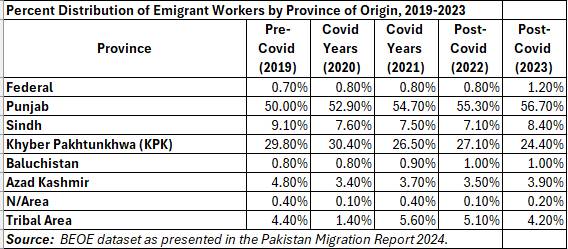
Together, Punjab and KP account for nearly 90 per cent of all migrants. This concentration has two parallel effects. It improves household incomes through remittances in these regions, but it also sustains dense migration networks—both legal and illegal—that operate through the same social corridors. Over time, these networks lower the barriers to exit for some, while deepening regional imbalances and reinforcing the same corridors through which both opportunity and exploitation travel.
Migration and militancy, then, are not parallel outcomes of poverty—they are outcomes of selective mobility
If poverty alone drove migration, these patterns would look very different. Balochistan and rural Sindh would feature far more prominently in outward flows. Instead, migration is concentrated in regions where households, though struggling, can mobilise resources and tap into established networks. The system does not move the poorest—it selects the relatively better-off among the poor: the “resourceful poor”.
Recent tragedies illustrate this dynamic starkly. In the Italy boat incident, several victims were reportedly travelling under the guise of Umrah pilgrims. Even this deception required money, planning, and access. The journey was illegal, but not unstructured. It followed a pattern available only to those who could afford it.
At the national level, the state celebrates the outcomes of this mobility. Remittances reached record levels—around $38.5 billion in FY25—while more than 700,000 Pakistanis left for work abroad in 2025 alone. In aggregate terms, the loss of lives along irregular routes is absorbed as a marginal cost within a much larger system of labour outflow. These flows are often framed as economic success because they feed into the foreign exchange earnings on which the country depends heavily. But they also reflect a deeper dependence. For a country with limited export capacity, remittances have become a financial lifeline, masking structural weaknesses in domestic employment and productivity.
Migration, in this sense, is not an explicit policy—but it is structurally embedded in the system. Citizens leave voluntarily, yet the state benefits systematically, absorbing foreign exchange inflows while deferring the responsibility to generate opportunities at home.
The composition of this outflow makes clear what Pakistan is actually exporting. Between 2019 and 2023, only 4 to 8 per cent of emigrants fell into the “highly qualified” category. The overwhelming majority were either skilled or semi-skilled, with the latter rising to 56 per cent by 2023. This is not a story of elite mobility or “brain drain”. It is the large-scale export of labour from the lower and middle tiers of society—the same “resourceful poor” who can finance migration but remain excluded from higher-value opportunities.
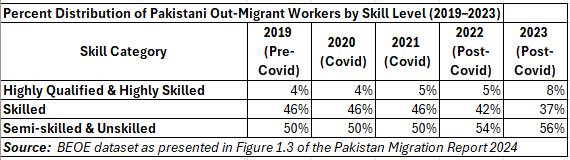
The state benefits from their remittances, but the structure of this migration raises a deeper question: is Pakistan merely facilitating labour export, or actively investing in upgrading the value of its human capital abroad? Looked at closely, the composition of this outflow makes clear what Pakistan is actually exporting.
The contrast with those who cannot migrate is stark. In Balochistan and parts of interior Sindh, extreme poverty coexists with immobility. Populations there lack both the resources to leave and access to formal employment within the country. Even large-scale projects—mining, energy, and infrastructure—have not translated into broad-based local inclusion. With limited education and few economic pathways, many are confined to informal or illicit activities, from cross-border smuggling to low-end survival economies.
Their deprivation is deeper, but it remains largely invisible—because they do not appear in migration statistics. They are not drowning in distant seas; they are stuck in place.
This logic of selective access also complicates another widely held assumption: the link between poverty and militancy. Militants are often described as products of extreme deprivation. But patterns suggest a more layered reality. Recruitment, like migration, depends on exposure, networks, and targeting. Those drawn into militancy are not necessarily the poorest; they are those within reach of ideological systems—seminaries, organisations, or social circles that enable mobilisation.
In recent years, even the emergence of female suicide bombers from Balochistan has underscored this point. These are not the most destitute individuals, but often educated or socially connected women, indicating that participation is shaped less by absolute poverty and more by access, narrative, and recruitment structures.
Migration and militancy, then, are not parallel outcomes of poverty—they are outcomes of selective mobility. One is economic, the other ideological. Both depend on networks, resources, and exposure. And both bypass the truly marginalised.
This is where the national narrative becomes misleading. Aggregate figures—total remittances, total emigrants, total militants—obscure the internal distribution of opportunity and exclusion. By focusing on national totals without provincial or social breakdowns, the state conceals a critical reality: Pakistan is not uniformly poor; it is unevenly connected.
Some populations have pathways outward—legal or illegal. Others have pathways into organised structures, whether economic or militant. And a large segment remains excluded from both, trapped in conditions of silent deprivation.
The result is a quiet sorting mechanism. Pakistan is exporting its frustrated but resourceful citizens, sustaining its economy through their earnings, while its most deprived populations remain immobile and largely unseen. At the same time, segments of the connected population are drawn into militancy through parallel networks of access and influence.
This is not simply a story of poverty. It is a story of filters—who gets to move, who gets recruited, and who is left behind.
Until policy begins to address these underlying inequalities of access, the tragedies will continue. Boats will sink, networks will adapt, remittances will rise, and the poorest will remain where they are—too poor to migrate and too invisible to matter.