

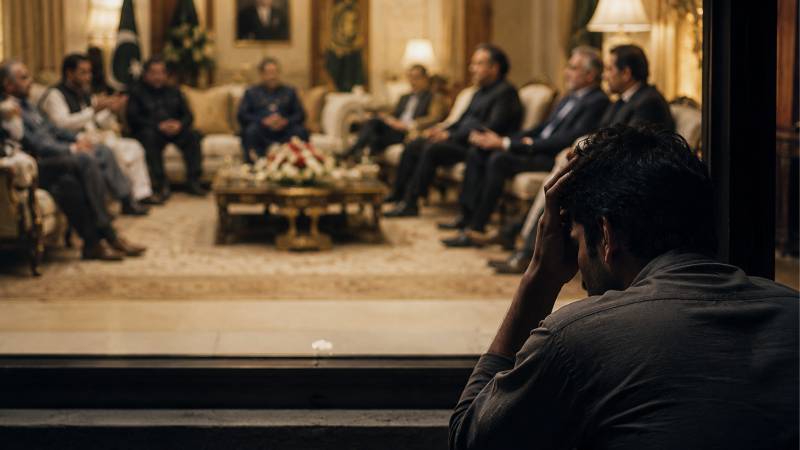
Two recent tweets by veteran journalists captured a mood of deep disillusionment in Pakistan’s media circles. Nusrat Javeed wrote that after “50 years of sacrificing everything for journalism,” chasing truths and exposing lies, he had become “utterly disillusioned with every single politician” because “they’re all the same.” Absar Alam responded that after “35 years of sacrificing everything for journalism,” he had reached the same conclusion.
I have a great deal of respect for these gentlemen. They have both paid a price for their views, at a time when others in the profession benefited from proximity to power, enjoying the privileges, wealth, and lifestyles that often accompany access to influential circles. Some accumulated substantial assets at home and abroad. Their frustration with politicians is therefore understandable. Pakistan’s political history has repeatedly disappointed those who expected leaders to rise above narrow interests and transform the country.
But the more important question is not why politicians have disappointed. That requires no great insight; history has answered it repeatedly. The real question is why, after decades of covering Pakistan’s politics, so much of the commentariat continues to misunderstand how power actually works.
The answer is uncomfortable: many confused access with understanding. Being close to politicians, generals, judges, and decision-makers does not automatically translate into an understanding of institutions, incentives, or political economy. It requires a lot of serious work, intellectual heavy lifting. Too many analysed politics through personalities rather than systems, through rivalries rather than structures, and through who was winning the latest power struggle rather than why the same patterns kept repeating.
They repeatedly mistook anti-establishment postures for democratic transformation, electoral victories for real progress, and changes in political alliances for changes in the underlying order. Each new actor was presented as the answer. Each eventually became part of the same cycle. The faces changed. The slogans changed. The system endured.
For decades, Pakistan’s political discourse has been a theatre of personalities rather than a serious debate about institutions. We search for saviours instead of studying systems, celebrate access instead of demanding understanding, and reduce complex national failures to the rise and fall of individual leaders.
One politician becomes the embodiment of hope; another becomes the villain responsible for everything that has gone wrong. One is declared the guardian of democracy; another its mortal enemy.
Yet beneath this endless cycle of political worship and political vilification lie the real questions that rarely receive attention: Who controls incentives? Why does the state reward patronage over productivity? Why have institutions remained weak? Why has Pakistan failed to replicate the economic transformation achieved by so many Asian countries?
The consequences are visible. While countries across Asia used the last three decades to expand exports, build human capital, improve governance, and raise living standards, Pakistan remained trapped in repeated cycles of debt, instability, low investment, and elite competition for control of the state.
We spent decades debating who should rule while paying far too little attention to how the country should be governed. For years, I have written about the role of the establishment in Pakistan. In May 1992, I wrote in Newsline magazine about what the failure of democratic forces to provide an agenda of change could lead to:
“Will Pakistan become a battleground for xenophobic ethnicism, religious fundamentalism, and eco-medievalism, or will the secular and democratic forces be able to prevent the explosion that this combustible convergence of forces may cause, if not in 1992, then perhaps in 2001?”
Where I differ sharply from much of the media and commentariat, however, is in their reading of Pakistan’s political class since the 1990s. A convenient myth has taken hold: that if democracy had not been repeatedly interrupted, Pakistan would have been on a fundamentally different trajectory.
It is an emotionally satisfying argument, but a weak one. Countries do not become prosperous simply because elections are held on schedule. They succeed because political elites develop coherent strategies for economic transformation, build institutions, strengthen state capacity, and create an environment where productivity, innovation, and investment can flourish.
The obvious question is: where was that strategy in Pakistan? The PPP and the PML-N dominated Pakistan’s politics for much of the post-Cold War era. Yet despite their bitter rivalry, both operated within broadly the same intellectual framework. Both accepted the conventional wisdom of the IMF, the World Bank, and the broader Washington Consensus.
Neither produced a serious developmental vision comparable to the countries that successfully transformed themselves through export-led growth, investment in human capital, institutional reform, and disciplined state capacity.
The differences between them were largely stylistic rather than strategic. The PML-N became obsessed with mega projects financed by debt, especially foreign loans. Motorways, flyovers, metro systems, power projects, and other visible infrastructure became the centrepiece of governance. Infrastructure matters, but it is not a development model by itself. Countries do not become prosperous because politicians inaugurate projects and cut ribbons.
More importantly, this approach reflected a deeper problem: the substitution of political visibility for economic transformation. Questions about productivity, competitiveness, exports, education, institutional reform, and governance were pushed aside by the politics of announcing large projects.
Many such projects were also accompanied by persistent allegations of inflated costs, opaque contracting, political favouritism, and rent-seeking. Whether every allegation was proven or not, the perception that state resources were being used to benefit connected elites became deeply entrenched.
The energy sector provides an even more serious example. Successive governments embraced the Independent Power Producer model without adequately addressing its long-term consequences. The result was a system that privatized profits while socializing losses, contributing to the circular debt crisis that continues to burden Pakistan’s economy.
The public ultimately paid the price through higher tariffs, fiscal pressure, and reduced economic competitiveness.
The PPP, meanwhile, became a caricature of its 1970s self. A party that once claimed to represent social transformation increasingly reduced politics to patronage, symbolism, and electoral brokerage. It confused pro-poor rhetoric with development, distribution with productivity, and political loyalty with institution-building.
One party worshipped concrete; the other romanticized populism. Neither built the foundations of a modern developmental state. Both became notoriously synonymous with patronage politics and the consolidation of family dynasties. The broader problem was not simply policy failure. It was the emergence of an elite political economy in which access to the state often became the fastest route to wealth accumulation. Ordinary Pakistanis were repeatedly asked to sacrifice while headlines were dominated by allegations involving offshore companies, foreign properties, unexplained wealth, Swiss accounts, and lifestyles far removed from the economic realities faced by ordinary citizens.
Whether every accusation was fair is not the central issue. The deeper issue is that successive political elites failed to convince the public that they were building institutions rather than using political power for personal and family advancement. Yes, democratic governments were repeatedly interrupted. But interruptions alone do not explain Pakistan’s failures. It is equally true that both parties willingly participated in the establishment’s power games whenever it suited them. They sought establishment support when out of power, benefited from it when in power, and rediscovered democratic principles when the balance shifted against them.
The politics of the 1990s was not simply a story of civilian governments being victimized by an overbearing establishment. It was also a story of politicians conspiring against one another, manipulating institutions, seeking non-democratic advantages, and treating the state as an instrument of political warfare.
The political class was not merely a victim of Pakistan’s power structure. It was also a participant in maintaining it. The Charter of Democracy was therefore an important development. It represented an acknowledgment that endless political warfare was damaging the democratic system itself. Whether it could have evolved into a more durable settlement had Benazir Bhutto survived is impossible to know. But the historical record is far more complicated than the simplistic narrative of democrats versus the establishment. Benazir Bhutto’s return was facilitated through significant international engagement, particularly American involvement. Nawaz Sharif, too, was no stranger to elite bargaining, backchannel politics, and institutional confrontation.
The Memogate episode, including the involvement of General Shuja Pasha and Nawaz Sharif’s appearance before the Supreme Court wearing a lawyer’s black coat, remains a reminder of how deeply such power struggles had become embedded in Pakistan’s politics. Pakistan’s political history has rarely been a battle between pure democrats and pure authoritarians. It has been a contest among competing elites seeking power within a flawed system. The Lawyers’ Movement is another example of how Pakistan’s political discourse often mistakes elite struggles for transformative moments. It is now routinely presented as a historic democratic awakening that fundamentally altered Pakistan’s trajectory. That interpretation is exaggerated and misplaced.
The movement emerged within a broader confrontation between Gen. Pervez Musharraf and competing centres of power within Pakistan’s establishment, particularly the leadership under General Ashfaq Parvez Kayani. Many lawyers and civil society activists participated with genuine convictions about constitutionalism and judicial independence. But the larger political struggle was never simply about courts; it was about the balance of power among institutions and powerful actors.
Its defenders often attributed to the judiciary a transformative role that no judiciary can realistically perform. An independent judiciary is important. Courts can protect rights, interpret laws, and provide checks against arbitrary authority. But courts do not build developmental states. They do not reform bureaucracies, create productive economies, improve education systems, expand exports, or transform societies.
No country in history has escaped underdevelopment because judges became more powerful. Successful countries were built through political leadership, effective institutions, economic strategy, and long-term state capacity. The greatest misconception among many supporters of the Lawyers’ Movement was the belief that changing the balance between judges and executives could substitute for the much harder task of transforming Pakistan’s political economy. It could not.
Then came Imran Khan. The faces changed. The slogans changed. The rhetoric changed. But the underlying dynamic remained remarkably familiar. Once again, Pakistan’s politics became a contest between heroes and villains. Once again, supporters and opponents focused on personalities rather than systems. Once again, the difficult questions disappeared. What economic model is being pursued? How will productivity increase? How will exports grow? How will state capacity improve? How will Pakistan escape the cycle of debt, dependency, and low growth?
The real question is not whether some modus vivendi between civilian and military institutions is necessary. It is.
These questions rarely dominate public debate because Pakistan’s pundit class remains obsessed with personalities. Every discussion revolves around who is rising, who is falling, who has the establishment’s blessing, who has lost it, who betrayed whom, and who is plotting against whom. Very few commentators seriously study political economy, state formation, comparative development, or institutional history. Access to the corridors of power has too often been mistaken for an understanding of power. Pakistan’s political commentary is rich in gossip and poor in analysis; rich in access and poor in understanding.
As a result, every problem is reduced to one explanation: the establishment. The establishment deserves criticism where criticism is warranted. It has played a central role in Pakistan’s political history and has often intervened in ways that weakened democratic institutions. But explaining nearly eight decades of political and economic underperformance through a single institution is not analysis. It is intellectual laziness. Pakistan was born as a security state and has largely remained one. That reality was shaped by Partition, wars, territorial disputes, and a persistent perception of external threat.
Any serious discussion about Pakistan’s future must begin with understanding that historical reality rather than pretending it does not exist. The real question is not whether some modus vivendi between civilian and military institutions is necessary. It is.
The real question is what kind of modus vivendi. What Pakistan has repeatedly witnessed under the label of a "hybrid system" is not a sustainable balance of power. It is political surrender. Political elites exchange principles for offices, privileges, contracts, influence, and patronage. They oppose interference when excluded from power and accommodate it when included. That is not democratic consolidation. It is elite accommodation.
Those who spent decades presenting these parties as champions of democracy should engage in serious reflection. Too often, they confused elections with democratic governance, patronage networks with representation, and elite bargains with institutional progress. The same intellectual failure was visible during the rise of the PDM.
Many commentators defended the removal of Imran Khan and the subsequent collaboration between the PDM and the establishment on the grounds that Khan, with the support of Gen. Faiz Hameed, intended to entrench himself in power through a long-term hybrid arrangement. Whether that assessment was correct or not, it was presented as a defence of democracy.
Four years later, those same commentators would be hard-pressed to explain the outcome. If the objective was to strengthen democratic institutions, expand political freedoms, reinforce constitutional norms, and reduce the role of unelected actors in politics, where exactly is the evidence?
If the fear was the creation of a long-term hybrid order centred around one leader, what exactly should we call a political system in which power continues to be transferred within a handful of families? The old political patriarchs have not built stronger institutions; they have prepared succession plans. From Nawaz Sharif to Maryam Nawaz, from Zardari to Bilawal Bhutto, the message remains the same: democracy is defended in principle, but political inheritance continues in practice. A system where parties function more like family enterprises than institutional organisations can hardly be presented as the triumph of democratic consolidation. These are not partisan questions. They are questions of consistency.
Principles that apply only to one’s opponents are not principles at all. If dynastic politics was a problem when practised by one political actor, it cannot suddenly become acceptable when practised by another. If institutional interference is dangerous when it benefits one party, it remains dangerous when it benefits another. If institutional interference is wrong when it benefits one political actor, it remains wrong when it benefits another.
Democracy cannot be defended selectively. Until Pakistan’s political class and its commentators confront these contradictions honestly, the country will remain trapped in the same cycle of personality cults, elite bargains, conspiracies, and political amnesia. The debate will continue to revolve around who rules rather than how the country is governed. And that is why Pakistan keeps going in circles.