

Prophet Muhammad (PBUH) is reported to have said, “The best form of Jihad is to utter a word of truth to a tyrannical ruler.”
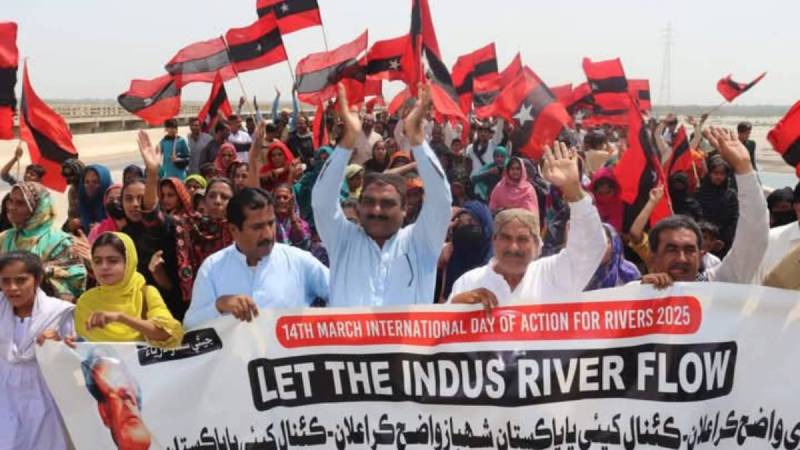
With the participation of lawyers in the ongoing anti-canal movement, the struggle has morphed into a meaningful phase. Their indefinite sit-in at the Babarlo Bypass, the crucial artery connecting the north and south of Pakistan, has entered its first day with resolute determination, spearheaded by Aamir Nawaz Waraich. For some months now, the province has seen widespread protests, sit-ins, rallies, and public demonstrations by nationalists, GDA, religious parties, professionals, students, writers, singers, and mainstream political parties, calling upon the Shahbaz Sharif-led government and the architects of corporate farming to end the controversial irrigation project known as the Cholistan canals on the Indus River.
While Sindh rose up in protest against the disputed canals, the federal government remained indifferent to the protests and consequently refused to end the project. Much has been written and highlighted by the intellectual establishment and water experts, and much will be penned down about the ecocide caused by the controversial project. The public was dismayed that despite the project not being approved by relevant institutions like the CCI and ECNEC, it was still inaugurated. This intensified the struggle in the province of Sindh.
Despite widespread public indignation against the project, those sitting in Islamabad and Punjab are not in the mood to revisit the unilateral project, which has ultimately strained the relationship between the Centre and the province. President Asif Ali Zardari, in his address to the joint parliament, highlighted the strain emanating from unilateralism and called upon the federal government to avoid such a scheme. Later, the Sindh Assembly passed a resolution against the controversial project, touted as a game-changer scheme, citing the man-induced disaster it would cause for the people and the riparian province, which heavily relies on the Indus River water for agriculture, livestock, and other sources of livelihood.
Measures such as these and the consequences deliberated upon should have halted the project in question. Last but not least, the elected representative political party, the Pakistan People's Party (PPP), is opposed to the construction of the disputed canals. Seeing no sign of political flexibility and subsequent closure of the canals, the legal fraternity took it upon itself to close the Sindh-Punjab border, giving a strong message that the canals on the Indus River were a red line and asking the federal government to end the proposed project altogether. They have staged a sit-in, determined to continue until the indifferent political spectrum is brought to its knees and publicly announces its decision to wind up the upstream water project. Since Saturday 19 April, reportedly inter-province road traffic has come to a halt. The business damage bill might be in billions due to disruption in the supply chain. The continued disruption will also usher in inflation, shortages of goods, of food and vegetables that are transported to and from the two provinces. The casualty of this will be the public. On the heels of lawyers closing the inter-provincial border, the price of potatoes has skyrocketed threefold, which is just the tip of the iceberg in terms of both the shortage caused by supply chain disruption and the monkey business applied by traders. This puts extra burden on public purse.
The public is paying a heavy price in every context.
The mother of all these multiple crises is the political inability to deal with the matter that demands urgent attention and redressal of the issue of canals, as demanded by the population in Sindh province. Water is a matter of life and death for all those living in the province. This is the reason why the anti-canal movement has caught the public's imagination and garnered an overwhelming response in terms of participation, facilitation, and support for the protesters. The sit-in continues to swell as people from all walks of life from nearby cities and far-off towns come to join the anti-canal struggle. The educated and advanced class, known as the legal fraternity, is determined to ensure the movement—launched against the looming strangulation of the Indus River—reaches its logical end, with the Shahbaz Sharif-led government announcing a cap on the controversial canals. The system cannot afford to neglect the second-most populated province, whose demands, according to expert opinion, stand valid in terms of scrapping the project. It is high time those in power corridors showed the political maturity and wisdom needed to weather the storm. Someone rightly remarked that the lawyers' movement marks a new chapter in the history of resistance against the disputed mega irrigation project. They have become the lawyers of Sindh's fight against water injustice without taking any fees or incentives. However, history will pay them a high tribute and place their names in the annals of history books written in golden letters.
What the ruling elites need to realize is that any political spectrum that does not take into account the genuine problems faced by the deprived population cannot survive. The parched lips of the downstream Kotri and Sukkur Barrage, and subsequent drought conditions and drinking water crises in the coastal belt, remind the people of Sindh of the looming water scarcity and associated worst-case scenario. And this is the driving force behind the struggle launched against capitalist progress, known as corporate farming, and the chain of canals to be built on the Indus River, the lifeblood of Sindhis. Those moguls favouring the mega irrigation project, who tirelessly keep churning out arguments to utilize floodwater, must wake up to the recent alarming news shared by none other than the National Disaster Management Authority (NDMA). According to the NDMA, the three-month forecast (April to June) indicates that cyclones are expected to form in the Arabian Sea during May and June, triggering rainfall in coastal areas. The report indicates that the summer season will bring higher-than-normal temperatures nationwide, coupled with below-average rainfall.
The legal fraternity have emerged as the rising stars of the anti-canal struggle
The combination of higher temperatures and diminished rainfall is projected to reduce agricultural output nationwide, potentially causing lower crop yields, water scarcity, and food security challenges. Food sovereignty is the fundamental right of every citizen living in this land. The upstream water project is seen as compromising the food sovereignty of the wider sections of society in Sindh. Unchecked capitalism often leads to greed-driven decision-making. According to Michael Löwy, “Capitalist progress threatens human survival.” Sindh Chief Minister Murad Ali Shah recently criticized the Punjab government for opening the Taunsa-Panjnad (TP) link Canal, calling it “irresponsible.” He said, “We are currently facing a 50 percent shortage of water. In such a situation, opening the TP Link Canal was irresponsible,” adding further he said, “We will not rest until there is a formal announcement to shut down the canals project.”
While addressing a large public gathering in Hyderabad past Friday, PPP Chairman Bilawal Bhutto Zardari conveyed his concerns in no uncertain terms when he threatened the ruling PML-N against continuing down the path of confrontation with Sindh over the issue of new canals on the Indus River. He made it clear that his party would not go along with the Shahbaz Sharif-led federal government if it didn't shelve the controversial projects, even after acknowledging the PPP's objections.
The PML-N federal government stands on shaky foundations, cobbled together by coalition partners. The more it delays, the murkier the political environment in the country will become.
Given the unprecedented anger in Sindh against the proposed corporate agricultural enterprise, and independent minds in Punjab speaking up against the ambitious scheme in question, it won't take off. It has to be buried today or tomorrow under the heavy weight of ongoing public protests across the country.
These escalating sensitivities and comparisons can't be and shouldn't be neglected. Hazrat Ali (RA) said, “Disbelief can rule, but tyranny cannot.” The political situation in the other smaller provinces needs no elaboration, as it is already in the public focus. Vested interests should not trump national interests.
The legal fraternity have emerged as the rising stars of the anti-canal struggle. Reportedly, the protesting lawyers have warned that if the federal government did not announce to shut down the contentious canals, they would block railway tracks leading to Punjab. Democracy demands a cool-headed policy in such a sensitive environment. The political heatwave emanating from the canal controversy needs to be mitigated with democratic norms.
“No more canals on the Indus” is a rallying cry that can’t be drowned out by coercion. Unfazed by intimidation and threats, Sindh’s lawyers are roaring like lions against the upstream water project.