


The Triumph of Reason: From Enlightenment to High Modernity.
For much of the 20th century, the evolution of global civilisation was framed through a secular lens. The prevailing assumption among the intelligentsia was that as societies modernised, the ‘sacred’ would inevitably retreat into the private sphere, replaced by a modern universal rational order.
This was the promise of the ‘Enlightenment’ era: a world disenchanted of myth and governed by empirical truth. The Enlightenment, often referred to as the ‘Age of Reason,’ greatly shifted the European worldview from a God-centred universe to a man-centred one. This process was famously described by the German sociologist Max Weber as “Entzauberung” or disenchantment.
Western societies were stripped of their magical-thinking and ‘superstitious’ traits, replaced by a logical, rational framework. Before this era, the world was perceived as a stage for divine intervention where people prayed for rain and kings ruled by divine right.
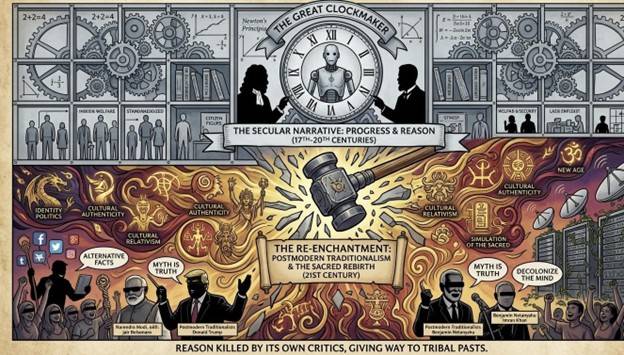
However, thinkers such as Isaac Newton demonstrated that the universe operated according to predictable mathematical laws. In the book The Bible, Protestantism, and the Rise of Natural Science, Professor Emeritus of History and Philosophy Peter Harrison wrote that during the Enlightenment era, beginning in the 17th century, God was demystified from an active participant in daily life to a ‘Great Clockmaker.’ In this view, He may have built the machine, but He was no longer constantly tinkering with the cogs.
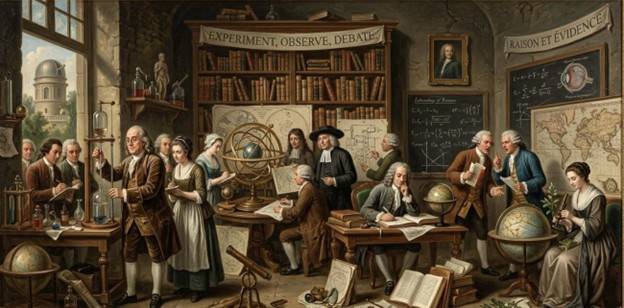
This transition was supported by the rise of empiricism and the scientific method, championed by figures such as the philosophers Francis Bacon (1561-1626), René Descartes (1596-1650), John Locke (1632-1704) and David Hume (1711-1776). They argued that if something cannot be measured, observed or tested, it cannot be accepted as fact.
In the previous eras, the Church held a monopoly on truth. Enlightenment philosophies challenged this by placing reason above revelation. The 19th century German philosopher Immanuel Kant defined this period as man’s emergence from his self-imposed immaturity (‘nonage’). He urged people to ‘dare to know.’
Secularism was one of the outcomes of the Enlightenment. It was never anti-religion as such but sought to compartmentalise the sacred and the profane in separate boxes. It saw the mixing of theology and politics as a problematic occurrence which stuns and mutilates intellectual as well as spiritual growth. Gradually, in the West, political and social structures were reorganised around secular concepts like the ‘social contract’ rather than on biblical mandates.
Events like the 1979 Iranian Revolution and the rise of the American Christian Right proved that religious identity remained a vastly more potent mobilizing force than technocratic nationalism
Morality began to be viewed as a human construction for social harmony rather than commands from the heavens. This stripped away the otherworldly aura of texts considered to be sacred. Scholars began to treat these texts as historical documents written in specific cultural contexts. They treated these writings like any other piece of literature, open to rational, objective inquiry.
By the late 19th century, Enlightenment ideas had transcended their European origins to become a global vernacular. This was achieved not only through colonial imposition but also through the agency of non-Western reformers who viewed Enlightenment rationalism and empiricism as the essential tools for national survival and modernisation. For example, the Muslim world witnessed the emergence of ‘Islamic modernists’ such as Jamal al-Din al-Afghani, Muhammad Abduh and Sayyid Ahmad Khan who tried to reconcile Islamic theology with Enlightenment ideas.
History identifies this as the "Global Enlightenment," where rational thought and empirical science were de-linked from their strictly Western geography and re-planted in diverse cultural soils. But the mid-20th century was the crucible that tested these ideals to their breaking point. The Enlightenment’s promise of rational progress was seemingly shattered by the horrors of the First and Second World Wars or due to conflicts where scientific efficiency was used for industrialised slaughter.
Thinkers such as Theodor Adorno and Max Horkheimer argued that the "dialectic of Enlightenment" had led reason to devour itself, culminating in the “nightmare of totalitarianism.” But whereas Adorno and Horkheimer blamed the Enlightenment ideas for the rise of authoritarian/totalitarian ideologies in the 1920s and 1930s, others saw these ideologies as the outcome of ‘Counter-Enlightenment’ philosophies such as modern conservatism pioneered by Edmund Burke, the irrationalism/vitalism of Friedrich Nietzsche, the anti-universalism of Johann Gottfried von Herder, and the ‘back to basics' ideals of the ‘Romantics’.
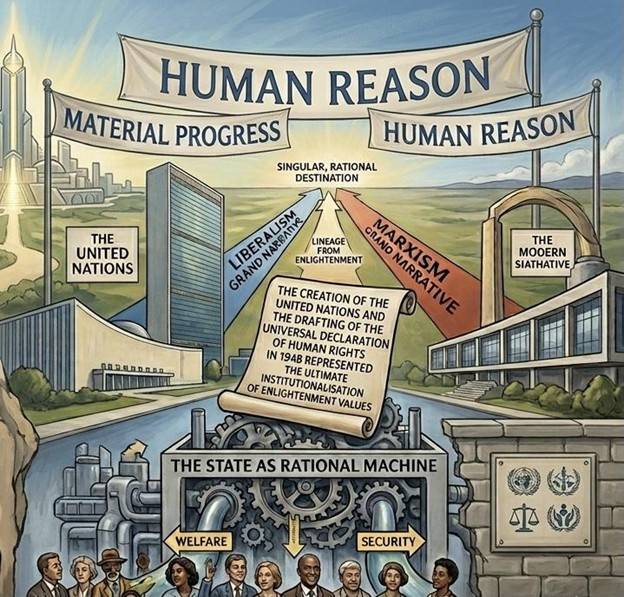
This is why the post-World-War-ll order did not reject the Enlightenment. It actually doubled down on it. The creation of the United Nations and the drafting of the Universal Declaration of Human Rights in 1948 represented the ultimate institutionalisation of Enlightenment values.
This period, often called the "High Modern" era, saw the world divided between Liberalism and Marxism. These two competing ‘Grand Narratives’ traced their lineage back to the Enlightenment’s belief in material progress and human reason.
According to the British historian Tony Judt, by 1945, the disenchantment of religion was an accepted intellectual premise, and the state was viewed as a rational machine designed to deliver welfare and security to its citizens. The world appeared to be moving toward a singular, rational destination.
The Rebellion Against Reason: From the Mutation of Postmodernism to the Re-Enchantment of Politics.
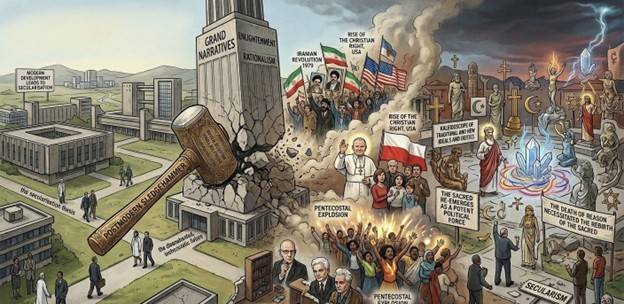
Until the late 1960s, the "secularisation thesis" remained the undisputed orthodoxy of the social sciences. It was widely believed that as the Global South underwent decolonisation, its leaders would march their nations into a disenchanted, technocratic future as the West had done. It was only with the collapse of this confidence in the 1970s that the postmodern sledgehammer found its mark, allowing the long-suppressed "sacred" to re-emerge as a potent political force.
The secular thesis collapsed as high-profile global upheavals shattered the belief that modern development inevitably leads to secularisation. This shift was most dramatically illustrated by the 1979 Iranian Revolution during which a technocratic, Western-aligned monarchy was toppled by a popular movement led by the clergy. Simultaneously, the era also saw the rise of the Christian Right in the United States, which re-politicised the "sacred" in the world's most advanced economy.
These events, alongside the election of Pope John Paul II sparking religious resistance against the secular Soviet bloc in Poland, and the rapid "Pentecostal explosion" (emphasis on a direct, personal experience of God) across the Global South, proved that religious identity remained a potent mobilising force than the disenchanted, technocratic nationalism of the High Modern Era.
Consequently, the 21st century is witnessing a world in which secularism is in a state of rapid retreat, replaced by a surge in religious and nationalist fervour. This "re-enchantment" of the political sphere is not merely a traditionalist revival. It is a sophisticated product of postmodernism, the philosophical current that began to emerge in the 1970s and sought to dismantle all certainty.
The intellectual catalyst for this shift was an iconoclastic backlash against the lingering Enlightenment ideas and the High Modern Era. Postmodernism arrived with a hammer aimed at "Grand Narratives" or overarching theories such as Marxism and Liberalism that claimed to explain the human condition in a holistic manner. Postmodernism championed a radical relativism that rejected the "absolute truth" as a viable solution to the perceived "absurdity" of the modern world, suggesting instead that all knowledge is contingent and parochial.
While postmodernism’s original intent was to liberate marginalised voices by deconstructing dominant power structures, it inadvertently dismantled the foundations of secularism itself. By asserting that all truths are "socially constructed," postmodernism stripped science and rationalism of their objective authority. It effectively "killed" reason and replaced it with a kaleidoscope of traditional and "new age" ideals and deities, allowing mythologies to claim equal status in the political-public square. The claim that the "death of reason necessitates the rebirth of the sacred" was transformed from an almost apocalyptic point of view into a devastatingly effective political tool.
Postmodernism began as a loose network of disgruntled European leftists. These included 20th Century thinkers such as Michel Foucault and Jacques Derrida who were disillusioned by the failures of Marxist teleology and the perceived rigidity of Enlightenment rationalism. In the wake of the late 1960s social upheavals, they sought to dismantle ‘totalising structures.’
However, while the postmodern turn was born from a crisis of the Left, its methods proved remarkably adaptable for the Right. The most unsettling outcome of this intellectual evolution is how the tools of the post-1970s Left, such as identity politics, cultural relativism, and the deconstruction of "truth", have been colonised by the far-Right.
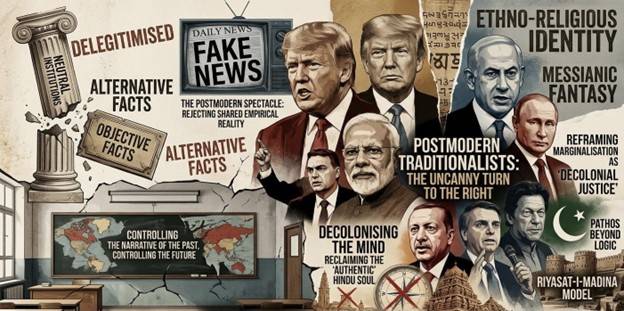
Postmodernism’s uncanny turn to the Right started with the insight that the socio-historical context of tradition is inevitable. By delegitimising neutral institutions and objective facts, and mixing the sacred with the profane, 21st Century political postmodernists have re-enchanted politics. They include Vladimir Putin, Vikter Orban, Recep Erdogan, Donald Trump, Narendra Modi, Jair Bolsonaro, Benjamin Netanyahu, and Imran Khan.
These leaders utilised "alternative facts" and what they claimed was “cultural authenticity’’ as their primary currencies of power, framing the liberal order as an alien assault on the national soul. In the United States, Donald Trump’s ascent was a postmodern spectacle that challenged the concept of a shared empirical reality. By labelling mainstream media as "fake news," he applied a populist version of the postmodern critique: the idea that all information is merely a tool of a corrupt "Deep State."
In The Death of Truth, Michiko Kakutani wrote that the postmodernist argument that ‘all truths are partial’ has been exploited to equate debunked theories with facts. Benjamin Netanyahu has steered Israel away from its initial secular roots toward a hardline ethno-religious identity. Recently, he has utilised messianic language, suggesting a divine mandate that bypasses secular debate. Multiple analysts have identified this as a "Messianic Fantasy," a strategy designed to delegitimise neutral institutions through the lens of identity politics.
In India, Narendra Modi has accelerated the decline of Nehruvian secularism by using a postmodernist critique of "coloniality." By framing secularism as an alien Western construct, his regime advocates for "decolonising the mind" to reclaim an ‘authentic’ Hindu soul. This rhetoric reframes the marginalisation of minorities as a form of "decolonial justice."
Pakistan’s Imran Khan transitioned from a Westernised celebrity to a piety-driven politician, promising a Naya Pakistan based on the 7th-century model of ‘Riyasat-i-Madinah.’ Khan used pathos and sentiments to move his audience beyond logic, romanticising a religious past as the only form of true cultural liberation. To solidify this re-enchantment, these leaders also turned to the classroom, recognising that whoever controls the narrative of the past controls the direction of the future.
While the 21st-century re-enchantment of politics feels like a sudden rupture, its roots are deeply embedded in the 20th century. Before the postmodernists dismantled reason, several earlier movements challenged the secular consensus. The 20th century German jurist Carl Schmitt argued that modern politics is just a non-religious version of old religious ideas.
His most famous idea was that the person truly in charge is the one who has the power to decide when the normal rules no longer apply. He believed that when a leader ignores the law to deal with a crisis, it is the political version of a religious miracle.
According to Emilio Gentile in Politics as Religion, this directly prefigures the hyper-partisan rhetoric used by leaders today. Gentile adds that the totalitarian movements of the 1930s experimented with "political religions" (such as Mussolini's Fascism, Hitler’s Nazism, Stalin’s Marxist-Leninism, etc.) using advanced propaganda to sell tribal identities.
According to the sociologist Theda Skocpol, the 1979 Iranian Revolution proved that modernisation does not necessarily lead to secularism, but that technology can be hijacked to serve a religious "Grand Narrative." The philosopher Martin Heidegger’s critique of the "meaninglessness" of the technological age influenced the contemporary populist Right’s call for a return to "authentic" ways of being.
In the 21st century, the "re-enchantment" of the political sphere has found its most potent legal weapon in the theory of ‘Decoloniality.’ Originally a leftist academic framework, decoloniality has been co-opted by right-wing leaders in the Global South to frame secularism as a "colonial hangover." Decolonial theory, pioneered by thinkers such as Walter Mignolo, argues for a "delinking" from Enlightenment codes of knowledge.
Right-wing postmodernists have applied this to the judiciary and the constitution, arguing that legal systems designed by colonialists are inherently alien to the native soul. Replacing a neutral judge with a "traditionally grounded" authority is thus framed not as authoritarianism, but as decolonial justice.
The ultimate irony of the re-enchantment era is that its postmodernist leaders are not anti-modern in their methods. They are masters of social media, algorithmic manipulation, and high-tech communication. They utilise the most advanced products of the secular, scientific world to promote a worldview that rejects this world’s core values.
This is the uncanny romance of 21st-century politics: using the machinery of the future to drive a chariot back into the perceived safety of the tribal past. In a review of the event ‘India AI Impact Summit 2026,’ the January 2026 issue of Journal of Tech and Society noted that digital technology is more than just a tool but a creative force used to construct new political realities.
Postmodernism’s supposed dismantling of objective truth uncannily created a void that is now being filled by a frantic search for tribal identity. By treating reality as a mere social construct, it paved the way for a "might-is-right" narrative, ironically empowering the authoritarian structures postmodernism once sought to dismantle.
This isn't a return to old-world mysticism, but rather a "re-enchantment" driven by digital, high-tech imitation of the sacred. It is a manufactured passion built for a society that has traded rationalism for the selective truths of decolonialism, localism and "authentic" experience.