

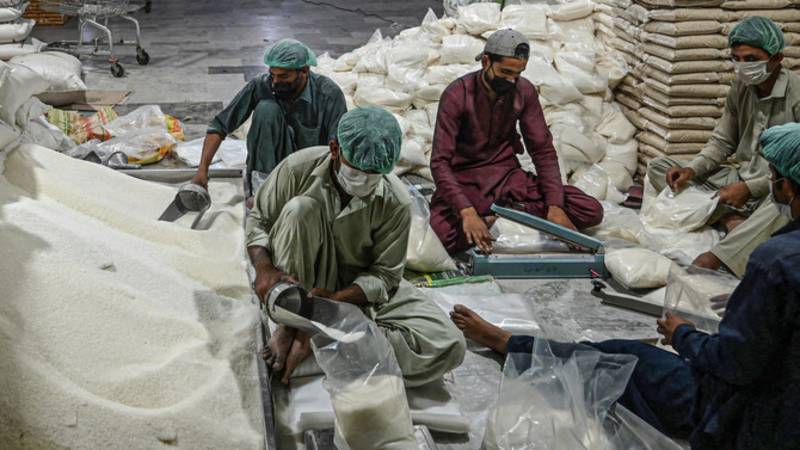
Global sugar prices have plunged by nearly $100 per ton—or about 20 percent—since October last year. But in Pakistan, domestic retail prices have surged by 37 percent since the start of 2025, even as the rupee has held steady against the US dollar.
Amid this troubling divergence, the Pakistan Sugar Mills Association (PSMA) has made the dubious claim that the industry provides $4 billion in import substitution to the national economy—a figure that is not only exaggerated but tone-deaf to economic and environmental realities.
In 2024, the sugar industry generated an estimated Rs 850–900 billion in revenues—roughly $3 billion—driven by increased output and rising local prices. But there is more to the sugar crisis than just the tariff protection issue.
Pakistan’s crop water productivity (CWP) for sugarcane stands at just 2.28 kg/m³—far below the global average of 3.5 kg/m³. In effect, Pakistan uses over 53% more water than other countries to produce the same amount of sugarcane. At a time when climate change and water scarcity threaten livelihoods, this inefficiency is not just costly—it’s unsustainable.
Yet, the myth of “import substitution” persists, rooted in an outdated, self-serving mindset that has long stifled Pakistan’s shift toward export-led growth. If local mills can’t produce sugar at internationally competitive prices, the hard truth is: Pakistan may be better off shutting them down and importing cheaper sugar.
Instead, the government did the opposite. Despite the global price crash, it banned imports and maintained tight controls over a sector it has repeatedly failed to regulate effectively—often to the country’s detriment.
It’s time to reckon with the industry’s real footprint.
Sugarcane is Pakistan’s second-most important crop after cotton, supporting millions and shaping rural economies. According to the FAO, sugarcane accounts for 80% of global sugar production, with sugar beet making up the rest.
Pakistan grows about 84 million tons of sugarcane annually, as projected for 2025 by the USDA, up from around 75 million tons in recent years, according to the Pakistan Bureau of Statistics (PBS). Cultivated across 1.2 million hectares, the crop yields between 70 and 100 tons per hectare (IWMI).
Punjab dominates production, contributing about 55.9 million tons, followed by Sindh at 21.7 million tons (USDA). From this, the country's mills produce around 6.6 million tons of sugar annually, based on typical sucrose recovery rates of 10–11% (IntechOpen).
Pakistan ranks 7th or 8th globally in sugar production, accounting for about 3.5% of the world’s 190 million tons
The industry comprises 90 licensed mills, of which about 78 operate each crushing season—42 in Punjab, 31 in Sindh, and 5 in Khyber Pakhtunkhwa—employing 100,000 people directly and supporting another million through allied sectors (PSMA).
Economically, sugarcane contributes roughly 0.7% of Pakistan’s GDP. Its byproducts—bagasse and molasses—fuel other industries. In 2024–25, sugar mills produced around 24 million tons of bagasse, a fibrous residue used to generate electricity, reducing reliance on the national grid. Molasses, accounting for about 5% of cane weight, feeds distilleries and the animal feed sector.
Pakistan ranks 7th or 8th globally in sugar production, accounting for about 3.5% of the world’s 190 million tons (FAO, USDA).
For farmers, particularly in Punjab and Sindh, sugarcane remains a vital cash crop. Historically, they have depended on government-set support prices. But in 2025, that support was withdrawn as part of an IMF-mandated deregulation agreement—leaving growers exposed to market forces without a safety net.
Sugar is deeply woven into Pakistan’s daily life—from sweetening morning tea to Eid desserts. Around 65% of the 6.6 million tons of sugar produced is consumed by households (PBS).
But the environmental cost is staggering. Producing one kilogram of sugar requires 1,200–2,200 litres of water, consuming an estimated 28 billion cubic meters annually—about 20% of Pakistan’s total freshwater withdrawals (IWMI).
It is a powerful symbol of contradiction: a crop that sustains millions yet depletes vital resources. An industry that claims to strengthen the economy while bleeding it dry.
Unless Pakistan adopts structural reform—by prioritising competitiveness, efficiency, and sustainability—its sugar sector will remain less a source of sweetness and more a bitter burden.
A Crisis Takes Hold
Why continue growing this thirsty crop when imports can be cheaper and climate change looms? Pakistan’s sugar sector is beset by soaring prices, erratic supplies, and environmental pressures. In 2008, domestic retail sugar spiked to ~PKR 60/kg—versus global prices near PKR 17/kg—prompting an 8% sales tax and 0.85% excise duty waiver on 750,000 tons of imports. By 2010, prices reached PKR 65/kg against global PKR 20/kg, triggering another import relief. When ex‑mill prices hit PKR 100/kg in mid‑2020 (world ex‑mill ≈ PKR 44/kg), the government again opened imports. By 2025, regional retail rates climbed to PKR 180–200/kg compared to global rates near PKR 102/kg, leading to a 750,000‑ton import quota with zero duties and minimal taxes.
A History of Rising Protectionism
Pakistan’s sugar industry entered its current troubles in the early 2000s as protectionism took hold—import tariffs climbed from around 25% in the early 2000s to 40% in 2015 under Nawaz Sharif and Ishaq Dar, per USDA trade records. Subsidies further propped up the sector. Each major domestic price surge—2008, 2010, 2020, and 2025—led to emergency duty waivers on up to 750,000 tons of sugar, costing the exchequer tens of billions of rupees and stoking market volatility.
Protectionism reached its peak in 2015, under Nawaz Sharif, fuelled by generous export subsidies that widened the price gap. By 2020, local ex-mill prices soared to PKR 100/kg, while global prices remained around PKR 44/kg—a 127% difference, according to the USDA. By 2025, retail prices in many regions had reached PKR 180–200/kg, compared to global levels of approximately PKR 102/kg. In response, the government authorised the import of 750,000 tons, slashing the sales tax to 0.25% and eliminating duties—at a fiscal cost of PKR 25 billion. These steps, however, clashed with IMF conditions. The government cut down the size of planned imports after the IMF raised objections. The repeated price swings and reactive policymaking highlight an industry persistently reliant on protectionism and subsidies.
The Barons Behind the Crisis
The sugar industry of Pakistan consists of 90 licensed sugar mills, of which about 78 (≈87 percent) operate each season: 46 licensed in Punjab (≈42 operational), 38 in Sindh (≈31 operational), and 6 in Khyber Pakhtunkhwa (≈5 operational).
In August 2021, the CCP imposed a record Rs 44 billion penalty on the sugar industry for cartelisation, price fixing, and market manipulation. This fine, based on the 2019 turnover of 55 mills, included a Rs 300 million penalty on the Pakistan Sugar Mills Association (PSMA), with Rs 75 million for each of four violations, per CCP records.
In Pakistan’s sugar industry, mills face a relentless storm of challenges that often force them to shut down. Soaring costs for raw materials, labour, and energy collide with unpredictable sugar prices, squeezing smaller mills already weighed down by debt or delayed payments. Political ties add another twist: mills owned by powerful families like the Sharifs or Zardari endure legal battles and scrutiny, while those without such clout struggle to survive in the shadows.
The Sharif family’s enduring hold on the sugar trade stands as a stark illustration of how entrenched political elites can exploit regulatory gaps, leaving both producers and end‑users caught in the crossfire of a highly politicised industry
Regulatory chaos—shifting policies on pricing, exports, and subsidies—keeps owners guessing, sometimes making operations a losing bet. In remote corners like Sindh and KPK, poor roads and scarce sugarcane pile on logistical woes, driving up costs. Corruption weaves through it all, with scandals over tax evasion and land disputes snarling mills in legal knots. In this brutal landscape, smaller or less-connected mills often crumble, while the well-backed cling to survival in an industry that seems to be consolidating.
Three figures dominate this mess, clashing with fair market principles. Jahangir Tareen, once an ally of Imran Khan, oversees six mills under the JDW Group, founded in the 1990s. This group—Pakistan’s largest sugar entity with an estimated market share of 16%—earns industry-leading revenues (recent estimates put consolidated annual revenues in the Rs 130 billion range), with net margins typically around 5–7 percent. When ex-mill prices spiked to PKR 100/kg in July–August 2020, Tareen stayed silent for over two months. This led the Competition Commission of Pakistan (CCP) and Federal Investigation Agency (FIA) to probe hoarding across 81 mills, including his six, in 2020. His vague suggestion in late October 2020 to “review” import duties came only after FIA pressure, not initiative, despite his influence in the PTI government. Tareen served as Minister of Industries and Production from 2003 to 2007 under Pervez Musharraf, building his empire before entering politics in 2002.
Prime Minister Shehbaz Sharif and his immediate family preside over one of Pakistan’s most extensive sugar empires, directly controlling nine major mills across Punjab—Abdullah, Brother, Channar, Chaudhry, Haseeb Waqas, Ittefaq, Kashmir, Ramzan and Yousaf. Beyond the Sharif household, key figures within the PML‑N have secured ownership of additional facilities in Kamalia and Layyah, cementing the party’s dominance in a sector that supplies the staple sweetener for millions of households.
This sprawling industrial footprint has long drawn scrutiny. In late 2017, the Lahore High Court struck down a government‑backed plan to relocate five of these sugar factories to South Punjab, concluding that the proposed moves flouted environmental safeguards and violated zoning regulations. Undeterred, the mills have continued to operate under the party’s protective umbrella, leveraging political connections to sidestep fresh compliance hurdles and expand market share.
Critics argue that this blending of political muscle and commercial interest has entrenched a near‑monopoly in Punjab’s sugar belt, driving input costs ever higher for smallholder cane growers while limiting competition. Farmers—already burdened by rising fertiliser and diesel prices—often face delayed or partial payments as mill owners prioritise profit margins. Despite pledges from successive PML‑N administrations to support the rural economy, sugar‑industry cartels underwrite lavish political campaigning, with loyalties secured through subsidised credit lines and artificially managed sugar quotas.
As domestic prices soar and the government alternates between price caps and import tariffs, ordinary consumers pay the ultimate price for this fusion of power and profit. The Sharif family’s enduring hold on the sugar trade stands as a stark illustration of how entrenched political elites can exploit regulatory gaps, leaving both producers and end‑users caught in the crossfire of a highly politicised industry.
The Zardari family, long alleged to be closely tied to the Omni Group, is widely believed to exert dominant control over Sindh’s sugar industry. President Asif Ali Zardari’s relatives and senior PPP associates are reported to own or control at least five major mills—Ansari, Mirza, Pangrio, Sakrand, and Kiran—positioning them at the centre of the province’s sugar economy. The Omni Group, a powerful conglomerate said to operate several additional mills across Sindh, has become a symbol of this consolidation. In 2025, its chairman, Khawaja Anver Majid, received the prestigious Hilal-e-Imtiaz from President Zardari for his contributions to economic development—a move that sparked criticism given the group’s controversial rise. Industry observers and court filings have accused the Omni Group of acquiring distressed assets under opaque conditions and benefiting from political patronage, all while sugar prices soared and regulatory oversight remained weak.
A Heavy Human Toll
Rising sugar prices are silently straining every Pakistani household. Sugar is a daily essential—used in tea, sweets, and Eid treats—relying on an annual production of 6.6 million tons. Of this, households consume about 65% (roughly 4.3 million tons), industries use 25% (1.65 million tons), and commercial sectors like bakeries account for 10% (0.66 million tons), according to the Pakistan Bureau of Statistics.
In 2008, a family buying 2 kg of sugar weekly spent PKR 120. By 2020, that rose to PKR 200, and by 2025, it had jumped to PKR 380—a threefold increase, far outpacing stagnant wages (World Bank). For low-income families—where food takes up 25–40% of income—this means cutting back on meals and putting children at risk of stunting.
Industries that produce food, beverages, and medicine face rising costs, endangering hundreds of thousands of jobs. Small shops—bakeries, cafes, sweet vendors—are also being squeezed. The result: a ripple effect that fuels inflation and pushes more of Pakistan’s 240 million people into deeper economic hardship.
A Draining Financial Burden
Pakistan’s sugar sector is plagued by severe policy failures that consistently favour millers over consumers. A recent international tender for 50,000 tonnes of sugar exports, managed by the state-run Trading Corporation of Pakistan (TCP), received no offers due to unrealistic loading and delivery timelines—loading was sought from August 1–15, with traders citing insufficient notice to submit realistic bids.
This incident highlights a broader, flawed trade regime that centralises control, disrupts efficient trade, and drives up prices. In 2025, the government plans to subsidise 500,000 metric tons of imported sugar at PKR 55 per kilogram, costing PKR 27.5 billion. Meanwhile, export permissions for 765,000 tons in 2024–25 have allowed millers to earn USD 411 million, driving domestic sugar prices to PKR 200 per kilogram. Since 2020, subsidies and market manipulations have reportedly enriched millers by over PKR 100 billion, straining public finances amid a 65% debt-to-GDP ratio. Deregulation is proposed to curb rent-seeking in the sector, but political influence and IMF-mandated subsidy reductions hinder meaningful reforms, leaving consumers burdened with persistently high prices.
An Environmental Crisis
The land suffers silently from neglect. Across 1.21 million hectares—yielding 70–100 tons/ha—sugarcane guzzles 1,200–2,200 litres of water per kilogram of sugar, totalling roughly 28 billion m³ annually, or 20% of Pakistan’s freshwater withdrawals (IWMI). Groundwater levels in Punjab drop by 1–2 meters per year, raising pumping costs and salinity risks (Pakistan Water Partnership). Outdated mills with 9–10% recovery rates discharge untreated effluents, polluting rivers and degrading soil—an enduring symptom of the barons’ neglect.
A Way Forward with Deregulation
Brazil’s deregulation of sugar industry in the 1990s has yielded significant productivity and export gains: Brazilian mills now recover around 138 kg of sugar per ton of cane, compared with roughly 112 kg in China and about 105 kg in India. That efficiency drives Brazil’s export leadership—shipping nearly 35 million tons of raw sugar in 2023/24, almost half of global exports—while India caps exports at about 1 million tons and China remains a net importer. For Pakistan, where government price controls, low recoveries (around 90 kg per ton) and aging mills constrain both farmer incomes and trade potential, Brazil’s experience suggests a clear path forward: liberalise pricing to reward quality, attract private investment in modern biorefineries, and develop biofuel and cogeneration industries to boost yields, diversify revenue streams and expand exports.
Deregulation is the only way to realign incentives—and it’s straightforward: lift all import‑export curbs, cut tariffs from 40% to 10%, and scrap every subsidy. Critics warn of public unrest, but Pakistan survived record inflation and oil shocks in 2023 without protests. That fearmongering serves the sugar barons—many top PML‑N and PPP figures who should never be involved in shaping sugar policy, yet shamelessly ignore conflicts of interest.
Yes, change carries a price: the sector employs 100,000 directly and supports another million. A swift overhaul could cost 20–30% of those jobs (20,000–30,000 direct; 200,000–300,000 indirect) if we don’t build safety nets first. Millers with entrenched power will fight fiercely, but public frustration over soaring prices, the USD 7 billion IMF loan conditions, and the long‑term gains of ditching import substitution all demand decisive action.
The stakes couldn’t be clearer: deregulation delivers cheaper sugar, conserves water, and frees up government funds. The crisis was engineered by these few—only a truly open, competitive market can fix it. Will Pakistan’s leadership seize this chance, or bow to vested interests once again?