

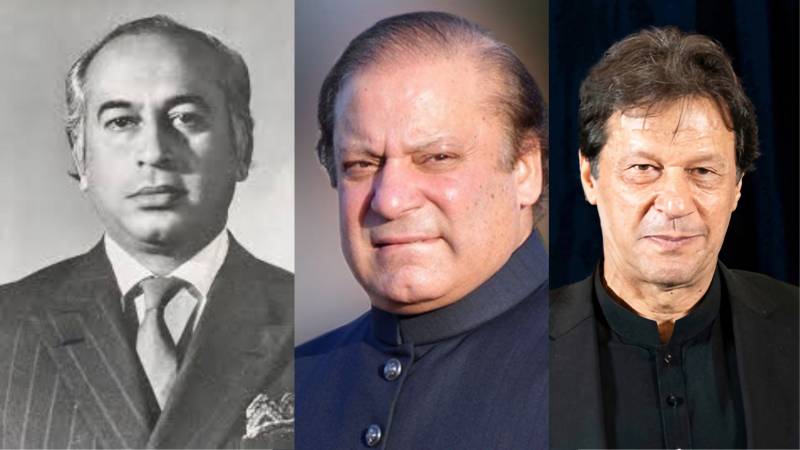
In Pakistan's tumultuous political landscape, the question arises: who among Zulfikar Ali Bhutto, Nawaz Sharif, and Imran Khan genuinely ascended to power through the people's mandate, and who were products of military patronage?
Zulfikar Ali Bhutto, the charismatic founder of the Pakistan People's Party (PPP), initially rose to prominence through democratic means. However, his tenure was abruptly ended by a military coup in 1977, leading to his execution. Despite his democratic beginnings, his downfall was orchestrated by the military establishment, casting a shadow over his legacy.
Nawaz Sharif, with his roots in industrial Punjab, has had a complex relationship with the military. While he has served as Prime Minister multiple times, his political career has been marked by periods of military support and opposition. Allegations of military backing during his rise and subsequent ousters suggest a symbiotic yet contentious relationship with the establishment.
Imran Khan, transitioning from cricketing legend to political leader, introduced a populist narrative centered on anti-corruption and governance reforms. However, his rise to power in 2018 has been described by some as a 'Project' of the military establishment, aimed at countering political rivals. Despite claims of grassroots support, his tenure faced challenges, including allegations of military interference and eventual ousting through a no-confidence vote in 2022.
Zulfikar Ali Bhutto's political journey began with his resignation from Ayub Khan's government, after which he founded the Pakistan Peoples Party (PPP) in 1967. Bhutto dedicated significant effort to developing the party's infrastructure, engaging with eminent personalities and the progressive middle class to promote democratic values and introduce social reforms. The PPP contested the 1970 general elections, widely regarded as free and fair, and secured a substantial number of seats in the National Assembly from West Pakistan. This victory underscored the party's grassroots support and commitment to democratic principles.
The aspiration for political stability and constitutional supremacy may remain elusive unless citizens actively engage in the democratic process
In contrast, Nawaz Sharif's ascent to power in the 1990s has been characterised by allegations of establishment support. The 1990 general elections, which resulted in Sharif's Pakistan Muslim League (PML) forming a coalition government, were marred by claims of manipulation. The Supreme Court of Pakistan later ruled that the elections were rigged, citing evidence of military and intelligence agencies' involvement in influencing the political landscape to prevent the PPP from returning to power.
This distinction highlights a fundamental difference between Bhutto's and Sharif's political trajectories. While Bhutto's rise was rooted in democratic engagement and popular support, Sharif's emergence was facilitated by external interventions, raising questions about the authenticity of his mandate.
Zulfikar Ali Bhutto and Imran Khan, two prominent political figures in Pakistan's history, share striking parallels in their experiences with the establishment and the judiciary.
Following the 1977 military coup led by General Zia-ul-Haq, Bhutto was arrested, tried under martial law, and sentenced to death. The trial was marred by allegations of judicial bias and irregularities, leading to widespread claims of a "judicial murder." In 2024, Pakistan's Supreme Court ruled that Bhutto did not receive a fair trial, acknowledging the deficiencies in due process during his conviction and execution.
Imran Khan's ascent to power in 2018 was not solely the result of electoral success; it was significantly bolstered by the support of Pakistan's military establishment. While he presented himself as a reformist alternative to the traditional political dynasties, his rise was facilitated by the establishment's backing, which played a pivotal role in shaping the political landscape.
In the 2018 elections, parties like the Muttahida Qaumi Movement (MQM), Jamiat Ulema-e-Islam-Fazal (JUI-F), Awami National Party (ANP), and Pakistan Peoples Party (PPP) experienced setbacks and some of their seats were given to PTI by manipulating the elections results. This strategic realignment created an opportunity for PTI to consolidate power and form a government.
However, Khan's tenure faced challenges. In April 2022, he became the first Pakistani prime minister to be ousted through a no-confidence vote in parliament, following a period of political turmoil and diminishing support from coalition partners. Subsequently, he faced legal battles, including disqualification from holding public office for five years due to charges of corruption and misrepresentation.
He was convicted in multiple cases, including charges related to corruption and the Toshakhana reference, and sentenced to prison. These cases are politically motivated, aiming to prevent his return to power. Despite appeals and some convictions being overturned, Khan remains incarcerated. It is evident from the circumstances or political atmosphere of Pakistan that the legal proceedings against him are orchestrated by the establishment to undermine his political influence.
The Pakistan Tehreek-e-Insaf (PTI) secured a remarkable victory in the February 8 elections, underscoring its substantial grassroots support, particularly in Khyber Pakhtunkhwa (KP) and Punjab. Despite facing significant challenges—including a controversial judgment regarding its intra-party elections, which a significant majority perceived as influenced by the establishment—the party secured a commanding presence in the National Assembly. This outcome highlights the enduring strength and resilience of PTI's base, which remained steadfast even amid adversities.
Both leaders' experiences highlight concerns about the independence of Pakistan's judiciary and the influence of the military establishment in political affairs. While Bhutto's execution in 1979 is often cited as a stark example of judicial overreach, Khan's ongoing legal battles serve as a contemporary reminder of the challenges faced by political leaders in Pakistan who confront the establishment.
The aspiration for political stability and constitutional supremacy may remain elusive unless citizens actively engage in the democratic process. If the people of Pakistan genuinely desire to live in a state governed by democratic principles under the Constitution, they must take the initiative to embark on this journey. Before the 26th Amendment, our Constitution stood as a true democratic document, embodying the ideals of justice, equality, and the rule of law.
In the end, I would suggest that one may disagree with the politics of Imran; by observing the constitution, law and principles of morality and fair play, he should respect the will of the people of Pakistan, considerable majority wants him back in power.