

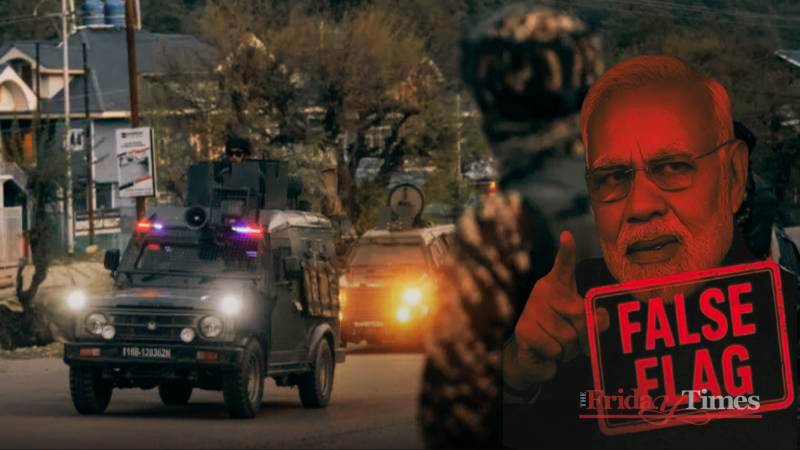
This was expected. No surprises there. What is surprising, however, is the amateurish manner in which it has been executed.
India’s Foreign Secretary, Vikram Misri, issued a statement on X, declaring: “CCS has decided that the Indus Waters Treaty is to be held in abeyance. The Attari (Wagah) border is to be closed immediately. Pakistani nationals will not be permitted to travel to India. Defence Attachés in the Pakistani High Commission have been declared persona non grata, and the overall staff strength is to be reduced from 55 to 30…”
This is the immediate outcome of a top-level meeting chaired by Prime Minister Modi, who cut short his visit to Saudi Arabia, having just received a $100 billion cheque from MBS, to return home. Meanwhile, the US Vice President is in India, sightseeing and holding what are being described as ‘meaningful’ talks. Presumably, those include curbing China’s influence in the South China Sea, following President Xi’s recent tour of ASEAN nations. Vance’s message is clear: as a strategic partner, India must now play its part. “We’ve given you geopolitical backing, trade benefits, restrained Pakistan for your convenience over two decades, and even told the Saudis to hand you a $100 billion investment—now it’s your turn, fat boy!”
But Vance forgot one thing—they’ve fattened the boy so much, he can no longer fight. And so, the bloated partner has conjured up a plan: a false-flag operation. Another episode in the long list that includes Pulwama, the Indian Parliament, the Mumbai Taj attacks—fabricated provocations across two decades of Indo-US strategic partnership. This time too, another stage-managed act unfolds, and within minutes, Godi media screams: Pakistan did it! Punish Pakistan! Vengeance! One wonders if Vance wasn’t startled by the sheer clumsiness of the script. Even he seemed unconvinced. His response: a condemnation and condolences for the victims—without naming Pakistan.
If India chooses to escalate the situation militarily, it has three plausible theatres of operation: Umerkot in Sindh, Sialkot in Punjab, and Skardu in Gilgit-Baltistan
Neither did the US State Department in Washington name Pakistan.
Now the challenge for India’s leadership is how to manage the domestic media and public, who are now in full jingoistic mode: attack Pakistan, crush Pakistan! But can India really afford that? Listen to what General Mehta has to say in his interview with Neelu Vyas. He makes it abundantly clear that India cannot launch an attack on Pakistan for several compelling reasons—Pakistan’s robust military, its strategic ties with China, its improving relations with Bangladesh to the east, and of course, its nuclear capability. India must also contend with restive conditions in its eastern states—the Seven Sisters—and mounting unrest in West Bengal, especially following the recent Waqf Amendment Act 2025, which has left the Muslim population discontented and alienated.
There’s plenty on India’s domestic plate already.
Still, something had to be done. So out comes the statement from the Indian Foreign Secretary. But note the silence from the usual fire-breathers: Defence Minister Rajnath Singh, National Security Adviser Ajit Doval—the architect of the Cold Start doctrine—and even the typically outspoken External Affairs Minister, S. Jaishankar. Modi’s team has decided to manage the situation politically, selling to their electorate the illusion that “we’ve closed Pakistan’s waters”—a hard punishment indeed.
But don’t be fooled, dear Indians. Pay attention to this:
India may believe it can simply turn off the tap and halt the flow of rivers—as if the Indus and its tributaries are mere water coolers to be leaned on at will—but they are mistaken. The Indus River system originates in Chinese Tibet, flows through Indian Illegally Occupied Jammu and Kashmir (IIOJK), and empties into Pakistan, where it irrigates 90% of the country’s agriculture, sustains 250 million lives, and upholds an entire civilisation. Any attempt to disrupt this lifeline won’t be met with bureaucratic protests but with responses that may far exceed diplomatic norms. The 1960 Indus Waters Treaty, which survived wars and crises, allocated the eastern rivers—Ravi, Beas, and Sutlej—to India, and the strategic western rivers—Indus, Jhelum, and Chenab—to Pakistan. Breaking this treaty isn’t leverage; it’s a perilous gamble. Though India has built hydroelectric projects like Kishanganga, Baglihar, and the yet-to-be-completed Ratle, they are run-of-the-river schemes designed to generate power, not obstruct flow. India’s total live storage capacity on western rivers is a mere 4.5 billion cubic metres, while Pakistan’s annual requirement exceeds 120 billion—hardly the stuff of weaponised water wars. Any attempt to divert the Indus eastward would require defying the Himalayan gradient, drilling through seismic fault lines, and courting environmental catastrophe—all for a fantasy of coercion that is neither strategic nor sane.
This narrative of water warfare persists because it grabs headlines and feeds domestic political fantasies, but nature, terrain, and divine will do not bend to nationalist theatre. The Indus will flow—not because of treaties or deterrence—but because no government, no military, and no dam can halt what is decreed to flow. Try to choke her, and it won’t be Pakistan that drowns.
In short, Modi has deceived his people.
Moreover, India has historically maintained an advantage over Pakistan in the maritime domain, particularly through the construction of dams on Pakistani rivers upstream. It is well known that India bribed Pakistan’s Indus Water Commissioner, Jamaat Ali Shah, who subsequently fled the country. Pakistan’s political leadership, paralysed for its own reasons, failed to take decisive action on the matter. This allowed India to act as it pleased, especially during the 1990s and in the post-9/11 era, when it entered into a strategic partnership with the United States, receiving unreserved Western backing.
Should India violate the Indus Waters Treaty, it exposes itself to the very real threat of Pakistani retaliation—specifically, potential strikes on the illegally constructed dams within Indian-administered Jammu & Kashmir.
What could India’s counter-response be?
One possible option would be an attack on Pakistan’s key reservoirs, such as Mangla, Tarbela, and others located within Pakistani territory. However, it is crucial to note that the Indian-built dams in question lie in Jammu & Kashmir—a region internationally recognised as disputed, including by the United Nations. Therefore, any Indian assault on Pakistan’s water infrastructure would invite an equivalent, if not escalated, response within India. There can be no ambiguity on that front.
Is India prepared for such a scenario?
If India chooses to escalate the situation militarily, it has three plausible theatres of operation: Umerkot in Sindh, Sialkot in Punjab, and Skardu in Gilgit-Baltistan. Defence analysts suggest that Skardu is the most probable target. It offers India the strongest prospect of American support, given its strategic proximity to the starting point of the China-Pakistan Economic Corridor (CPEC). By opening this front, India could present its actions to Washington as a move against China, thereby aligning with perceived American strategic priorities: “You wanted us to challenge China—well, here we are.”
However, if it ever comes to this—will China remain a bystander?