

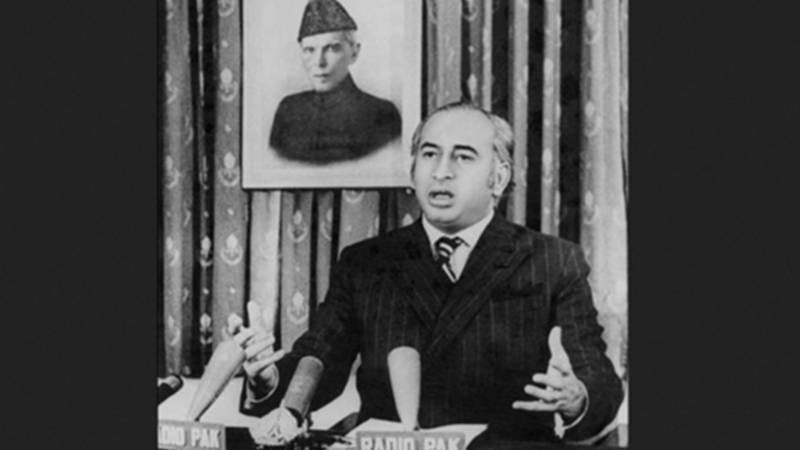
Very few people in history are fortunate enough to become a cabinet minister at the national level, let alone at the young age of 30. Zulfikar Ali Bhutto was one of those few. Five years later, he rose to the rank of foreign minister. His rise to power seemed unstoppable. He became the prime minister at the age of 45. He was brilliant, very well-read, and articulate. Yet he died on the gallows aged 51.
How do we explain his dramatic rise to power and his equally dramatic fall from power? I begin with some personal observations and then review what others have written about him.
I first heard Bhutto’s name while I was in my middle-school grades at St Mary’s High School, Sukkur. He was articulate when he spoke out on the radio against India, which had fought a war with China in 1962. And he was bold, eloquent, and persuasive when he spoke out against the US war in Vietnam.
I would see him a few times a year when he came to relax at a club in the Barrage Colony in Sukkur. Our house was just across the street. In 1964, when campaigning had begun for the national elections, I saw his motorcade emerge from the train station. President Ayub Khan was seated in the back seat of the limousine, and he was seated on his side. Both were waving to the crowds on both sides of the road. I was one of many Cub Scouts who had marched from school to shower rose petals on the motorcade.
In 1967, he broke with Ayub, his mentor, and created his own political party, whose credo was based on “Islamic Socialism,” which he claimed would take money from the wealthy and give “bread, clothing, and housing” to the poor.
My adulation for him was at a peak when I entered the University of Karachi to study economics in 1969. His doctrine of Islamic Socialism appealed to me. A year later, a few friends of mine pointed out the contradictions between his words and actions. Initially, I dismissed their concerns. Then I became double-minded.
He was virulently anti-American but sent his daughter to study in the US, where he had studied himself decades earlier. He talked about bringing the poor out of poverty, yet he was one of the wealthiest feudal lords in the country with a reputation for being cruel to the peasants who cultivated the land.
When the army launched Operation Searchlight in East Pakistan, on the 25th of March 1971, triggering a civil war, Bhutto returned from Dhaka, where negotiations had been taking place. At the Karachi airport, instead of condemning the army’s onslaught against innocent civilians, including intellectuals and academics, he said “God has saved Pakistan.”
Doubts began to surface in my mind about the character and integrity of the man whose devotee I had been for years. I wrote to Bhutto, requesting a meeting to resolve the apparent contradictions between his words and actions. A response came, dated the 15th of May 1971.
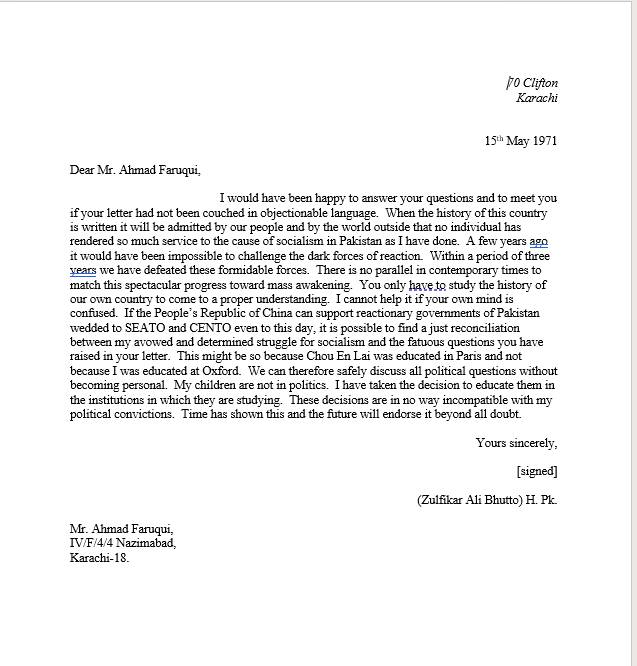
While I was pleased to get his letter, his tone put me off. It was arrogant and strident. I shared the letter with my father, and he ordered me to write an apology to Mr Bhutto, a BIG man, fearing the consequences. So, I sent a second letter in which I apologised to Bhutto.
He responded, saying he did not want to upset me. He suggested that I set up a meeting with him the next time he was in Karachi. But I was so put off by his demeanour that I never set up that meeting. He had fallen from grace. However, I couldn't stay away from him.
He was seething with revenge against political opponents and calling them condescending and demeaning names based on their appearance
I attended two of his massive public rallies at Nishtar Park in Karachi. In the first meeting, he took off his jacket and threw it into the crowd. It was torn up by his acolytes, each seeking to get a piece of what they probably regarded as a sacred object. He also referred to Mrs Gandhi with a derogatory term used for older women. And he was extraordinarily rude about Shaikh Mujib, calling him a congenital liar with a sick mind.
In the second meeting, he got the massive crowd to approve of his decision to recognise Bangladesh. An old man stood up in the audience and asked him why he had abandoned the Kashmir cause. Bhutto asked his henchmen to shut up the old man. It was an ugly scene.
While giving a speech in Lahore that was broadcast live on Radio Pakistan, he addressed the issue which the conservative public had raised: his addiction to alcohol. He said, yes, he drank alcohol, but he didn’t drink the blood of the people, as the [expletive deleted] landlords and industrialists were doing. Seconds later, he realised his blunder and asked the audio technician to remove it. But nothing could be done. This was not a recording, but a live broadcast. My father and I were listening to the speech in Karachi and were shocked beyond words. Profanities were never used in our house.
Seeing him up close confirmed my worst suspicions. Not only was he a populist demagogue, but he was also rude to anyone who questioned him. He was seething with revenge against political opponents and calling them condescending and demeaning names based on their appearance.
He went on to create a Federal Security Force which could round up anyone that he did not like. They would be incarcerated, sexually abused, tortured, or killed. It was like Hitler's Gestapo or the Shah's SAVAK. That fate sadly befell many of his opponents, including a few loyal companions, such as Mairaj Muhammad Khan, and even a mentor who had written the manifesto of his party, JA Rahim.
I was not a student of political science or history. I studied economics, mathematics, and statistics. But Bhutto’s letter and his subsequent conduct in office got me seriously interested in political economy. I started reading Marx, Lenin, and Mao along with Aristotle, Plato, Machiavelli, and Hobbes. Of course, each play of Shakespeare was also replete with political economy.
A few months after the army’s disastrous military operation in East Pakistan, which he had earlier praised, Bhutto penned his version of events, seeking to absolve himself of any guilt. The book was entitled The Great Tragedy. He knew the end for Jinnah’s Pakistan was near, but there was not a word about his role in the break-up of the country.
The break-up came on the 16th of December 1971, when the Eastern Garrison of the Pakistan army surrendered to India. East Pakistan seceded and became Bangladesh. Pakistan became the largest post-colonial state to break up into two pieces.
The army overthrew General AM Yahya Khan, who was the president, commander-in-chief of the army, and chief martial law administrator, and replaced him with Bhutto.
The Italian journalist Oriana Fallaci interviewed him in April 1972. He bared his soul in the interview. He talked about his approach to politics, his views of other politicians, especially of Indian Prime Minister Mrs Gandhi, and his inner personality.
The journalist had earlier interviewed Mrs Gandhi. Fallaci told Bhutto that she had called him “an unbalanced man, that today you say one thing and tomorrow another, that one never understands what’s on your mind.” He responded by quoting the philosopher John Locke: “Consistency is a virtue of small minds.” And then he went on to say that “An intellectual should never cling to a single and precise idea—he should be elastic. Otherwise, he sinks into a monologue, into fanaticism. A politician, the same. Politics is movement per se—a politician should be mobile. He should sway now to right and now to left; he should come up with contradictions, doubts. He should change continually, test things, attack from every side so as to single out his opponent’s weak point and strike at it.
“Woe to him if he focuses immediately on his basic concept, woe if he reveals and crystallizes it. Woe if he blocks the manoeuvre by which to throw his opponent on the carpet.”
Asked for his views on Indira Gandhi, he called her “a diligent drudge of a schoolgirl, a woman devoid of initiative and imagination. All right, she’s better today than when she was studying at Oxford or taking notes in London.” Earlier in the interview, he recalled the day he met her in London. “We were both attending a lecture, and she was taking notes so insistently and pedantically that I said to her, ‘Are you taking notes or writing a thesis?’ And speaking of these, I can’t believe she succeeded in getting that degree in history at Oxford.”
When Mrs Gandhi read the interview, she almost cancelled the upcoming Simla Summit which would decide not only the fate of the 93,000 Pakistani prisoners of war held by India, but also the fate of Kashmir.
She asked him how he could “be very rich and yet a socialist, live like a Westerner and yet have two wives.”
He replied: “There are many conflicts in me. I try to reconcile them, overcome them, but I don’t succeed and I remain this strange mixture of Asia and Europe. I have a layman’s education and a Muslim’s upbringing. My mind is Western and my soul Eastern… I call myself a Marxist in the economic sense; that is, I confine myself to accepting Marxist doctrine so far as it concerns economics. What I reject in Marxism are its dialectical interpretation of history, its theories of life, the question whether God exists or not. As a good Muslim, I believe in God.”
In her last question, with due apologies, she put a very blunt question to him: “Will you last?” With no hesitation, he said yes and then went on to explain why.
“I know the fundamental rule of this profession. What is the rule? Well, in politics you sometimes have to pretend to be stupid and make others believe they’re the only intelligent ones. But to do this you have to have light and flexible fingers, and ... Have you ever seen a bird sitting on its eggs in the nest? Well, a politician must have fairly light, fairly flexible fingers, to insinuate them under the bird and take away the eggs. One by one. Without the bird realizing it.”
His sophistry came straight through. When it was published, the interview lit a firestorm. He repudiated it and said he never gave it. It appears in her book, Interview with History (published on the Bhutto.org website).
In 1973, he took over the role of Prime Minister. When the army chief retired, he appointed a replacement who was junior to several other generals as army chief. To Bhutto, General Zia-ul-Haq came across as a sycophant because of his modest demeanour. In due course of time, Bhutto began humiliating Zia publicly. Here is how Professor Stanley Wolpert of UCLA describes it in his biography, Zulfi Bhutto of Pakistan: His Life and Times.
‘Zulfi’s choice of Zia proved his most fatal error of personal judgment. Many of his earlier appointments seemed to betray an apparent lack of discernment in choosing people for positions of high public trust…He often made Zia the butt of public ridicule, shouting at him from the head of the dinner table, “Where’s my monkey-general? Come over here, Monkey!” He would pretend to pull Zia toward himself on an invisible string and then introduce him to a foreign guest, quickly dismissing him, even before Zia finished bowing, ever smiling. Sometimes Zulfi “joked” about how “funny” Zia’s teeth looked, humiliating the man he had singled out for such a high and powerful distinction.’
Why did he not last long as he thought he would in the interview with Fallaci? Multiple factors led to his undoing. The language riots in Sindh, for starters, followed by large-scale nationalisation of industries, businesses, and even of schools. That was accompanied by the injection of nepotism, even in the elite Civil Service of Pakistan.
That was followed by the creation of the Federal Security Force and the persecution of his political opponents and dissidents in his own party. The humiliation of JA Rahim, his intellectual mentor, was shocking beyond words.
And then, to top it off, there was the humiliation of his hand-picked army chief, General Zia. The rigging of the elections in 1977 and the surge of the Pakistan National Alliance, a coalition led by Air Marshal (retired) Asghar Khan, was the final straw. Zia had been waiting in the wings. He got his golden opportunity on the 5th of July 1977, and deposed Bhutto, who was hanged in 1979 for ordering the murder of a political opponent.
Two decades later, veteran politician Sherbaz Khan Mazari penned a poignant memoir, A Journey to Disillusionment. He analysed the performance of several Pakistani leaders, including ZA Bhutto. In his words, over a period of 23 years, Bhutto progressed from being “a despondent political aspirant … to a civilian martial law administrator and president.” He had an unbridled lust for power, and a dark admiration for Adolf Hitler. His library at 70 Clifton in Karachi stored what was possibly the largest collection of books about the Führer in Pakistan. He was also infatuated with Napoleon and had a large collection of books about him. Perhaps that is what enabled him to engage in “lying, double-dealing and deceit.” These were Bhutto’s “normal” means of attaining and keeping power.
Owen Bennett-Jones, in The Bhutto Dynasty, sums up Bhutto’s contradictions by saying that he was “variously a feudal lord who wanted to dispossess landlords, a socialist who admired Hitler, a civilian politician and chief martial administrator and, fittingly, a man who said coherence is the virtue of a small mind.”
To summarise, Bhutto was a very gifted man in many ways. He was educated in some of the best universities, he was a very well-read man who had a large library at his residence in Karachi, he was eloquent in his speeches, and he was a gifted and prolific writer.
He was also the consummate politician who mesmerised millions. He had mastered the art of diplomacy and was a high-profile figure on the world stage, whether he was speaking at the UN or meeting with heads of state. He was equally at ease when communicating with world leaders in Asia, the Middle East, Europe, and the US.
One may conclude that he was brilliant. Sadly, like most populist demagogues, he failed to deliver on his grandiose promises. But what did him in the end was his flawed character, which was marked by an overwhelming sense of superiority coupled with being cruel and vindictive against anyone who questioned his views. That was his Great Tragedy.