

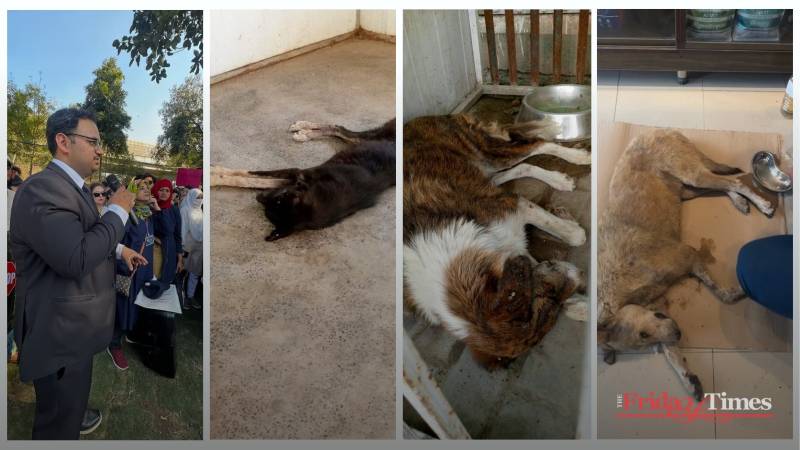
Over the past few days, the pictures and videos circulating across social media from CDA’s horrific ‘Stray Dog Population Centre’ in Tarlai, Islamabad, have been nothing short of heart-wrenching.
Established in 2022 to remove stray dogs from the streets following complaints from residents in the capital, the centre has falsely presented itself as a facility that humanely cares for stray dogs—nothing could be further from the truth. Given the CDA’s long history of killing and poisoning healthy stray dogs (including pregnant females and their puppies), local animal welfare sanctuaries and activists have consistently provided visual evidence—through distressing images and videos—exposing the CDA’s utter brutality towards the voiceless. The centre, established with much pomp and promise, has failed to uphold its commitment.
This week, I speak with Altamush Saeed, an award-winning interspecies justice lawyer and activist in Islamabad, who is now fighting to hold the centre accountable. Fresh off a landmark legal victory earlier this year—banning mass dog culling in Punjab—Saeed is leading the charge against the CDA Stray Dog Population Centre. A well-known voice for the voiceless, Saeed’s mission is clear: to expose the shocking reality of the capital’s stray dog centre. From abuse, starvation, and lack of hygiene, to the complete absence of qualified animal welfare staff, he speaks about the upcoming court hearing this month, the need to recognise animal rights in tandem with human rights, and much more...
Altamush, given the deplorable condition of the CDA dog ‘shelter’ and reports of inhumane treatment, what legal grounds are currently being pursued to address these violations?
There are several grounds for our case, but legally we are arguing under the violation of the Islamabad Stray Dog Population Control Policy of 2020, which was formulated in the case of Islamabad Wildlife Management Board v. Municipal Corporation Islamabad. This landmark policy was issued on the orders of then Chief Justice Athar Minallah of the Islamabad High Court.
There have been only two landmark cases decided in favour of animal rights in Pakistan, and very few lawyers truly understand animal law
The policy specifically mandates humane population control methods such as trap, mass sterilisation, vaccination, and relocation back to the dogs’ original locations. To implement this, a Stray Dog Population Control Centre was established in Tarlai (Islamabad) in 2023 and was officially inaugurated by the CDA Chairman.
However, from day one, the centre has not been managed by individuals with expertise in animal welfare, a situation that remains unchanged. The centre has now become a death trap, where animals are captured from the streets of Islamabad and left to die from starvation and neglect. The facility’s walls are infested with ticks, posing a serious threat to both humans and animals, as potential carriers of zoonotic diseases such as COVID-19. We are fighting to end this legalised dog culling campaign, which is being carried out at the centre in direct violation of the policy.
How significant is the 25 June hearing in the broader fight for animal welfare in Pakistan, and what outcomes do you hope to see from it?
It’s a significant hearing. The Stray Dog Population Control Centre has been ordered to submit a concise report detailing their dog population statistics, the condition of the facilities, and other relevant information. However, we are fully aware that they are likely to misrepresent the facts. That’s why we urgently need support to ensure the real narrative is heard. Just yesterday, Stray Homes Animal Welfare, an animal shelter, rescued 50 dogs from the centre. Despite receiving treatment, almost 80% of the dogs died and had to be humanely euthanised. They were suffering terribly, even while still alive.
In your opinion, what systemic failures have allowed the CDA dog shelter to reach such a torturous state, despite existing animal protection laws?
The fact that the contractor running the facility lacks any knowledge of animal welfare is absolutely criminal. Under the law, dogs are picked up but then left to die from starvation and disease. It is criminal that the facility has never been run by an animal welfare organisation. On 18 June, the centre even released a fabricated video showing street dogs being picked up and posted it on Twitter, falsely presenting their facility as ideal. If human lives were involved and people stooped this low, what standards could we expect them to uphold regarding animals?
What immediate legal or policy changes would you recommend to prevent shelters like the CDA from continuing this cycle of abuse?
I recommend the full implementation of the ICT Stray Dog Population Control Policy of 2021, and the transfer of management of the stray dog centre to a registered animal welfare organisation in Islamabad, or, alternatively, to a joint committee including animal welfare experts and animal law professionals.
You are Pakistan’s first animal law lecturer and have championed animal rights on multiple fronts. How has your academic and legal background shaped your approach to cases like the CDA dog shelter?
This work is my mission, my very identity. I envision a world where poverty of empathy does not exist—where we understand that we all coexist in harmony. Even tiny lifeforms, such as honeybees, which are on the brink of extinction, are critical. Without pollination, humanity could cease to exist within two weeks. That may sound insane, but that’s how delicate the balance is: all life matters. My vision bridges human, animal, and environmental justice—a holistic approach that guides my legal advocacy and activism.
What challenges have you faced as a lawyer advocating for interspecies justice in Pakistan’s legal and social environment?
There have been only two landmark cases decided in favour of animal rights in Pakistan, and very few lawyers truly understand animal law. Building these cases requires immense effort—any narrow understanding can actually harm animals. Sadly, some lawyers compete rather than collaborate in developing animal law jurisprudence. I have personally faced such challenges. Moreover, few judges are willing to listen or rule in favour of animals. I don’t view these as obstacles but as opportunities—opportunities to guide lawyers and judges toward harmonious collaboration for a much greater cause.
Failing to unify human and animal welfare reflects a deep empathy deficit—if we cannot care for animals, how can we truly care for each other?
Could you share some success stories from your work where legal intervention led to tangible improvements in animal welfare?
Absolutely. After filing over 13 petitions in the Lahore High Court, we won three landmark judgments:
- Hamza Khan v. Government of Punjab (14 January 2025): The Punjab Stray Dog Policy of 2021 was established as law.
- Anila Umair v. Government of Punjab (6 February 2025): We secured its implementation.
- Eiraj Hassan v. Government of Punjab (initial stay on 25 March 2025, final judgment 22 May 2025): This case held the government accountable for the culling of over 2,000 stray dogs in March 2025. Justice Shahid Karim issued a historic final order ending the era of dog culling after 78 years, citing government notifications for full policy implementation.
- Beyond dogs, we obtained court-ordered rescues for two bears in dire conditions at Jallo Zoo and from jugglers, relocating them to sanctuaries. We have also filed cases against private captivity of wild animals in zoos and circuses across Punjab and Islamabad. Landmark judgments are expected soon, with many more cases scheduled in the coming weeks. Stay tuned.
As the founder of Pakistan’s first International Animal and Environmental Rights Conference, how important is international collaboration in strengthening Pakistan’s animal protection framework?
International collaboration is vital. The world must see that Pakistan has equal, or even greater, potential to advocate for its most vulnerable. By partnering with over 60 international and national animal and environmental rights organisations, we have created a platform that connects Pakistan with the global community, helping build our national reputation. We share resources but, more importantly, we share hope. At our conference, Supreme Court and High Court judges delivered keynote addresses, including Justice Athar Minallah (landmark Kaavan the elephant judgment), Justice Ayesha Malik, and Justice Jawad Hassan. Their involvement demonstrated that the judiciary supports this cause, and for that, we are eternally grateful.
How do you envision the future of animal law and welfare in Pakistan over the next decade?
First, I hope to extend these efforts to every province. Since the 18th Amendment, animal welfare falls under provincial jurisdiction, which means identical struggles must be fought simultaneously across all regions. Right now, we are addressing the dog culling disguised as population control at the Tarlai centre. We hosted a press conference on 21 June at the National Press Club Islamabad, followed by a peaceful protest in collaboration with civil society. Our case will be heard at the Islamabad High Court on 25 June by the Environmental and Animal Rights Consultants Pakistan. This is part of building a movement, creating collaborative spaces across the nation.
How can citizens get involved or support the efforts to reform shelters like the CDA dog shelter and promote better animal welfare standards?
By writing to the government, advocating for better reforms, using our services to file lawsuits, and informing us of any animal cruelty issues. We offer free animal legal aid across the nation, and people trust us. We will never break that trust.
In Pakistan, whenever the topic of animal rights comes up, people often respond with, ‘But what about human rights?’ How do you respond to such myopic questions?
Animal rights are intrinsically human rights. A lack of empathy leads to animal cruelty, which is a known driver of domestic abuse. Diseases like COVID-19 have zoonotic origins. Animals play crucial roles in pollination and ecological balance. Failing to unify human and animal welfare reflects a deep empathy deficit—if we cannot care for animals, how can we truly care for each other?
What role can education and public awareness play in transforming attitudes towards animals—particularly dogs—and the treatment they receive?
Education is key. All animal welfare organisations should work collaboratively to drive awareness. For instance, we launched Pakistan’s first Animal and Environmental Rights Fellowship, training 30 university students in Punjab and Islamabad to become agents of change. We must grow movements that no longer rely on us to lead. That’s my ultimate mission.