

The popularity of Case No. 9 is highly encouraging, as it will motivate and induce writers to venture into hitherto uncharted territory. As the TRPs go through the roof and the play reaches what people hope will be a befitting climax, new plot twists and turns keep the viewers hooked.
Shahzeb Khanzada has penned a phenomenal script, with every character being fully sketched out. His own wife enacts the role of Kiran, the rapist Kamran’s wife. It is heartening to see that nearly all the female characters in this play are portrayed as women of substance, rather than the namby-pamby characters we normally see women enacting, or roles that women deem to be safe for them to play.
Haseena Moin, the renowned playwright, is also known for portraying strong women with minds of their own, unafraid to speak up for what is right. In fact, women for centuries have been mentally brainwashed into believing that standing by their spouses, whether they are right or wrong, is the right thing to do, because saving one’s marriage should be the top priority, irrespective of how unpleasant a character one’s spouse may be.
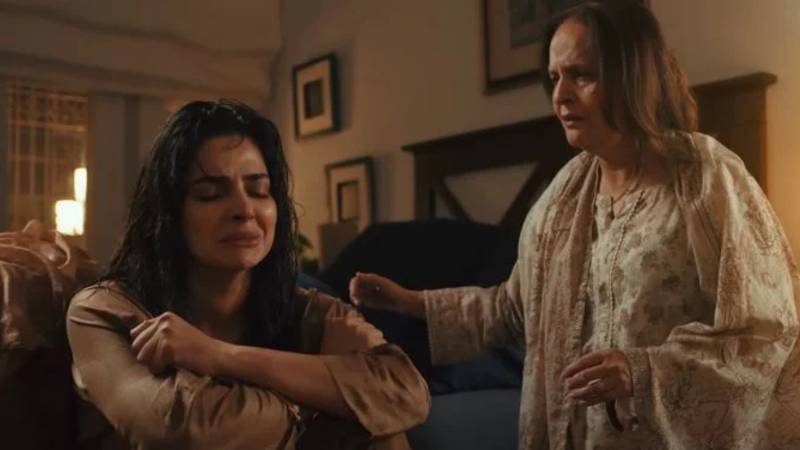
Kiran, Kamran’s wife (Rushna Khan), Saba Qamar’s mother (Hina Khawaja Bayt), and Manisha, Rohit’s wife (Naveen Waqar), all portray very strong women who are not afraid to stand up for what is right, even if it means sacrificing their marriage or other personal interests. These characters are extremely refreshing to see on screen, as they redefine the quintessential wishy-washy female characters we normally encounter, especially in plays aired before the prime-time slot.
Hopefully, this play will also encourage rape victims to come forward and stand up for themselves, despite the dismally low conviction rate at present. Rape is a heinous crime, but this play is a ray of hope in the sense that it not only raises the bar in terms of production, direction, script, and acting, but also gives hope to other middle-class women like Sehar to speak up and fight for what is right.
No matter what happens, Kamran has already lost; if he wins the case, his reputation is ruined, and if he loses, his career is over
Coincidentally, most of the male characters are portrayed as utterly spineless and insipid, beginning with the rapist (Faisal Qureshi), for whom winning this case has become an obsession. Although his wife has left him with their daughter, he is not willing to back down. He is hell-bent on making an example of Sehar and all other women like her who dare to say “no”.
It also sends out a message that divorced women are not promiscuous or available, and that being a divorcée does not mean that a woman, now considered second-hand, will settle for any monster or rascal who comes along. The message is loud and clear that divorcées are not up for sale (to use a very crude term), and that not all ex-husbands are bitter, disgruntled individuals looking for an opportunity to get even with their spouses. In fact, the scene where Kamran attempts to bribe Ali is expertly executed and filmed.
In addition, every character has been perfectly developed, and rather than the typical black-and-white portrayals seen on screen, they have their own emotional arcs; all of them are fighting their own personal battles. There are no easy choices, and this is perfectly portrayed in the way the characters are developed. The dialogues are superb and never once succumb to mediocrity. They are razor-sharp, witty, and dipped in acid, without being preachy or sanctimonious.
In a nutshell, this play has redefined the landscape of Pakistani dramas by shattering a number of stereotypes. It is heartening to see such powerful scripts being written, produced, and directed, and being supported and applauded by the general public. This play is far superior to the material ordinarily screened on streaming platforms and underlines the fact that Pakistani drama has evolved and will continue to do so. This is just the beginning.
With each episode, the play shatters more and more stereotypes and raises the bar even higher. Each character is solidly fleshed out and has many layers, a testament to the ingenuity and originality of the writer. Some extremely bold issues have been highlighted — for example, the blasphemy angle revealed in a flashback, due to which Rohit is unable to betray Kamran and, despite being the only witness, cannot bring himself to testify against him in court.
In life, there are no easy choices, and every decision and action has consequences and ramifications. Life will exact a price, and one must decide whether it is worth paying or not. No matter what happens, Kamran has already lost; if he wins the case, his reputation is ruined, and if he loses, his career is over. As Kiran rightly points out, too much damage has been done; there is no turning back now.
This play is a very accurate portrayal of life. As mentioned, there are no easy choices, and every character in this production has personal demons to battle with. Will there be any winners in this war? Only time will tell. Until then, stay tuned.