

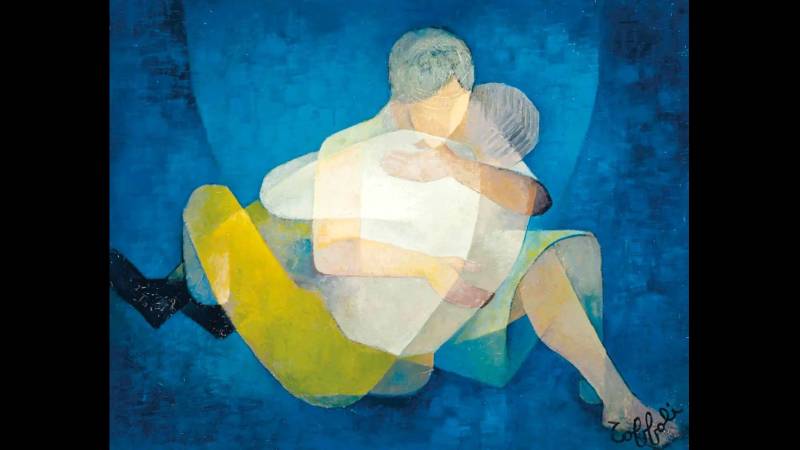
Across time and cultures, the embrace has served as a gesture charged with meanings that exceed its physical form: an act that can console, possess, reconcile, or even unsettle. Psychologically, it reveals our need to bridge the gap between self and other, to affirm belonging in the face of isolation. Whether tender or fraught, an embrace becomes a living symbol of how human beings negotiate vulnerability, desire, and the search for connection.
The Embrace as Gesture and Metaphor
"Embracing" is the act of holding someone closely in one’s arms, often as an expression of affection, love, protection, or consolation. It’s a bodily posture, but not a static one: it's dynamic, performative, and relational. To embrace someone is to cross a boundary, to invite the other into one’s intimate space. The arms enclosing another person is a symbolic action, often saying: “You are safe here,” “You matter to me,” or “You belong.”
In a metaphorical sense, "embracing" means to accept something or someone willingly and wholeheartedly: an idea, a belief, a change, a culture, even a challenge. This figurative use draws from the emotional depth of the physical act: as if by accepting, we are enfolding something unfamiliar into the warmth of our own being.
So, yes — embracing is both a posture and an acceptance. And more: it is a moment where the physical gesture becomes the enactment of emotional truth. It is one of the rare gestures where the outer form (posture) and the inner meaning (acceptance, inclusion, ownership) mirror and complete each other.
In human expression, there are few acts as whole, as encompassing — literally and symbolically — as the embrace.
Embodied Longing: The Embrace in Classical Urdu Poetry
In classical Urdu poetry, the act of embracing stands apart from the usual register of restraint and subtle suggestion. Unlike many other amorous gestures that are wrapped in the layers of metaphor, ambiguity, and ethereal longing, the embrace is surprisingly direct, almost brazen. It does not tiptoe around desire; it announces it. Far from being couched in delicacy, the embrace often arrives with an urgency and boldness that seems at odds with the cultivated decorum so often associated with the ghazal tradition.
This dissonance becomes particularly evident when we consider the case of the great classical poet Mīr Taqī Mīr, a master of melancholic longing and refined sensibility. He famously chastised his contemporary Jur’at for writing poetry reduced to chūmā chāṭī (“mere kissing and fondling”), accusing him of degrading the art. Yet, paradoxically, in a moment of his poetic surrender, Mīr writes:
"Tū jo hamāre ghar āyā hai, kyā jo tujh pe nisār kareñ
Illā kheench baghal meñ tujh ko der talak ham pyār kareñ."
(“Now that you’ve come to my home, what sacrifice could suffice for you?
Let me draw you into my arms and love you for a long time.”)
Here, the imagery is not merely affectionate: it is possessive, physical, and immediate. The beloved is not adored from afar; she is pulled into an intimate, extended embrace. This is not love as abstraction, nor longing as spiritual metaphor: it is desire embodied.
The directness of this expression invites a re-evaluation of the supposedly refined boundaries of classical ghazal. In truth, the tradition has always allowed for sudden eruptions of corporeality. These moments do not break the form; they are embedded within it. The ghazal lives in contradiction: yearning for distance while occasionally collapsing it altogether.
The tension only intensified in the poetry of the Lucknow school, which leaned more decisively into the theatrical, the decadent, and at times, the explicitly erotic. What was startling in Mīr becomes more deliberate in later poets. Physical intimacy with the beloved—once couched in the metaphysical—now teetered toward vulgarity, especially in the hands of lesser poets intoxicated with their daring.
In the early twentieth century, Hasrat Mohānī emerges as a particularly revealing figure. A poet, politician, and Sufi, Hasrat wrote across a vast emotional register. Yet a significant portion of his verse was unabashedly sensual. He categorised it as fāsiqāna shāʿirī (libertine poetry). This was not a hidden aspect of his corpus but an avowed pursuit: a space where he explored raw, bodily longing unmediated by mysticism or metaphor.
What began as flashes of sensuality in classical verse became, by Hasrat’s time, a recognised subgenre. The beloved: once elusive, divine, or even symbolic, was now within reach, her body described with as much detail as her temperament. The embrace was no longer exceptional; it was expected.
And so, embracing in classical Urdu poetry occupies a peculiar space. It is not cloaked in suggestion like a stolen glance, nor idealised like union in a dream. Instead, it is visceral, temporal, and disarmingly real. It represents moments where Urdu poetry dares to abandon abstraction and step fully into the physical world, reminding us that love—before it is spiritual, or tragic, or mystical—is also flesh and blood.
To understand this mode of presentation, one needs only to consider the following two couplets:
The first comes from Hasrat Mohānī:
Andhere meñ wo ā lipṭe the pehle kis ke dhokhe meñ
Ke jab āḳhir mujhe dekhā to ghabrā kar kahā: "Tum ho!"
(In the dark, she embraced—mistaking me for someone else;
And when at last she saw it was me, she recoiled and said: "It's you!")
The second is by Yās Yagānā Changezī, otherwise known for exhibiting a certain masculine ego in his poetry towards the opposite sex:
Dīvāna ban ke un ke gale se lipaṭ bhī jāo
Kām apnā kar lo Yās bahāne bahāne meñ
(Pretend to be a madman and cling to her neck— Get what you want, Yās, through sly little excuses.)
Intimacy Reimagined: The Modern Urdu Embrace
From the charged physicality and emotional urgency of classical verse, where the embrace signified possession or unmasked longing, we move into modern Urdu poetry, where the same gesture becomes more introspective, symbolic, and layered with existential inquiry. What was once a declaration of desire now becomes a mirror for memory, loss, and the fragmentation of the self.
The most honest intimacy is found not in the dissolution of the self, but in the quiet recognition of the solitude that persists even in the arms of a lover.
In the landscape of modern Urdu poetry, few gestures carry as much symbolic weight as the act of embracing. Far from being a mere physical act, the embrace (galē lagānā, baghalgīr honā, lipṭ.nā) emerges as a threshold gesture: a liminal portal through which yearning, selfhood, alienation, and memory pass. It is the gateway through which bodies speak the unspeakable, and where the self may either dissolve, realise, or reflect. The couplets explored here navigate this deeply resonant motif with nuanced variation: some evoke metaphysical annihilation, others warn of desire's volatility, and one, finally, reaches a moment of unsentimental clarity that transforms the very idea of intimacy.
1: Annihilation in Touch: Z̩afar Iqbāl's Alchemy of the Embrace
Bas ek bār kisī ne galē lagāyā thā
Phir us ke bʿbad na maiṇ thā na merā sāyā thā
(Just once someone embraced me / After that, neither I remained, nor my shadow.)
This couplet by Z̩afar Iqbāl launches us into the realm of the ontological. The embrace here is alchemical, transformative in the extreme. With the beloved's single act of touch, the speaker experiences a radical undoing: not only is the self erased, but even the shadow: the last trace of bodily presence, vanishes. There is no sensory description, no tactile detail. The emphasis is on what the gesture takes away: identity, continuity, even reflection. The embrace becomes a void, a sacred obliteration.
Phenomenologically, this is a gesture without fullness. It does not affirm existence; it nullifies it. And therein lies its poetic power. The reader is not merely asked to imagine an embrace but to witness the speaker's disappearance through it. There is ecstasy here, but also a warning: not all intimacy leaves one whole.
2. Seduction and Restraint: The Threshold of Desire
Āhaṭ ātē hī nigāhoṇ ko jhukā lo, warna
Dēkh lo gē to lipaṭ.nē ko bhī jī chāhēgā
(At the sound of footsteps, lower your gaze / Because once you see her, you might long to embrace her.)
In contrast, this couplet by Z̩afar Iqbāl inhabits the prelude to contact. The embrace is not performed; it is projected, anticipated. The poet paints a scene where the sensory world—a sound, a glance—can ignite desire. There is a flirtatious tension here, a balance between restraint and temptation. The act of lowering the eyes becomes a defence against the desire that sight may provoke.
Here, the embrace is cinematic. We hover in the moment before touch, where imagination and tension feed each other. The body is untouched, but already vulnerable. This is the embrace as potential energy, and its power lies in its suspense. The gesture is not transformative like in the earlier couplet; it is destabilising and feared for the very change it might usher in.
3. Loneliness Embodied: Solitude as Embrace
Apnē galē mēṇ apnī hī bāhoṇ ko ḍālīē
Jīnē kā ab to ēk yahī ḍhaṅg rah gayā
(Wrap your arms around your own neck / Now, this is the only way left to live.)
Ẕahīr Kāshmīrī's couplet internalises the motif entirely. Here, the embrace becomes a ritual of survival, performed in solitude. The absence of the beloved forces the self to hold itself, a gesture both tragic and profound. The couplet’s beauty lies in its starkness: there is no illusion, no memory, no metaphoric grandeur. Only a human, wrapping their arms around themselves to simulate the warmth they can no longer receive.
Here, the embrace does not dissolve the self or anticipate union. It becomes a substitute for loss, a coping mechanism. It also gestures toward self-compassion in a world bereft of tenderness. In this moment, poetry doesn’t reach for the celestial: it stoops to the real, the broken, the surviving.
4. Desire Deferred: The Lunar Beloved
Galē milā na kabhī chānd, bakht aisā thā
Harā bharā badan apnā darakht aisā thā
(Never did the moon embrace me—such was my fate; Though my body was lush and green, like a tree.)
In Shakīb Jalālī’s vision, the beloved is not merely absent but cosmically inaccessible. The metaphor of the moon stands for beauty beyond reach, and the speaker, likening himself to a flourishing tree, is rooted: unable to transcend his fate. There is no blame, no dramatic sorrow; just quiet acceptance of missed chances.
This couplet doesn’t dramatise. It elegises. The embrace is never realised, but its absence defines the speaker’s bodily and emotional existence. Jalālī places the body at the centre, not as a site of pleasure or contact, but as one of arrested motion. The embrace is suspended in a void between potential and impossibility.
5. The Ache of Delay: Temporal Shock in the Embrace
badan mēṅ jaise laḥū tāziyāna ho gayā hai
usē galay se lagā’e zamāna ho gayā hai
(As if blood in my body has turned into a whip / It’s been ages since I embraced her)
— ʿIrfān Ṣiddīqī
This couplet crackles with deferred physicality, where the memory of touch reverberates not as warmth but as violence. The body becomes a site of cruel delay: the speaker’s veins no longer carry quiet longing but pain sharpened by time. The metaphor of laḥū tāziyāna (blood as a whip) is startling: it collapses interiority and punishment, as if each heartbeat lashes the self for having waited too long, or for having lost something irrevocable.
The embrace is not in the present: it happened long ago. But its aftermath floods the speaker’s body now, in the unbearable now. There is no nostalgia here, only trauma. What was meant to be tender becomes traumatic through absence and temporal dislocation. The speaker’s body, once perhaps a vessel of affection, is now a relic of deferred connection. The delay itself has turned affection into violence.
The couplet hinges on embodied memory. The body remembers the embrace, not through sweetness, but through pain. It shows how the residue of physical closeness, if left unreplenished, does not fade: it ferments. In this way, the couplet explores how time distorts intimacy, transforming a once-gentle gesture into something almost punitive.
6. The Mirror of Contact: Solitude in Self-Reflection
us se galē mil kar khuḍ ko
tanhā tanhā lagtā hūn
(After embracing her, I feel / somewhat lonely)
— Jaun Elia
With characteristic emotional directness, Jaun Elia distils a delicate contradiction into two haunting lines. The speaker performs the most intimate of gestures: an embrace, only to find himself brushed by an unexpected loneliness. This is not despair, nor the vast emptiness of abandonment. The embrace occurs; it is tactile and real. Yet in that moment of nearness, a faint but undeniable sense of distance arises.
The repetition of tanhā tanhā (somewhat lonely) carries a softness rather than desolation—an echo that lingers gently after the arms have unlocked. The couplet does not dramatise separation or yearn for union. It instead captures a subtle emotional dissonance: how one may be physically close yet inwardly aware of a small, persistent gap between selves. Contact does not dispel solitude; it makes the contours of inner separateness visible.
Phenomenologically, the embrace functions as a mirror. In touching the other, the speaker encounters the boundary of connection: not as an injury, but as awareness. The act does not transport him to transcendence; it returns him, momentarily, to the quiet recognition that even in intimacy, the self remains partly alone. There is no bitterness here, no anguish: only a tender acknowledgement that presence cannot complete what is essentially unshared.
Jaun Elia thus offers a form of emotional realism that is at once modern and merciful. His couplet holds no melodrama, only the grace of recognition: that love may reach, but not always merge; that one may hold another and still feel the soft pulse of solitude within.
7. Memory Dissolved: The Fugue of Affection
Kuch nahīṇ yād ke shab raqs̩ kī maḥfil mēṇ Zafar
Ham judā kis se huʿē, kis se baghal-gīr huʿē
(I remember nothing of that night of dance, Zafar / Whom did I part from? Whom did I embrace?)
In Ṣābir Zafar's couplet, the embrace is neither celebrated nor mourned: it is forgotten. A fugue state blankets the speaker’s memory. Was there a parting? An embrace? The poet no longer knows. This moment of dissociation, likely induced by emotional or sensual intoxication, emphasises the fragility of presence. Touch becomes a possibility erased by the passage of time or the excess of feeling.
The absence here is total. Not even the sensory residue remains. The embrace is reduced to a question: one the speaker cannot answer. This void reflects modern disaffection, the numbness that follows too much sensation or loss of anchor.
8. The Embrace as Revelation: The Solitude Within Intimacy
Tujhē galē se lagātē huʿē khulā ham par
Ham apnē gham mēṇ akēlē haiṇ aur rahēṇgē bhī
(While embracing you, it became clear to me / I am alone in my sorrow, and always will be.)
This couplet by Seemāb Zafar stands alone in the clarity and stillness it offers. The embrace is real, bodily, unambiguous. There is no metaphor, no allegorical veil. The arms wrap around the lover, and in that moment of supreme closeness, an even deeper solitude is revealed.
The speaker is not devastated. She is not even surprised. There is no performative anguish. Instead, there is an almost philosophical recognition: that sorrow is solitary, and no embrace, however tender, can undo it. What makes this moment powerful is precisely its quiet ordinariness. This is not the moonlit, perfumed embrace of poetic tradition. It is a mundane gesture that opens into existential insight.
The paradox here is exquisite. The embrace, traditionally a sign of union, reveals irreducible separation. And yet, this realisation does not negate the gesture. The speaker does not recoil. She embraces, knowing now that this act will not save her from loneliness. Therein lies the phenomenological depth: the body acts, the senses are engaged, but the soul perceives its condition with unwavering clarity.
This is not resignation; it is acceptance. And such acceptance grants the lines their profound grace. The couplet does not dramatise suffering. It offers the truth in its most disarmed form. The embrace does not fail. It simply does not cure.
The Honest Embrace
Both Jaun Elia and Seemāb Zafar reveal a startling truth: the moment of deepest physical closeness can coincide with emotional solitude. The embrace is not imagined or deferred: it happens. Yet instead of dissolving loneliness, it exposes its finer layers.
Their couplets show how the instinct to connect does not always result in communion. The body reaches out, but the self remains partly untouched. The beloved or lover is neither rejected nor blamed: simply unable to bridge the subtle space between presence and understanding.
Elia’s vision is hushed and contemplative, aware of the strange loneliness that lingers even within touch. Zafar’s is calm and accepting, conscious that some distances: those of grief and interior life, are clarified by closeness rather than erased. One senses the ache; the other, the acceptance. Yet both refuse to romanticise the embrace. They render it honest: a gesture that does not heal but still holds.
Through such moments, the embrace emerges as more than a physical gesture. It becomes a ritual that exposes desire, memory, and the limits of connection.
Some see it as a site of union; others, a moment suspended in longing or a confrontation with solitude. In its most unflinching form, the embrace does not fail from lack of presence but from the impossibility of complete understanding.
Yet in that failure lies a deeper intimacy: the grace to hold another without expecting salvation. The highest embrace does not promise wholeness or comfort. It simply acknowledges the irreducible solitude of each self and still chooses to reach across it.
Such an embrace does not close the distance: it reveals its shape. And in that revelation, it becomes something rare: limited and luminous, transient and transcendent.
In the arms of another, the soul may not be cured—but for a moment, it is seen. And sometimes, that is enough.