

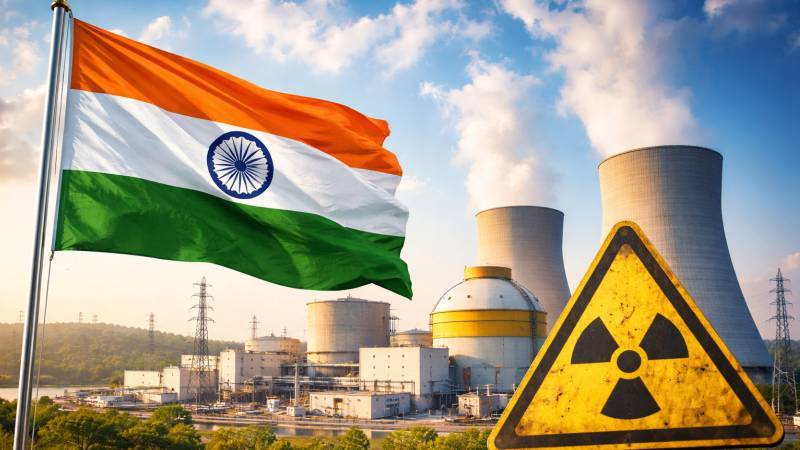
The recent Stockholm International Peace Research Institute (SIPRI) policy document (2026) clearly indicates that India has been deploying 12 nuclear warheads on the sea leg of its nuclear triad. This, in addition to its increasing conventional and nuclear forces, makes India one of the fastest-growing nuclear-weapon states in the world. India is creating both conventional and nuclear force asymmetry against Pakistan in South Asia.
With its increasing conventional and nuclear forces, India may deploy more nuclear forces and mobilise its conventional forces closer to the Pakistani border, thereby threatening nuclear-armed Pakistan. India has already been canisterising and encapsulating its nuclear forces, making them a "ready arsenal" that can be used within minutes.
This is no longer a non-weaponised posturing, as many may perceive, thereby increasing the risk of rapid escalation to a dangerous level during a serious crisis between the South Asian nuclear rivals. The question is: why has India been increasing and modernising its nuclear weapons and conventional forces, bolstered by its deployed nuclear warheads targeting Pakistan and others in the international system?
First, India has long aspired to be a regional hegemon in the broader Asian region, calling the Indian Ocean "India's Ocean" and replacing its "Look East" maritime strategy with the "Act East" policy. This means that India will be looking for more nuclear-powered submarines, advanced maritime capabilities, overseas military bases, and economic investment across the region to protect its vital maritime security interests while keeping an eye on the crucial Sea Lines of Communication (SLOCs). Once India acquires all these capabilities, it will have greater maritime influence over others, undermining the security of other states, including some of the leading powers, such as the United States, which has maintained military preponderance for decades.
Second, India desires to retain escalation dominance over its rivals. In doing so, it has been increasing and modernising its deterrent forces beyond its security needs. To retain such dominance, India has already embarked on several conventional and nuclear force developments. These include MIRVing its missile capability, expanding its fleet of nuclear-powered submarines supported by increasing ranges of submarine-launched ballistic missiles (SLBMs), ballistic missile defence (BMD) systems, anti-satellite systems while rapidly militarising space, tactical nuclear weapons (TNWs), hypersonic missile capability, and, more importantly, increasing the ranges of nuclear-capable intercontinental ballistic missiles (ICBMs) to over 12,000 kilometres, thereby targeting and threatening regions such as the United States, Europe, and Canada, well beyond Pakistan and China.
Third, India largely aspires to prestige (Akhand Bharat) rather than security, while treating other sovereign states as part of India. This is embedded in the RSS religious ideology, which threatens and undermines the sovereign status of other leading players in the international system. With this ideological arrogance and strategic hubris, India will continue to increase its conventional and nuclear forces, going beyond the perceived minimum deterrence and the so-called doctrinal posture of the No First Use (NFU) nuclear option. The Akhand Bharat religious ideology has saffronised the Indian civilian and military leadership, which may accept the risks of dangerous escalation in South Asia, thereby preparing India for preventive strikes against Pakistan and others.
Pakistan needs to sustain Full-Spectrum Deterrence, which falls within the ambit of Credible Minimum Deterrence while deterring India at the operational, tactical, and strategic levels
The consistent increase and modernisation of India's conventional and nuclear forces could have the following strategic and grave policy implications for India in general and the region in particular.
First, with an increasing number of deployed nuclear forces, India's NFU doctrinal posture no longer remains consistent with the nuclear policy that India originally conceived. Ready arsenals and deployed nuclear forces may tempt India to use its nuclear forces early during serious military crises, thereby increasing the risk of nuclear escalation. This also does not align with the minimum deterrence posture India previously conceived. In other words, the more India develops missiles and nuclear-powered submarines, the more warheads it will require; the more warheads it deploys, the more inconsistent this becomes with the minimum deterrence policy it previously followed.
Second, India's deployment of nuclear forces in the sea leg of its nuclear triad creates a "lose-or-use dilemma". During the Cuban Missile Crisis in 1962, the Cold War rivals, the United States and the Soviet Union, confronted such a dangerous dilemma that could have led to nuclear Armageddon had the Soviet submarine B-59, armed with a nuclear torpedo, not surfaced. With emerging technologies, Pakistan and China may eventually be able to locate, identify, and force Indian nuclear-powered submarines to surface and surrender.
Given a saffronised mindset, India may refuse to surface its submarines and could eventually come under strategic pressure to use its SLBMs before losing them. India, by deploying SLBMs in the sea leg of its nuclear triad under such circumstances, becomes increasingly vulnerable and therefore more susceptible to inadvertent escalation. To avert such a dilemma, the Indian security leadership needs to think carefully before deploying or pre-delegating authority over its sea-based nuclear forces.
Third, India's deployment of nuclear forces also creates a strategic issue of "entanglement" between conventional and nuclear delivery systems, which, in turn, provides India with an incentive to adopt a launch-on-warning posture, thereby increasing the risk of the early use of nuclear weapons. Therefore, India's deployment of strategic forces during both peacetime and crises creates an entanglement problem that may tempt India to use its nuclear forces early during a serious military crisis, which is deeply concerning for strategic stability in South Asia.
Finally, India's deployed nuclear forces might lead it into an unending arms race, placing the country in a dangerous position of overconfidence and perceived dominance. This could further push India into a risky escalation trap with both China and Pakistan, especially if its civilian and military leadership consider themselves capable of inflicting unacceptable levels of damage on both countries.
However, this would be an illusion of escalation dominance against a credible nuclear-armed Pakistan capable of retaliating decisively and effectively. Conventional wisdom should teach India that a credible and militarily capable Pakistan with reliable nuclear forces should never be underestimated. The 2019 and May 2025 crises demonstrate Pakistan's resolve in pursuing this strategic imperative by deterring and denying India's aspirations for both limited and large-scale war against Pakistan.
All that being noted, India's deployed nuclear forces create a use-or-lose dilemma, increase the risk of accidental war, encourage a dangerous escalation trap, fuel an arms race, undermine crisis stability, and, more importantly, foster the dangerous confidence to undertake preventive strikes, thereby risking rapid escalation to the nuclear level.
Pakistan needs to sustain Full-Spectrum Deterrence, which falls within the ambit of Credible Minimum Deterrence while deterring India at the operational, tactical, and strategic levels. Any conventional force development should remain an integral part of Full-Spectrum Deterrence. Since India has been placing Pakistan under increasing strategic pressure, Pakistan should continue to maintain strategic balance without engaging in a larger arms race, so long as it successfully deters India.
India should be convinced that there is no viable option for waging either a limited or a large-scale war against Pakistan in the presence of credible nuclear forces. The only option available is to adopt institutionalised confidence-building measures and establish the Strategic Restraint Regime that Pakistan proposed long ago. A sustained dialogue process aimed at achieving lasting peace and stability remains the only viable way forward.