

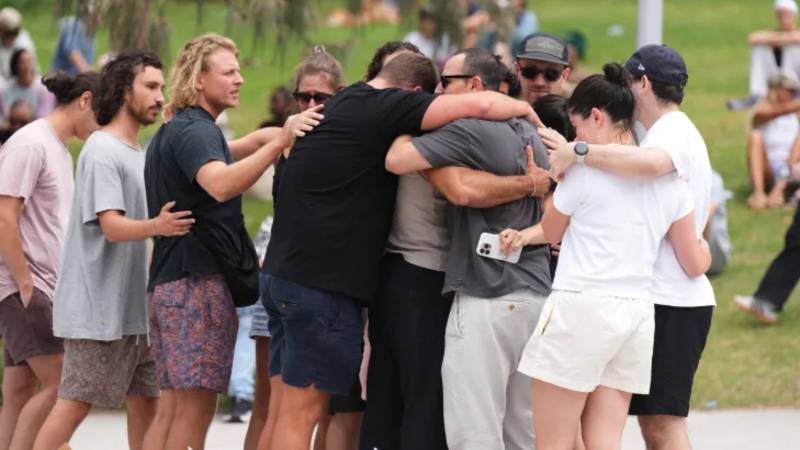
After the Bondi Beach attack, public debate immediately shifted to discuss the nationality of the perpetrators, whether they were Indian, Pakistani, or Afghan, as if citizenship could explain their actions. Some outlets even celebrated the news that they were not Pakistani. One leading newspaper ran a front-page headline: “Sydney Shooting Terrorist Our Citizen, India Admits”. This relief was even more evident on social media, where early guesses about their nationality revealed more about collective relief than about the act itself. People seemed more focused on who the attackers were, rather than on the act itself.
Yet what went mostly unmentioned was far more significant: both attackers were Muslim. The focus on nationality offered comfort, but it distracted the public from asking a more difficult question: why do such violent attacks so often come from within one particular religious community? This sense of relief exposes a deep-seated tendency to avoid, our unwillingness to acknowledge, and repeating patterns of violence.
Even if immediate reactions are excused in the name of the so-called "fifth-generation war", such patterns are visible. Contemporary acts of individual religious terrorism, especially far from active war zones, disproportionately involve Muslims, while they rarely involve Buddhists, Hindus, Sikhs, atheists, or agnostics. This pattern is not imagination; it is fact.
Europol’s latest EU Terrorism Situation and Trend Report covering 2024 records 24 jihadist attacks, far more than any other ideological category, with 289 arrests linked to jihadist activity. This is compared to just a handful for far-right or left-wing extremism. In Australia, almost every terrorist plot or attack since 2014 has been jihadist-inspired, including nine directly tied to Islamic State in the years up to 2020, according to the George Washington University’s Program on Extremism. Globally, the French think tank Fondapol has tracked over 66,000 Islamist attacks since 1979. These attacks have caused a quarter of a million deaths, the overwhelming majority carried out in the name of a religious ideology.
Yes, far-right violence is rising and cannot be ignored, especially in the United States, where it has caused the most recent terrorism deaths. But in Europe and Australia, jihadist attacks and plots still outnumber far-right ones. This is not to blame a particular religion, but it is an observation that needs explanation. Even when moderate Muslims condemn violence, these violent acts continue to happen, often shocking wider society.
The answer is not in religion, but in beliefs and social structure. Over the past few decades, this extremism has created a clear story that transcends national borders quite easily. People do not need to have lived in a war zone or seen battle first-hand. They are offered a prebuilt identity: not criminals, but actors in a global struggle. This way, violence feels meaningful instead of chaotic.
Communities often assume that claims of Islamophobia or antisemitism automatically carry moral grounds. They do not. Suffering only matters when it is recognised beyond the community that experiences it
Other religious traditions, even with histories of violence, have not created this kind of framework for lone actors. Their violence tends to be confined within local or political boundaries, not a global phenomenon. Islamist extremism, by contrast, allows individuals to act anywhere while feeling that their actions are morally significant. For those searching for a purpose, the ideology offers a straightforward answer: they are fighting for a higher cause and are part of a story bigger than themselves. This certainty feels empowering, especially for those who are lost or powerless.
But ideology alone does not act in a vacuum. The social and moral structures also play an important role. After such attacks, many moderates who apparently oppose violence immediately contextualise by often saying: “This did not happen in a vacuum, look at Western actions, what about Gaza…” These statements may be factually correct, but they redirect the focus away from the victims and the violent act itself toward global political issues.
State violence towards Muslim communities is often used to explain or justify individual terrorism. Occupation, oppression, and foreign wars are defined as root causes. While such context may help us understand the motivations behind such acts, it does not justify the act. State and individual attacks are not the same, even if they may look alike. One is distant and bureaucratic, the other immediate and personal. Injustice may explain, but it cannot justify. Both must be defined separately, without allowing one to excuse the other.
Terrorism at a personal level flourishes where belief systems meet shame, fear, and a hunger for certainty. These extremist movements offer a simple moral binary system. Complex human life is reduced to black and white. For some people, violence gives them a sense of direction and meaning, something that is absent in their daily lives.
This phenomenon can also help us understand why hard-line clerics, barred abroad for promoting violence, become popular at home. This also shows why the distinction between moderates and radicals is growing thin. Acts of kindness are presented as part of faith, while violent acts by fellow believers are met with justifications or silence. Gradually, moral lines fade away, and sympathy for perpetrators can arise even among those who reject violence in principle.
This may also foster a deeper misunderstanding that suffering is self-explanatory. Communities often assume that claims of Islamophobia or antisemitism automatically carry moral grounds. They do not. Suffering only matters when it is recognised beyond the community that experiences it. Otherwise, even authentic suffering can harden into resentment or serve as a rationale for violence.
This is not just a theoretical framework. Other groups have learned this lesson the hard way. Jewish, Armenian, and African-American communities have faced similar challenges. They waited for others to recognise their suffering and ended up bearing a deadly cost. Hesitation to introspect allows confusion and extreme ideas to gain ground in society. Failing to confront leaves room for violence.
History is unforgiving to communities that defend their suffering alone. Moral recognition does not happen automatically; it exists when granted by others. When recognition comes only after violence, it is already too late. Grievances left unrecognised turn into resentment, and resentment, if left to grow, inevitably seeks a target, as did in Bondi Beach.