

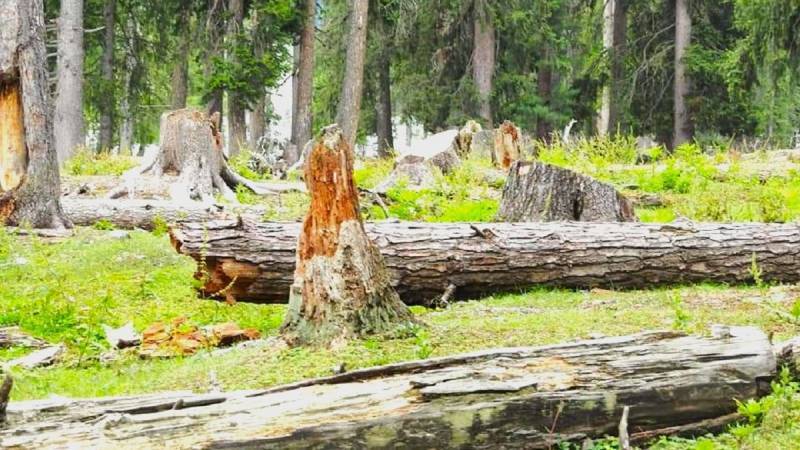
Khyber Pakhtunkhwa’s forests are more than just trees. They are the green lungs of Pakistan, a crucial defence against floods, soil erosion, biodiversity loss, and the escalating impacts of climate change. Yet, they are once again under unprecedented assault from timber mafias, political manipulation, and the systematic dismantling of safeguards meant to protect them.
The crisis is not new. In July 2023, during the interim government, the Sustainable Conservation Network (SCN) presented a detailed deforestation report to then Federal Minister for Climate Change and Environmental Coordination, Senator Sherry Rehman. The findings were alarming: massive, rampant forest destruction across all districts of KP, with documented evidence implicating then Secretary Forest, Syed Nazar Shah, in gross violations and irregularities.
Minister Rehman, visibly shocked by the scale of devastation, responded immediately. She wrote to the KP Chief Secretary, federal secretaries, and other key stakeholders, attaching the SCN’s report. SCN collaborated with SDPI to host a seminar in Islamabad, launching the report and screening a graphic documentary on the ongoing destruction of KP forests under the interim government. The report recommendations gained traction at COP23, where international donors demanded immediate action. Consequently, this led to the removal of the former secretary and the termination of several destructive ongoing projects.
But the fight was far from over.
Today, the ubiquitous networks are working tirelessly to revive their unfinished agenda — the release of huge volumes of illegal timber, the transfer of Guzara forest lands into private hands, and the conversion of reserve forests into commercial hubs. The stakes are enormous:
- 1.4 million cubic feet of illegal timber withheld at Arandu Gol, Chitral.
- 0.65 million cubic feet held in Batagram, Hazara.
- 0.6 million acres of Guzara forests in Hazara at risk of being declassified, opening the door to unchecked commercial exploitation — roads, farmhouses, hotels, and resorts.
The global community must recognise that KP’s forests are a frontline defence in Pakistan’s climate resilience strategy
At the heart of the resistance to this onslaught is Shahid Zaman, the intrepid Secretary, Climate Change, Forests, Environment and Wildlife Department, Government of Khyber Pakhtunkhwa. Known for his uncompromising integrity and a clear green vision, Zaman has invoked every relevant forest rule and regulation to block these destructive moves. Having refused to sign off on the declassification of Guzara forests, rolled back illegal transfers, and acted against encroachments in the Galliyat and Margalla ranges, particularly in the Makanial forests adjoining Islamabad. For these actions, he is now facing an aggressive campaign to remove him — so that the timber mafia can proceed, unhindered. It appears he is holding on as the key institutional barrier to this wave of destruction.
The story of KP’s forests is a microcosm of the global climate crisis: a clash between short-term profiteering and long-term environmental survival. Pakistan’s climate policies speak of sustainability, biodiversity, and resilience, yet the ground reality tells a starkly different tale — of policy gaps, weak governance, and questionable stakes undermining climate and forest commitments.
Saving KP’s forests is not just a provincial issue; it is a national and global imperative. If these forests fall, the consequences will cascade far beyond the mountains of Hazara and Chitral — affecting water security, disaster resilience, and climate stability for millions.
It is time for the federal government, climate leadership, and international partners to stand firmly with rare climate crusaders in the government, like incumbent KP secretary forests, who choose the harder path of integrity over compromise. KP’s forests are not for sale. They are our inheritance – and our responsibility.
Khyber Pakhtunkhwa (KP) has historically held Pakistan’s richest forest resources, ranging from coniferous and pine forests in the north to riverine and scrub forests in the south. These ecosystems are not only biodiversity hotspots but also critical for water regulation, carbon sequestration, and local livelihoods.
Over the past decade, however, KP’s forests have been in the crosshairs of climate pressures, political instability, and organised exploitation by powerful timber mafias. Illegal logging, unchecked infrastructure expansion, and the weakening of forest governance have accelerated deforestation, eroding the province’s natural defences against climate disasters.
The removal of these protections would set a precedent that could open floodgates for further forestland conversion across KP. International experience shows that once forestlands are privatised or commercialised, restoration becomes near impossible.
The stakes extend beyond ecology: KP’s forests are vital for regional hydrology, disaster mitigation, and climate stability. Their destruction would exacerbate glacial melt, intensify floods and landslides, and undermine food and water security. This situation underscores the urgent need for federal and international support to protect both the forests and the integrity of governance in KP.
A key question to ponder is why governments remain so helpless in arresting the menace of deforestation. Several factors contribute, but two stand out:
- The voices advocating forest conservation within government are often a minority, and
- Vested interests within the forest service and bureaucracy appear to have deliberately misled policymakers, to secure political cover for ongoing exploitation.
Mohammad Rafiq, the former Country Director, IUCN Pakistan, and International Consultant in forestry, environment & climate change, insightfully observes: “An independent forensic audit of forest policies over the past decade would undoubtedly expose serious irregularities — and likely result in many heads rolling. The problem is not lack of laws but deliberate obfuscation and collusion that undermine enforcement.”
While the provincial leadership has shown commendable resolve in safeguarding KP’s forests, the scale and complexity of this crisis demand a stronger, more coordinated response at the national level. Key federal institutions must rise to the occasion by providing unwavering support, ensuring transparency, and fostering policy coherence that bridges provincial efforts with national climate and conservation goals. Only through such collaborative leadership can the systemic challenges undermining forest protection be effectively tackled.
The global community must recognise that KP’s forests are a frontline defence in Pakistan’s climate resilience strategy. Failure to safeguard them will undermine not only national commitments under the Paris Agreement but also the survival prospects of millions who depend on these ecosystems.
The July 2023 Sustainable Conservation Network (SCN) report brought to light the magnitude of the crisis with evidence-backed findings that led to significant policy-level actions. Yet, these gains are now under threat from renewed efforts to reverse forest protections.