

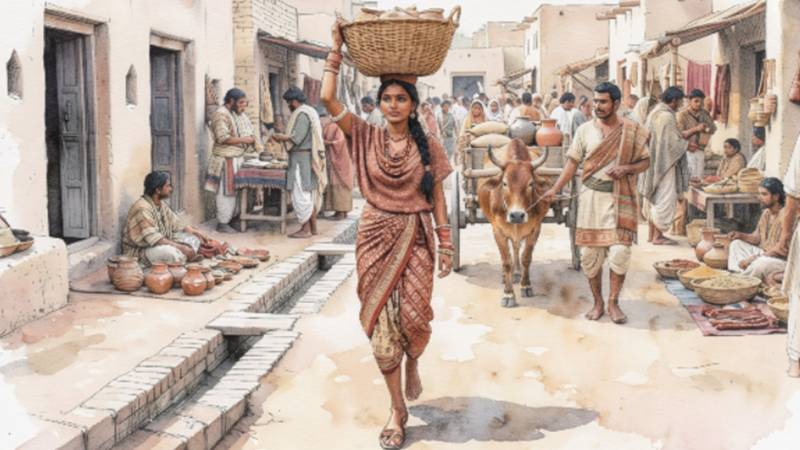
In 1934, Chaudhry Rehmat Ali, barrister, essayist and visionary from Cambridge, penned a thin volume named Pakistan: The Fatherland of the Pak Nation, in which he argued that the Indus region which was Pakistan had existed as an independent and distinct region from the rest of the subcontinent since the “dawn of history.” He was referring to the Indus Valley Civilisation as the forerunner of Pakistan.
Whenever Pakistanis try and claim the Indus Valley Civilisation as their own (and at no point has Pakistan ever disowned its 9,000-year history contrary to what our ill informed chatterati class would have you believe), there is a chorus from across the border in India as well as their camp followers in Pakistan saying that the idea of Pakistan has meant a negation of that. This is a terribly ignorant view both of history of the Indus as well as the Pakistan movement.
In 1947, Jinnah, the founding father of Pakistan, objected vociferously though unsuccessfully to the adoption of the name India by Hindustan or Bharat. To him there was no India without Pakistan. He was right from a purely historical point of view. Herodotus, who coined the term Indike or India, referred to the land around Indus as India. In fact, India is a derivative of the word Indus, and the Indus is a Pakistani river, not in Bharat or modern India.
We Pakistanis are a generous people. Therefore the people of Hindustan/Bharat can keep the name India but historical facts cannot be denied.
Pakistan's cultural heritage starts approximately 9,000 years ago from Mehrgarh: the Pakistan Movement was simply the latest layer of this history, but by no means the beginning
So what was Pakistan movement about? It was a revolt first and foremost against Hindu Zionism which believes in an Akhand Bharat from Afghanistan to Thailand. I use the term Hindu Zionism very deliberately because just like its Jewish and Christian cousins, Hindu Zionism is rooted in the idea that “this entire land belongs to us because our religion says so.”
United India has always been a fallacy. With the exception of brief periods under Asoka and Aurangzeb, Indian subcontinent was never one country and even under Asoka and Aurangzeb it was an empire. On the eve of British conquest, there were many political entities and as many 560 states big and small that made up the Indian subcontinent. British India, therefore, was an artificial colonial entity which existed from 1857 to 1947 and once the British bayonet was removed, it dissolved. Hindu Zionism which emerged as an intellectual force under the Empire as a result of British building up Hindus against Muslims, who had been the rulers of much of the subcontinent before them, is ultimately an exclusivist ideology though some of its key figures and thinkers like Gandhi and Nehru did try to put the lipstick of inclusivity on it. Ultimately though to Gandhi especially Hindus were the real owners of the land and Muslims and Christians mere minorities in a supposedly secular democratic framework. Could Indian subcontinent have emerged as a united country after the British left? Yes but that required a consociational framework.
Among the Hindu Zionists there were two distinct blocs: Gandhian/Nehruvian bloc which spoke of a composite nationalism in which “Mahatma” Gandhi and “Pandit” Nehru knew Hindus would always be the majority. Thus their version of “secularism/multiculturalism” was very convenient because far from guaranteeing the large Muslim minority (the largest Muslim population in the Islamic world) an effective say at the centre, it promised to make them a permanent cultural minority in perpetuity- the constitutional Cinderella status. Benign neglect of minorities in the name of faux secularism has never delivered justice for minority groups any where in the world. The United States of America today is a prime example because despite its religious, ethnic and cultural diversity and large immigrant populations, it remains a White Christian dominated state and has in fact hardened that paradigm under Donald Trump. Merely saying that everyone is now an equal citizen before the law does not do away with the human psychology that is tribal and seeks to exclude. So called composite nationalism of the Indian National Congress meant effacement, all in the name of an artificial colonial entity i.e. united India, which suited Hindu Zionism and its primeval millennial religious ambitions.
The second group of Hindu Zionists – ie Savarkar and his coterie – proposed something far less palatable in theory but far more honest: A complete constitutional subjugation of the Muslim nation by the Hindu nation in a united India. That is precisely what Modi is trying to bring about in India now. He has taken the Gandhian/Nehruvian mask off.
Arrayed against this idea of an Akhand Bharat were two historical forces: the memory of the Indus Valley Civilisation as a distinct cultural unit from the rest of India, and the strong sense of group identity that Muslims of this region had, be it in the then NWFP, Balochistan, Punjab or Sindh. Punjab was critical to this. Even if East and West Punjab were to unite today (and Punjab was divided at the insistence of Hindus and Sikhs it must be remembered) Punjabi Muslims vastly outnumber all other religious groups in Punjab put together. This is not accidental. It was Geography. Till the establishment of the Delhi sultanate in 1206, the conquerors from the west concentrated on the Indus, as far back as Alexander and Cyrus. Persian Empire before then colonised the Indus and not beyond.
So what is Pakistan’s cultural heritage and history? It starts approximately 9,000 years ago from Mehrgarh. It is the most layered history in the world. Therefore when we claim Indus Valley Civilisation as our own and go back all the way to Mehrgarh, there is no inconsistency. It is this history that has shaped the distinctness of the unit that is Pakistan. The Pakistan Movement was simply the latest layer but by no means the beginning. Nor was the coming of Muhammad Bin Qasim 712 AD the beginning, seminal event as it was.
It is this history that stood in the way of the very potent intellectual and political force of Hindu Zionism that emerged in the late 19th century. It is also this history that ultimately disassembled the colonial project called united India. Pakistanis have every right to be proud of their history and heritage since antiquity. No one can deny them their birthright.
As Chaudhry Rehmat Ali put it, Pakistan has been the fatherland of the Pak Nation since the dawn of history.