

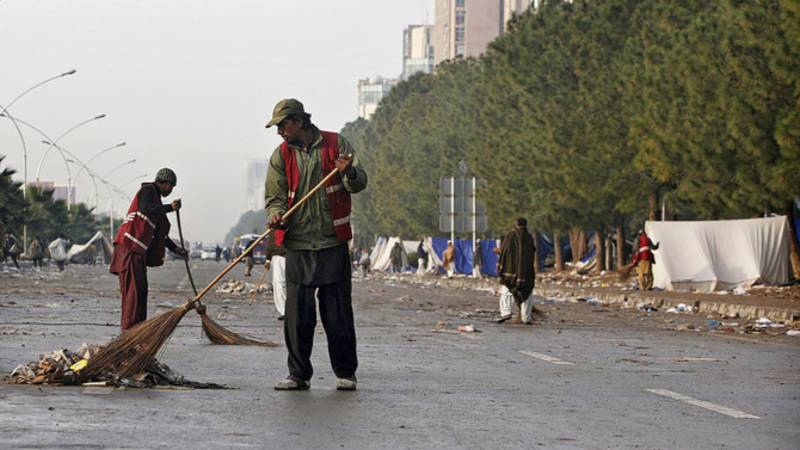
Sanitation workers are the unseen custodians of our cities. Without valuing their dignity and well-being, any ambition for climate resilience will remain hollow. Their struggle and our survival are bound together in a shared calling.
Sanitation workers keep our cities functioning, yet carry a burden most of us prefer not to see. They clear drains and collect litter so markets breathe and children play without wading through sewage. Their labour is essential but hidden. It is dangerous, poorly paid, and burdened by a shame our laws and institutions have tolerated for generations. This is not only a matter of dignity. It is also a matter of public health and climate resilience. We cannot expect cities to become more climate resilient while we treat the people who keep them clean as disposable.
Recent fieldwork and investigations make this clear. Amnesty International’s July 2025 report “Cut Us Open and See That We Bleed Like Them” documented interviews with sanitation workers across multiple districts in Pakistan and found routine denial of protective gear, short-term contracts, and systemic discrimination. The International Labour Organisation’s 2024 socio-legal study on sanitation in Lahore highlighted similar “decent work deficits,” including a lack of occupational safety, informal hiring, and exclusion from social protection.
These are not isolated findings. They describe how contracts are often structured to avoid regular employment and the obligations that come with it. Protective gear and training are rare. Women in the sector earn less and face more harassment. When a worker is injured, there is no safety net. When a drain is blocked and a city floods, the human cost falls first on the bodies of those sent to clear the mess with bare hands.
Stigma compounds these structural failures. Sanitation work is often caste-coded, pushing the most hazardous tasks onto religious and social minorities. Workers are called degrading names and excluded from public spaces. Institutions that should safeguard labour rights sometimes become part of the problem by outsourcing services to private firms that undercut safety to lower costs.
Outsourcing can increase operational speed, but it also creates layers of distance between municipal authorities, contractors, and workers, and that distance lets corners be cut without public scrutiny. Amnesty’s field interviews make painfully clear how social exclusion and contractual precarity combine to trap families in hazardous, low-pay work.
Fixing these problems requires policies that treat sanitation as a public service aligned with climate goals, and that draw on concrete examples of what works
While such an injustice is wrong in itself, it also damages the environment and deepens the climate crisis we all face. When waste collection is unreliable, garbage piles up in lanes and drains. Organic waste rots and releases methane, a potent greenhouse gas. Overflowing drains and choked sewers make urban floods worse during heavy rains and spread disease when contaminated water reaches homes.
When communities lack reliable collection, open burning becomes the cheap disposal option. Open burning pours toxic smoke into the air, harming respiratory health and adding to atmospheric pollution. Manual clearing of waste without mechanised support exposes workers to chemical and biological hazards that then enter waterways and soil. When waste is not separated at source, useful materials mix with hazardous items, and the entire system becomes harder to manage and more polluting.
Treating sanitation as disposable labour is therefore a governance failure with climate consequences. Systems that keep waste out of sight are the same systems that reduce emissions, limit smoke from burning, and prevent sewage from turning into urban floodwater. If we expect cleaner air and fewer urban floods, we must begin by valuing the custodians of the city.
Fixing these problems requires policies that treat sanitation as a public service aligned with climate goals, and that draw on concrete examples of what works. Municipalities should retain regulatory control, while contracting work should be structured in ways that protect workers and reward climate-smart practices. Contracts must require secure employment, personal protective equipment, training, wage guarantees, and pathways to access climate re-generation incentives.
Performance measures should reward reductions in open burning, improvements in drainage clearance, and increases in material recovery. Fiscal incentives can encourage contractors and private firms to invest in mechanised cleaning equipment and decentralised composting that turns organic waste into useful products. Citizen reporting and community monitoring should be formal parts of oversight so local people can hold service providers to account.
There are models we can learn from. In India, the Pune waste cooperative SWaCH has shown how integrating waste pickers into formal city systems, with training and defined roles, improves collection and recycling while raising incomes for workers. In Dhaka and other South Asian cities, small community composting initiatives have reduced local waste volumes and provided fertiliser to neighbourhood parks and farms.
Internationally, the Zabbaleen community in Cairo has long run an informal but highly effective door-to-door recovery system, demonstrating how local organisation can achieve high material recovery with low emissions when supported rather than marginalised. These are practical precedents for integrating sanitation work into climate-sensitive waste management systems rather than relegating it to the margins.
Sanitation workers do not need our pity. They need laws that protect them, contracts that secure their wages, equipment that shields their bodies, and public recognition that their work is essential to the health of the city and the climate
Legal reform must begin with formal recognition of sanitation work in provincial labour codes. Extending labour rights to these workers would make a tangible difference, especially if occupational safety rules were binding and consistently enforced rather than token inspections. Employers must be obligated to provide protective gear, gas detection devices, and emergency response training. These measures are not technical details; they determine who is protected from injury, who lives longer, and who can continue supporting their families. Stronger protections also mean fewer accidents, less disruption of waste systems, and more reliable climate-sensitive service delivery.
Anti-discrimination laws that prohibit caste- and religion-based exclusions would reduce the concentration of hazardous jobs among already marginalised groups. This is not only about fairness. It is about climate resilience too. When protections are extended and discrimination challenged, the workforce becomes more stable, and waste systems function more effectively, reducing practices like open burning that worsen air pollution.
Cultural change reinforces the legal framework. Language matters. Replacing degrading titles with respectful descriptions signals dignity and shifts behaviour. In Pakistan, UNICEF’s sanitation campaigns under the Pakistan Approach to Total Sanitation encouraged communities to adopt terms like “Safai Karmi” or “Safai Wala Bhai/Behen,” linking respect with healthier practices.
In India, the Pune-based SWaCH cooperative showed how waste pickers, once stigmatised, gained recognition as “service providers” when integrated into city systems, improving recycling and reducing open burning. Globally, UN Water’s World Toilet Day campaigns have highlighted sanitation workers as essential to climate and health, reframing them from invisibility to civic pride. Schools, media, and civic initiatives should build on such examples to portray sanitation workers as central to public health and climate resilience. Valuing them strengthens the very systems that safeguard our air, water, and climate.
Waste management must be reshaped with climate and dignity in mind. The first step is simple: households separating organic scraps from plastics and hazardous waste. Organic matter can be diverted to composting or to small anaerobic digesters.
Anaerobic digestion means letting organic waste decompose without oxygen in a sealed container; as it breaks down, it produces biogas that can be used for kitchens or to power local equipment. Local compost hubs can supply city parks and nearby farms with natural fertiliser, while digesters generate usable energy. These steps reduce the methane released by waste rotting in the open and cut the incentive to burn trash.
Climate policy often focuses on technology and finance. Those are necessary but not sufficient. Technology will fail if the workforce is casual and unsupported, if waste streams are contaminated by hazardous mixing, or if communities resort to open burning because they lack alternatives. Investing in dignified employment, training, and protective equipment delivers multiple returns. It reduces emissions, clears drains before the monsoon, protects groundwater, and improves public health. Localised, people-centred systems multiply the benefits of any technological investment.
This is not a call for charity. It is a call for systemic thinking and instilling strong political will. Sanitation workers do not need our pity. They need laws that protect them, contracts that secure their wages, equipment that shields their bodies, and public recognition that their work is essential to the health of the city and the climate. When we secure their rights and redesign waste systems around dignity and emissions reduction, we protect everyone. Clean air, safer streets, fewer floods, and cooler cities begin with how we treat those who clean up after us. They clean our cities every day. It is time we clean up the systems that exploit them.