

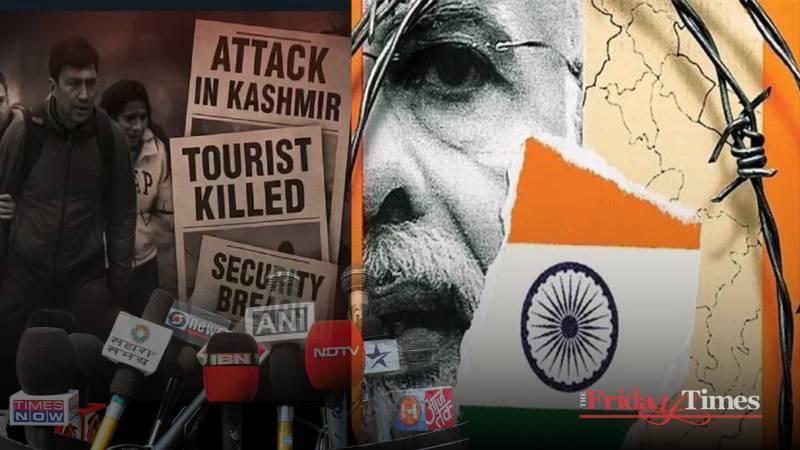
What’s playing out on Indian national television is not journalism – it is a circus in which anchors act like street jesters and ridicule serious issues with reckless theatricality. Gone are the days when cinema or stand-up comedy served as our go-to escape; as for now, it's the Indian news channels that wear the crown of theatrical mastery, broadcasting more drama than Bollywood ever dared. With more twists and turns than a soap opera and more fiction than a fantasy novel, India’s so-called "newsrooms" have transformed journalism into a "circus of hysteria." Their star journalists don't just report the news; they audition for drama, focusing more on showcasing their acting skills. This is followed by exaggerated gasps, wild screaming in dramatic tones, mindlessly repeating lies, and spinning each fabricated tale that even Bollywood scriptwriters would clutch their heads in despair.
This is not the first time the Indian media has descended into a frenzy of theatrics. In fact, we have watched this script unfold before. Back in 2019, when national security decisions in India were influenced more by political rhetoric than by clear, verified facts, the Indian media followed the same pattern as in the current scenario following the Pahalgam incident. Please forgive me, but as I write this, a serious question comes to my mind: Is journalism even taught as a subject in Indian universities? Or do these "journalists" simply take a crash course at an acting school before joining news channels?
Quite frankly, it's as if these Indian news channels have become theaters, and these "journalists" are the "clowns" performing there. And if you find this hard to believe, just pause for a moment and compare this media spectacle with the gravitas of CNN, BBC, Al Jazeera, or any other international news channel. The difference becomes clear: This is what serious newsrooms look like, this is what real journalism should be. More specifically, it highlights the stark contrast between a newsroom and a theater stage, between informing the public and entertaining a mob.
In a span of just four days, India's trajectory has spiraled downward: from aggressor to exposed hypocrite, denigrating allies, losing pilots, falsifying narratives, and clinging to the fragments of international sympathy
Furthermore, I am truly surprised that the tragic deaths of 26 innocent tourists in the Pahalgam incident should have prompted national mourning for the Indians, followed by a thorough and impartial investigation. Instead, the Indian media quickly turned this into a political blame game and a media-fueled storm of war hysteria, supporting premature accusations against Pakistan. A few hours after the incident, Indian Home Minister Amit Shah accused Pakistan, declaring: “Pakistan must pay a price for every act of terrorism.” And without waiting for credible evidence from investigations, this statement immediately resurfaced on all Indian media platforms and television screens, and any reasonable attempt at restraint was forgotten.
In light of the recent India-Pakistan stand-off, their headline alone, accusing China and the US of launching a propaganda campaign because the Indian armed forces allegedly imposed "heavy costs" on Pakistan, reads as if it were written in the midst of a psychotic episode. Surprisingly, within five minutes, they blamed three world powers for India's humiliation, claimed missiles failed because they did not detonate, and cited unconfirmed airstrikes as "proof" of success, without providing any imagery, BDA, or signal confirmation. They even spun the Rafale losses as a Western conspiracy to sell jets, as if Delhi’s credibility collapsed because of Lockheed Martin, not its incompetence. But here’s the catch: when your definition of "victory" hinges on delusion, inventing conspiracies, and airing fabrication on national television, you’re not controlling the narrative, you’re confessing to losing it.
And whether you like it or not, the world saw the reality: JF-17s sliced through the S‑400 like a phantom blade, each CM‑400AKG warhead exposing Delhi’s hollow posturing. A living proof that bravado cannot buy you control. India’s iron fist now quivers with uncertainty, every manoeuvre echoing panic. A sight not seen before. When your crown jewel air defense system is neutralised and your borders feint-checked into paralysis, it is not a battle lost. It is sovereignty that is bleeding at the edges.
More importantly, several western analysts are now admitting what Delhi cannot: “Pakistan owns the skies”. India’s attempted barrage on Nur Khan, Murid, and Rafiqui was totally ineffective, a clear showcase of impotence rather than power. The Pakistan Army’s systematic and integrated counterstrike, by contrast, destroyed Indian military targets from Bhuj to Udhampur. More so, even CNN could not hide the obvious: Pakistan had hit India so hard that India agreed to a ceasefire. It wasn't a negotiation; it was a surrender. Plain and simple. And the markets reacted with surgical instinct— NIFTY fell by 0.8 percent, banks collapsed, and Delhi's credibility went up in smoke.
In a span of just four days, India's trajectory has spiraled downward: from aggressor to exposed hypocrite, denigrating allies, losing pilots, falsifying narratives, and clinging to the fragments of international sympathy. Pakistan barely spoke and won everything.